
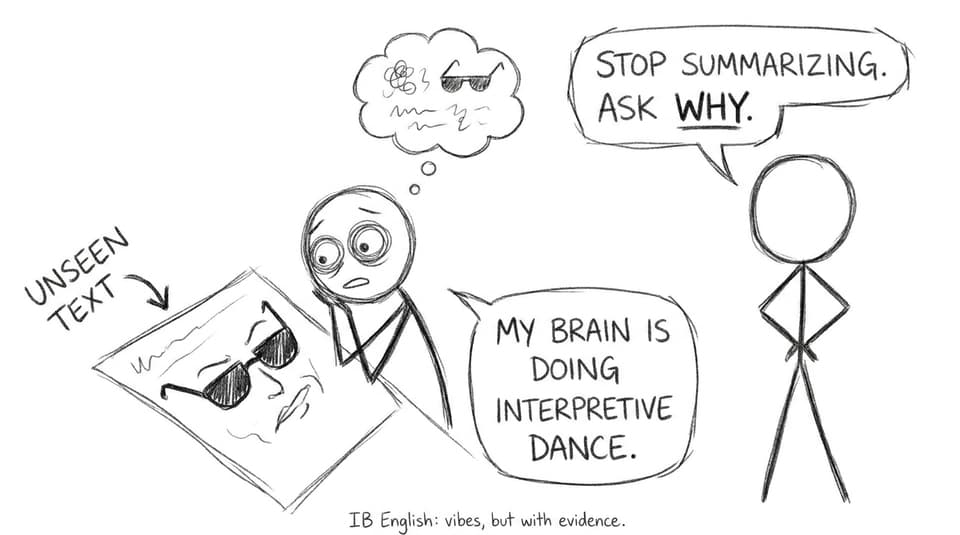
In the exam room, the unseen text can feel like it has a personality. It sits there calmly, while your mind starts sprinting. The students who score highly in IB English Paper 1 aren’t calmer; they’re simply trained to look for the same few things, in the same order, every time.
That’s the real trick to analyzing language and style in unseen texts: you don’t “wait for inspiration.” You run a method. And when you run a method, your analysis starts sounding like you know exactly what you’re doing (because you do).
A fast Paper 1 checklist (save this for every IB English unseen)
Use this as your 5-minute setup before you write a word:
-
Identify text type (speech, article, ad, blog, extract) and any obvious context clues
-
Name the purpose (persuade, inform, criticize, entertain, reflect)
-
Define the audience (who is meant to agree, buy, fear, admire?)
-
Spot 2-3 dominant stylistic patterns (tone, imagery, structure, diction, syntax)
-
Build a thesis that links style to purpose: How does the writer’s language create the intended response?
If you want a bigger, exam-ready structure for IB English Paper 1, keep Step-by-Step Guide to Revising IB English Paper 1 open when you practice.
What “language and style” really means in IB English
In IB English, “language” is the choices (words, phrases, sentence shapes). “Style” is the signature those choices create (voice, tone, rhythm, attitude). Together, they answer the examiner’s favorite silent question: Why this, and why now?
A strong Paper 1 response usually returns to the same core areas:
Diction and connotation
Not just “formal” or “informal.” Ask: what emotional baggage do the words carry? Who benefits from that emotional framing?
Syntax and rhythm
Short sentences can punch. Long sentences can persuade, overwhelm, or soften. In IB English, syntax is often where urgency or control is hiding.
Tone and register
Tone is the writer’s stance: respectful, bitter, playful, intimate, detached. Register is how “public” or “private” the voice feels.
For a tone-focused deep dive, use Understanding Tone in IB English Language & Literature.
How to analyze language and style in unseen texts (the method)
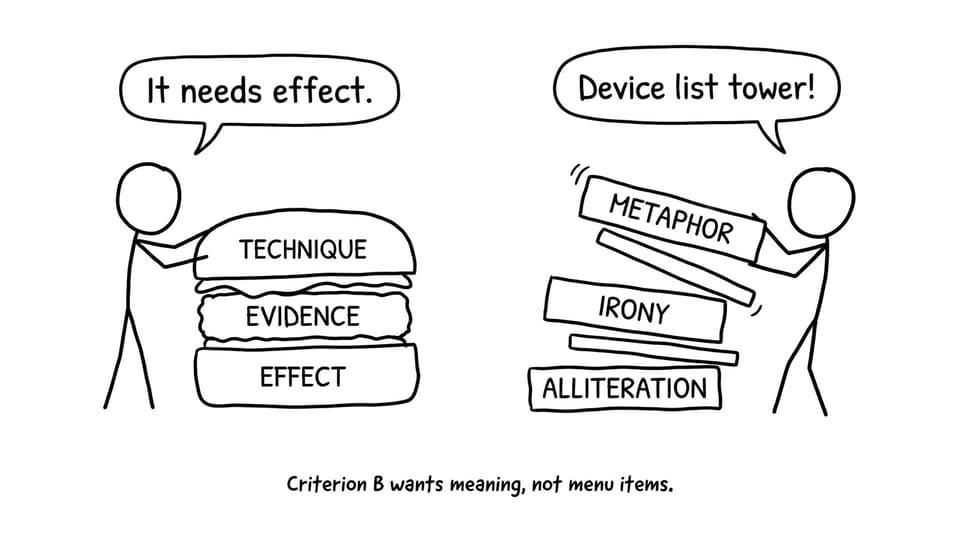
The easiest way to sound sophisticated in IB English is to keep repeating one loop: feature, then evidence, then effect, then purpose.
Notice what feels “deliberate”
Underline only what looks designed: repeated pronouns, surprising metaphors, a sudden shift from calm to aggressive, a sentence that’s weirdly short.
Then ask one powerful question: What response is the writer trying to trigger here?
Name the technique precisely (but don’t show off)
Precision helps you control the paragraph. “Emotive diction” beats “strong words.” “Parallelism” beats “repetition.” If you want a quick technique bank for IB English, see Mastering Literary Devices in IB English Exams.
Explain the effect like you’re describing a reaction
Instead of “This creates imagery,” try: This sensory detail makes the situation feel physically uncomfortable, pushing the reader toward the writer’s disgust.
Link back to audience and purpose
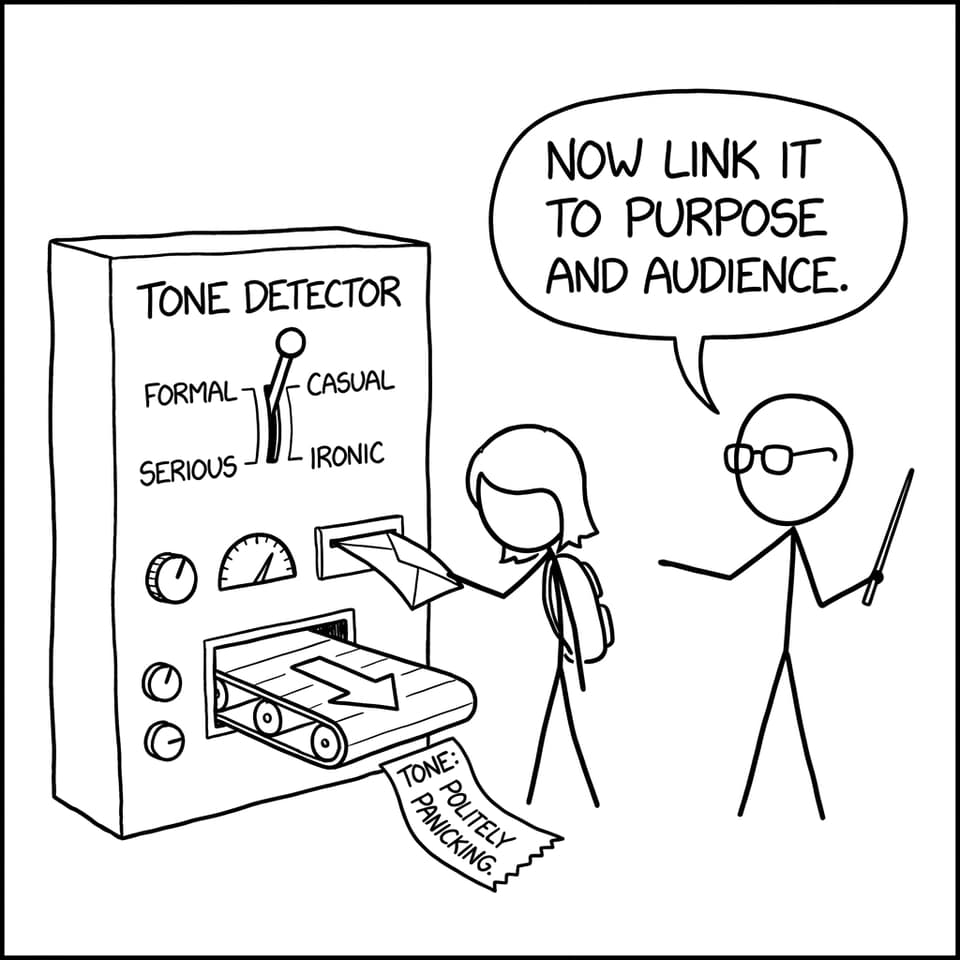
This is where many IB English students lose marks: they stop at “effect” and forget “intent.” Always finish with: So what does this help the writer achieve?
If you want a full success framework, IB English Paper 1 Success Guide: 7 Expert Strategies pairs well with timed practice.
Write paragraphs that don’t collapse under pressure
Paper 1 rewards controlled writing. Use PEEL to keep your analysis from turning into a device list.
-
Point: the claim about the writer’s choice
-
Evidence: a short quote (one phrase is often enough)
-
Explain: how it works + why it matters
-
Link: back to thesis and purpose
For a clean template and examples, use Writing Analytical Paragraphs: PEEL Method for IB English A.
Practice faster with RevisionDojo tools (and make IB English feel predictable)
The calmest IB English students usually have the most repetitions.
On RevisionDojo, you can build that repetition without guessing what to do next:
-
Use the IB English A Lang & Lit Resources hub to organize your Paper 1 prep.
-
Drill unseen texts with targeted prompts in the English Paper 1 course.
-
Check your structure using the IB English Language and Literature Paper 1 Grader and tighten weak paragraphs.
-
Build memory for recurring mistakes with Flashcards, reinforce concepts with Study Notes, and run timed Mock Exams with the Exam Builder.
-
When you’re stuck, use AI Chat to test thesis ideas or generate alternative readings, then decide what you truly believe.
If you want a broader prep loop, read Best Ways to Prepare for IB English Paper 1.
Closing: make the unseen text feel seen
Unseen texts aren’t random; they’re built. And in IB English, your job is to show that you can see the building: the choices, the patterns, the pressure points where language nudges the reader.
If you want that skill to become automatic, practice with RevisionDojo’s Questionbank, Study Notes, Flashcards, AI Chat, Grading tools, Predicted Papers, Mock Exams, and Coursework Library, and bring your next Paper 1 response closer to top-band control.