
A comparative essay can feel like trying to hold two thoughts in your head while the clock loudly clears its throat. You know your texts. You know the themes. But in IB English, Paper 2 isn’t a memory test dressed up as analysis. It’s a decision test: can you keep choosing comparison over comfort, argument over summary, craft over plot?
The strongest Paper 2 essays don’t sound “fancy.” They sound inevitable. Each paragraph makes a claim about both works, then proves it by showing how authorial choices create meaning. If you learn a repeatable process, you stop hoping inspiration arrives and start writing like you expected to do well.
IB English Paper 2 quick checklist (save this)
Before you write a single sentence in IB English, confirm you can do these seven things:
-
Pick the prompt you can genuinely argue using both works.
-
Rephrase the prompt into one clear task.
-
Write one comparative thesis using while/but/whereas.
-
Choose 2-3 comparative angles (theme + technique, not theme-only).
-
Plan point-by-point paragraphs that include both texts every time.
-
Use short, accurate micro-evidence (moments, images, phrases).
-
Keep balance: similar depth for both works in each paragraph.
If you want an overview of what Paper 2 expects, start with Structuring Your IB English Paper 2 Essay and then keep this guide open as your writing routine.
Step 1: Choose the prompt (and let it choose your texts)
In IB English, Paper 2 rewards selection as much as skill. Your best prompt is the one that lets you compare methods clearly: narrative voice, structure, symbolism, characterization, tone, setting, irony.
A practical test: can you name one strong similarity and one strong difference between your two works in under 20 seconds? If not, pick another prompt.
For fast prompt practice, use RevisionDojo’s IB English A Lang & Lit English Paper 2 Questionbank. It trains you to spot which questions naturally fit your text pair, which is half the battle in IB English.
Step 2: Build 2-3 comparative angles (theme plus technique)
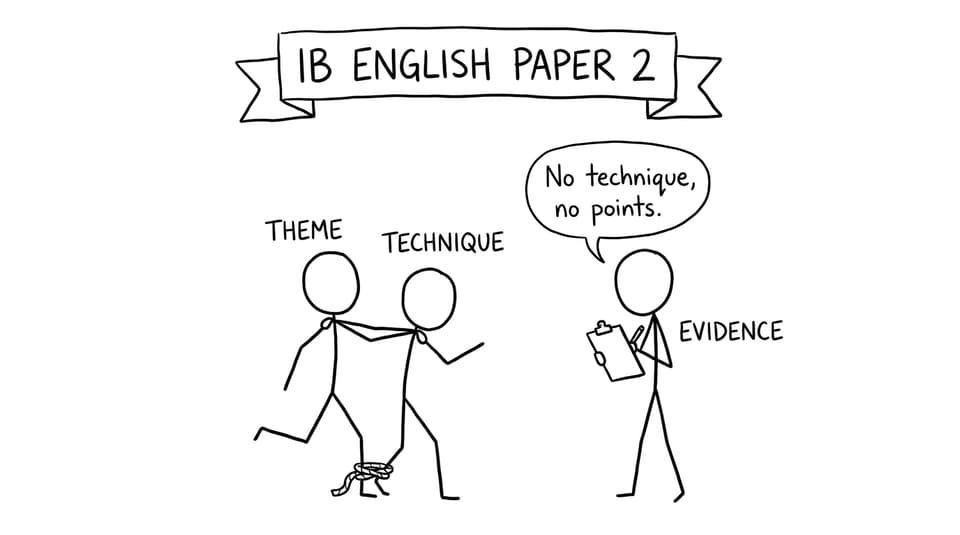
Most students plan by theme only: “power,” “identity,” “conflict.” Examiners can’t award high marks for theme announcements. You need theme + how it’s made.
Try this planning template:
-
Angle: the idea you’re comparing (e.g., control through fear vs. comfort)
-
Text A method: technique + effect (e.g., oppressive setting + clipped syntax)
-
Text B method: technique + effect (e.g., satirical tone + structural repetition)
-
So what: what the comparison reveals about the prompt
If you want a clean way to sort ideas, this breakdown helps: Comparative Essay Planning: Theme vs. Form vs. Content.
Step 3: Write a comparative thesis that actually argues
A strong IB English thesis doesn’t say “Both texts explore…” and stop. It makes a comparative claim that names a relationship and implies a method.
Use a “while/but/whereas” frame:
- While Text A presents X as __ through __, Text B portrays X as __ through __, suggesting __ about the prompt.
Need more help making it specific (and not just a theme label)? See IB English: What Makes a Good Thesis Statement?. A thesis is your promise to the examiner. Everything else is keeping it.
Step 4: Use point-by-point paragraphs (not block structure)
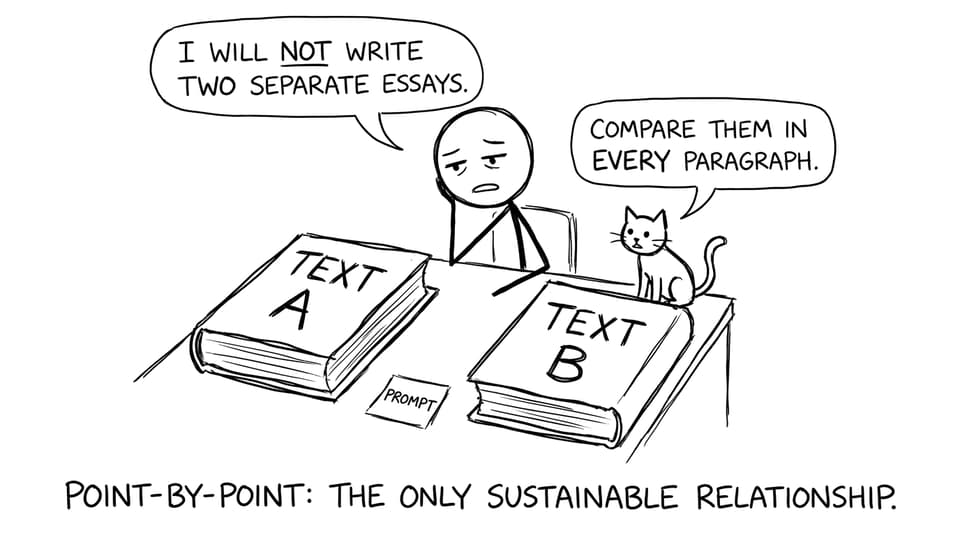
Block structure feels safer: write about Text A, then Text B. But it often becomes two mini-essays with a weak “compare” sentence stapled on at the end. In IB English, that’s where marks quietly disappear.
Instead, build each paragraph like this:
-
Comparative claim (about both texts)
-
Evidence + method (Text A)
-
Evidence + method (Text B)
-
Synthesis: what the contrast/similarity reveals
-
Link back to the prompt and thesis
If you struggle to keep both works present, practise with this: How Do You Write a Comparative Paragraph?. It’s one of the fastest upgrades you can make for IB English Paper 2.
Step 5: Use micro-evidence you can recall under pressure
Paper 2 is from memory. That doesn’t mean you need long quotations. It means you need reliable evidence: short phrases, recurring images, turning-point scenes, structural choices.
A good rule for IB English revision: learn 5-7 flexible quotes or “quote fragments” per text, each tied to a technique word (imagery, motif, irony, narrative perspective, juxtaposition). Then practise inserting them into different prompts.
RevisionDojo makes this easier because you can pair your practice with tools that mimic exam conditions: build sets in the Questionbank, turn your evidence into Flashcards, and test recall with AI Chat when you’re stuck on how to phrase analysis. If you want guided practice, the platform’s Tutors can also help you turn “I kind of get it” into a repeatable method.
Step 6: Manage time like it’s part of the argument
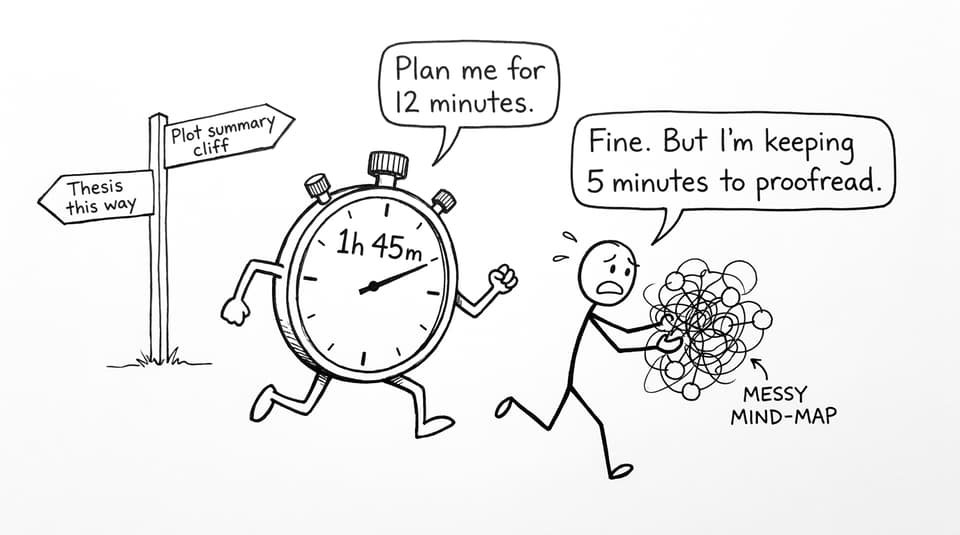
Most Paper 2 stress comes from writing too soon. Planning feels slow, but it prevents panic paragraphs.
A workable IB English split:
-
10-15 minutes: choose prompt, thesis, 2-3 angles, paragraph plan
-
70-80 minutes: write (staying comparative every paragraph)
-
5-10 minutes: edit for clarity, balance, and prompt focus
If you want a pressure-tested routine, read How to Prepare for the IB English Paper 2 Exam Under Time Pressure.
Closing: make comparison your default setting
The best IB English Paper 2 essays aren’t powered by last-minute motivation. They’re powered by a simple habit: every time you make a point, you immediately ask, “What is the other text doing with this idea, and how?” That one question turns knowledge into comparison, and comparison into marks.
If you want a place to practise this method until it feels automatic, RevisionDojo is built for it: the Questionbank for prompt training, Study Notes for technique-based recall, Flashcards for evidence, AI Chat for quick feedback, and Mock Exams plus Predicted Papers to rehearse under realistic pressure. In IB English, confidence is rarely a personality trait. It’s a system you can repeat.