
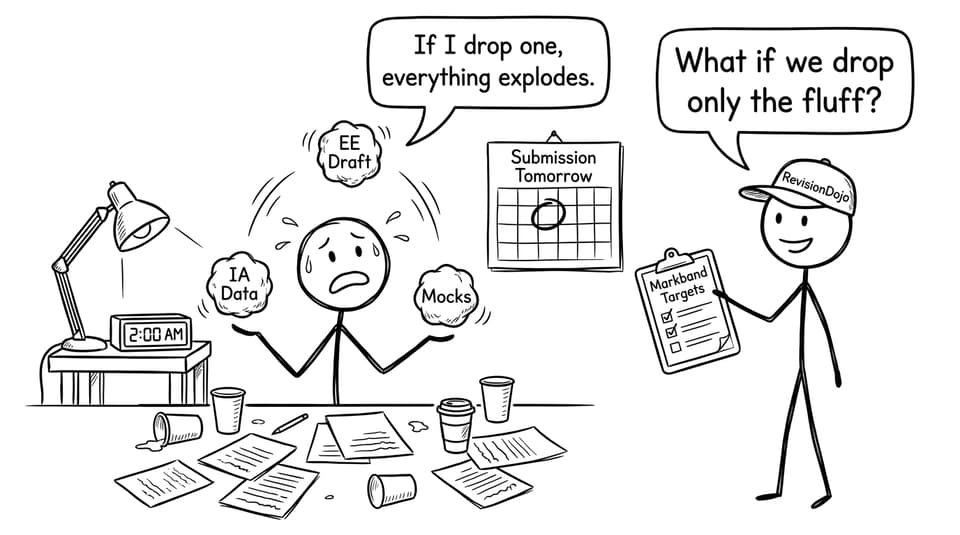
A week before submission, most students do the same strange thing: they reread their work and suddenly see it like an examiner would.
The paragraph that felt “detailed” becomes “descriptive.” The research question that sounded “interesting” becomes “too broad.” And the formatting you promised you’d fix “later” becomes an entire afternoon.
This is exactly where IB Extended Essay markbands stop being abstract and start being useful. Markbands are the IB’s way of saying, “Here is what quality looks like, in levels.” If you learn to read them like a map (instead of like a judgement), you can plan smarter drafts for both your EE and your IAs.
What IB markbands are (and why they feel confusing at first)
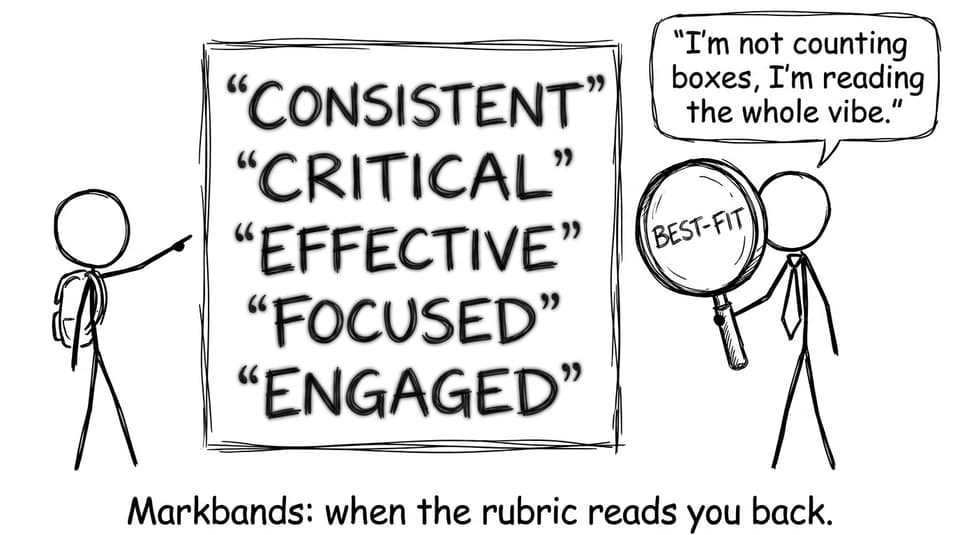
Markbands are performance levels tied to descriptors. Instead of earning points for ticking tiny boxes, you’re placed into the band that best matches the overall quality of your work, then awarded a mark inside that band.
That “best-fit” logic matters because it changes how you revise:
-
You fix the biggest bottleneck first (focus, argument, evaluation)
-
You stop polishing sentences that won’t move the band
-
You learn what the IB means by words like “effective,” “consistent,” and “critical”
If you want a deeper vocabulary for examiner language, use the EE Extended Essay Glossary: Key Terms for the 2027 Guide and keep it open while editing your IB Extended Essay.
Quick checklist: how to aim for top markbands (EE + IA)
Before you rewrite anything, run this fast check:
-
Focus: Is your question narrow enough to answer with real evidence?
-
Method: Can a reader follow what you did and why it fits the subject?
-
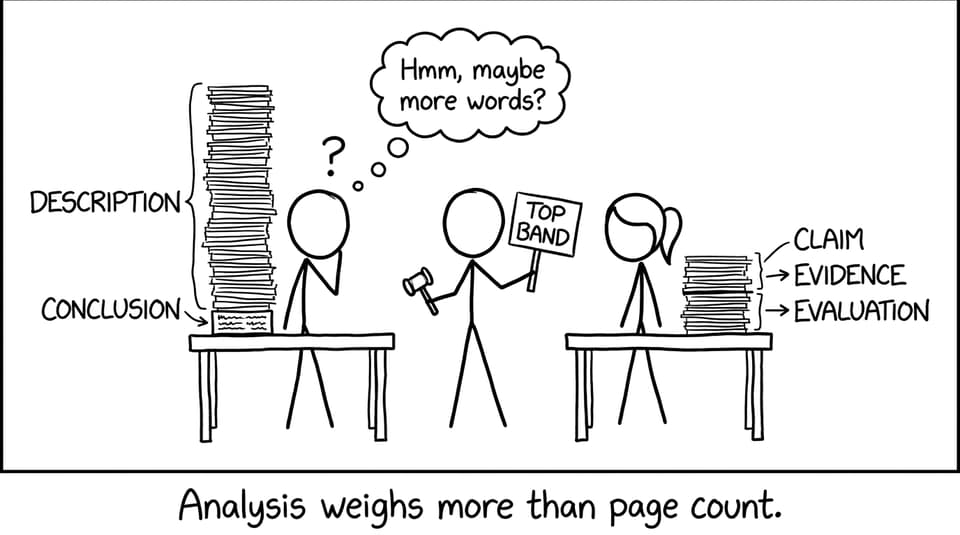
Analysis: Are you explaining meaning, not just reporting facts?
-
Evaluation: Do you discuss limits, alternatives, and trade-offs?
-
Presentation: Is your structure clean, referenced, and easy to navigate?
-
Engagement: Do your reflections show decisions, not just feelings?
RevisionDojo helps you turn this into a repeatable workflow using Study Notes, Flashcards, AI Chat, and the Grading tools so your drafting cycles stay anchored to markbands, not anxiety.
IB Extended Essay markbands: what examiners are really scoring
The IB Extended Essay is assessed through five criteria:
-
Focus and Method
-
Knowledge and Understanding
-
Critical Thinking
-
Presentation
-
Engagement
Markbands exist within each criterion. That means you can have a strong topic but still land in a mid band if your method is unclear, your argument is thin, or your reflection reads like a diary instead of a research record.
To ground yourself in how points convert to grades, see IB Extended Essay 2025 Grade Boundaries Guide. And if you want an organized hub while you work, bookmark IB Extended Essay Guides plus All IB Extended Essay Posts.
What top-band EE work tends to have in common
High markbands look different across subjects, but the same patterns show up again and again:
-
A research question with boundaries you can actually defend
-
A line of argument that develops (not a list of sources)
-
Evaluation that is integrated into the body, not dumped at the end
-
Evidence that is interpreted, challenged, and compared
If you’re still in the messy middle of the process, How to Survive the IB Extended Essay Research Process is a steady guide back to what matters.
IA markbands: similar logic, different emphasis
Internal Assessments also use markband rubrics, but criteria vary by subject.
-
In sciences, you’ll often be rewarded for method quality, data processing, and evaluation of limitations.
-
In humanities, you’ll often be rewarded for the logic of your argument, evidence selection, and interpretation.
-
In languages, you’ll often be rewarded for analysis of author choices, global issue focus, and coherent structure.
If you need a clear starting point for your subject, go to IB IA Guides: Internal Assessment Structure, Rubrics & Tools. For a concrete example of markband language in action, read the Language A Internal Assessment (IA) Rubric.
How to read a markband rubric like a strategist
Most students read rubrics like this: “What do I need to include?”
Top students read rubrics like this: “What level of thinking is the IB describing?”
Here’s the trick: highlight the qualifier words in the top band and translate them.
-
“Consistent” often means your argument doesn’t disappear for two pages.
-
“Critical” often means you test claims against alternatives.
-
“Effective” often means your method and evidence match your question.
Then revise in this order:
-
Fix focus (research question, scope, thesis)
-
Fix thinking (analysis and evaluation)
-
Fix structure (headings, signposting, paragraph logic)
-
Fix polish (citations, phrasing, formatting)
RevisionDojo’s AI Chat is ideal at step 2: you can ask, “What is the weakest link in my argument for Criterion C?” and get targeted revision actions instead of vague encouragement.
Strategies that reliably lift you into a higher markband
A higher markband is rarely a mystery. It’s usually the result of doing the hard, unglamorous upgrades.
Build evaluation into the skeleton, not the conclusion
For the IB Extended Essay, evaluation should show up throughout: why this source, why this method, why this interpretation, what else could explain it. When evaluation is only in the final paragraph, examiners read it as an add-on.
Use exemplars to calibrate “enough”
When you’re unsure what the top band looks like, you don’t need more motivation. You need a model.
Use IB Coursework Examples: IA, EE and TOK Exemplars to compare structure, density of analysis, and how students discuss limitations without collapsing their argument.
Practice the thinking you’re being rewarded for
Your coursework doesn’t exist in a vacuum. Exam performance and coursework quality rise together when your skills improve.
Use RevisionDojo’s Questionbank to practice command terms like analyze and evaluate, then bring that same thinking back into your IA and IB Extended Essay paragraphs. The platform’s Mock Exams and Predicted Papers help you pressure-test your clarity under time.
Common pitfalls that drop work into lower markbands
Most mark losses are not dramatic failures. They’re quiet, repeated habits.
-
Writing that summarizes sources instead of arguing with them
-
A research question that asks for everything, so you prove nothing
-
Method sections that describe steps but don’t justify choices
-
Reflections that say “I learned a lot” but don’t show decisions
-
Formatting and citations that look rushed, undermining credibility
If you want a focused list of mistakes (and how to fix them), read Mistakes to Avoid in IB Extended Essays.
How RevisionDojo helps you use markbands without guessing
A rubric is only useful if you can apply it. RevisionDojo makes markbands practical through:
-
Grading tools that align feedback to rubric criteria (so revisions target marks, not vibes)
-
A Coursework Library where you can study what high-scoring structure actually looks like
-
Study Notes and Flashcards to keep subject knowledge sharp while drafting
-
AI Chat to translate examiner language into concrete actions
-
Tutors when you want a human second set of eyes before final submission
For point planning, the IB Grade Calculator is a helpful reality check while you allocate time between IAs, the IB Extended Essay, and exam prep.
Closing: make markbands your unfair advantage
Once you understand markbands, your coursework stops feeling like a mystery and starts feeling like engineering. You make choices that move criteria, not just word count. You build evaluation into your argument, not into your panic.
If you’re working on an IB Extended Essay right now, use RevisionDojo to turn your next draft into a markband upgrade: browse exemplars, run criterion-level feedback with the Grading tools, and use AI Chat to fix the one weakness that’s holding your whole essay back. When the rubric becomes your plan, scoring high stops being luck.