

If you’ve ever tried to feel calm by “just checking the timetable,” you already know the trick: the moment you see IB English scheduled early, your brain starts doing maths it was never taught.
Not the good maths, either. The kind where one Paper 1 becomes “I should have started months ago,” and one Paper 2 becomes “I will simply not sleep again.”
In the May 2026 session, IB English A papers are often placed early in the exam window (depending on your exam zone), which makes planning less about motivation and more about timing. Literature and Language & Literature can feel like two different worlds in class, but when exam season arrives, they move with the same unstoppable rhythm.
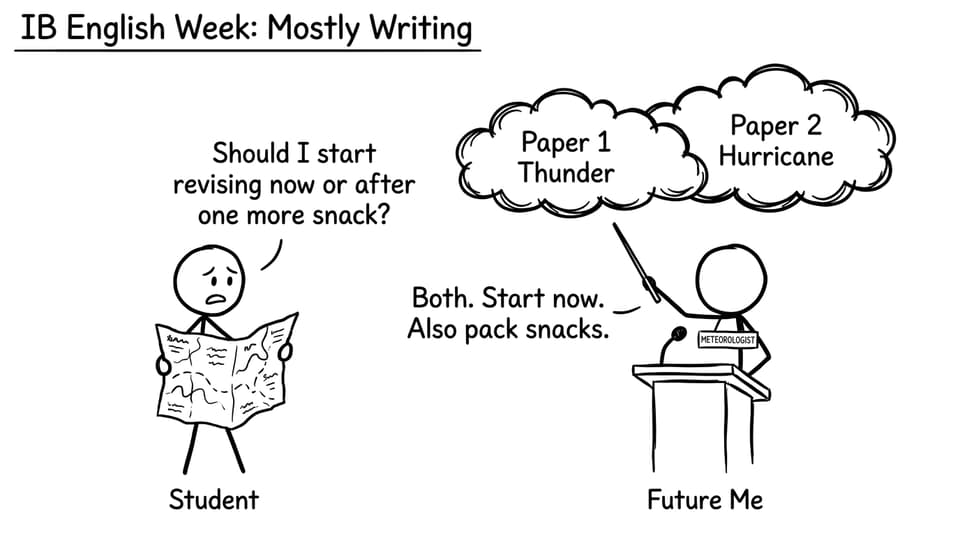
IB English A May 2026 timing: what you actually need to know
Here’s the practical overview students are usually searching for:
-
Literature and Language & Literature are scheduled at the same time for fairness (same paper windows, different prompts/texts).
-
Your school’s official timetable and your IB exam zone decide the exact start time.
-
Expect Paper 1 and Paper 2 to be close together within the session, so you need two separate preparation tracks.
-
Because these are writing-heavy papers, energy management matters as much as content.
To place your English papers inside the full month, start with the broader timetable guide: IB May 2026 Exam Schedule: Full Timetable, Dates, and Planning Guide.
IB English A: Literature vs Language & Literature (what’s different, what’s not)
The most reassuring truth is also the most annoying one: IB English doesn’t reward the student who “knows the most.” It rewards the student who can build a clean argument under time.
English A: Literature
Literature is built around literary works and the habits of close reading:
-
interpreting authorial choices in novels, plays, poems
-
writing essays that stay analytical (not summary)
-
using brief evidence with sharp commentary
If you want a clear exam-focused pathway, RevisionDojo’s Literature guidance is a strong anchor point: Preparing for IB English A: Literature Exams.
English A: Language & Literature
Language & Literature widens the lens. You still study literary works, but Paper 1 often asks you to read the world too:
-
non-literary texts (speeches, ads, journalism, digital texts)
-
purpose, audience, context, and persuasion
-
analytical writing that connects technique to intended effect
RevisionDojo’s course hub gives you an at-a-glance map of how this version of IB English is structured: IB English A Lang & Lit Resources.
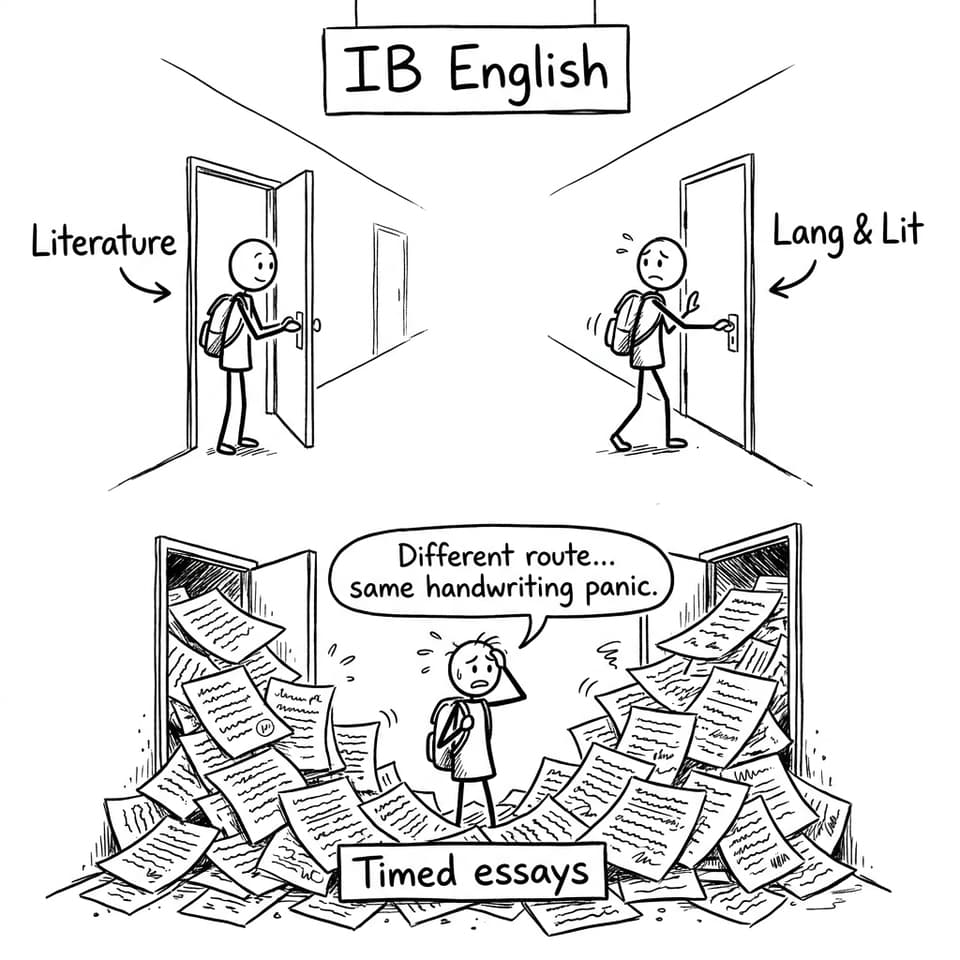
IB English A exam structure (May 2026): the shared skeleton
Even though the courses feel different, the exam architecture is famously similar.
Paper 1 (both courses)
Paper 1 is unseen analysis. That means your revision can’t be only “knowing texts.” It has to be training a repeatable method.
-
In IB English A Literature, Paper 1 focuses on unseen literary analysis.
-
In IB English A Lang & Lit, Paper 1 may include non-literary and/or literary analysis (format depends on route/level).
If Paper 1 is the part that spikes your stress, keep a method-based guide open while you practise: IB English Paper 1 Revision: A Step-by-Step Guide. For language-level precision, this helps too: Close Reading Techniques for Prose and Poetry.
Paper 2 (both courses)
Paper 2 is a comparative essay on studied works. This is where students discover the difference between “I remember the plot” and “I can compare authorial decisions.”
A strong Paper 2 plan has:
-
a thesis that contains similarity + difference
-
paired moments you can recall quickly
-
method-focused comparisons (structure, voice, imagery, characterization)
For a clear breakdown of what Paper 2 expects in IB English, use: IB English Paper 2 Structure: Lang & Lit Guide and then sharpen your comparisons with: Thematic Comparisons Across IB Prescribed Texts.
IB English A exam dates May 2026: where the pressure comes from
RevisionDojo’s May 2026 schedule guides highlight a pattern students feel every year: language papers are commonly early in the session, and papers within the same subject often sit close together.
That’s why “I’ll revise after exams start” tends to collapse for IB English. When Paper 1 arrives early, it doesn’t ask what you intended. It asks what you trained.
To understand why week placement matters (and how to read it properly), pair these guides:
How to revise IB English for May 2026 without burning out
The best IB English revision plans are boring in the right way. They separate skills, repeat them weekly, and remove decision fatigue.
A simple 2-track plan (Paper 1 vs Paper 2)
Track 1: Paper 1 (unseen) -- 2 sessions/week
-
15 minutes annotation under time
-
25 minutes write 1--2 body paragraphs
-
10 minutes upgrade one paragraph (better topic sentence, tighter evidence, clearer effect)
Track 2: Paper 2 (studied) -- 2 sessions/week
-
build a “comparison bank” (themes + methods + 6 moments per text)
-
practise introductions and thesis lines
-
outline full essays before writing full essays
To keep your routines realistic, borrow structure from: IB English Study Techniques That Actually Work and Effective Note-Taking Strategies for IB English.
Use RevisionDojo to turn effort into feedback
When you’re preparing for IB English, practice only helps if you can see what to improve.
RevisionDojo gives you a full loop:
-
Study Notes to rebuild concepts fast (IB English A Lang & Lit Revision Notes)
-
Flashcards for technique vocabulary and quote recall
-
Questionbank to practise under exam-style constraints
-
AI Chat to clarify confusions quickly and generate practice prompts
-
Grading tools for targeted improvement (try the English Language and Literature Paper 1 Grader)
-
Predicted Papers and Mock Exams to simulate timing (English A Lang & Lit Predicted Papers)
-
Coursework Library and Tutors when you need examples or human guidance
To map all of this onto the May 2026 calendar, use the RevisionDojo Study Planner.
FAQ
Are IB English A Literature and Language & Literature exams on the same days in May 2026?
In most sessions, yes: IB English A Literature and IB English A Language & Literature are scheduled in the same paper windows to keep global assessment fair. That doesn’t mean the papers are identical, but it does mean you can plan your calendar without worrying that one course has a “later, easier slot.” The exact date and start time depend on the official IB timetable and your exam zone. Your school will issue a candidate schedule showing your local start times. Use that schedule for logistics, but use the month-long overview to see where English sits relative to your other subjects. When English papers are early, the best advantage is simply being ready before the first week begins.
What’s the biggest difference between Literature and Lang & Lit when revising?
The biggest difference is the kind of reading you’re training yourself to do under pressure. In IB English Literature, you are mostly practising literary commentary skills: tone, structure, imagery, voice, and how those choices build meaning. In IB English Language & Literature, you still do that, but you also need to read non-literary texts with purpose, audience, and context as your starting compass. Many students revise both courses as if they are only memorising themes, and that’s where marks quietly disappear. The exam is rewarding method: spotting patterns, forming a thesis, and selecting evidence efficiently. If you separate your Paper 1 toolkit from your Paper 2 comparison bank, revision becomes clearer and less stressful.
Which paper feels harder in IB English: Paper 1 or Paper 2?
It depends on what kind of uncertainty you dislike. Paper 1 can feel harder because you can’t predict the text, which makes students mistake anxiety for unpreparedness. But Paper 1 becomes manageable when you have a repeatable process: annotate for patterns, write a thesis linking methods to meaning, then build paragraphs that prove that thesis. Paper 2 can feel harder because it punishes vague knowledge of your studied works. You may “know” the book and still struggle to compare authorial choices in a timed essay. The good news is that both papers improve quickly with the right practice schedule. In IB English, confidence is often just familiarity with the timed routine.
Conclusion: plan your IB English May 2026 revision like it’s already week two
May 2026 will arrive the way timetables always do: quietly, then all at once. And IB English will reward the student who prepared before the first exam morning, not the student who planned to feel ready later.
If you want a calm, practical approach, treat IB English as two skills (unseen analysis and comparative argument), practise both weekly, and use tools that give you feedback. Build that plan in the RevisionDojo Study Planner, then reinforce it with RevisionDojo’s Questionbank, Study Notes, Flashcards, AI Chat, Grading tools, and exam-style practice through Predicted Papers and Mock Exams.
Your goal isn’t perfect writing. It’s controlled writing, on the day, when it counts for IB English.