
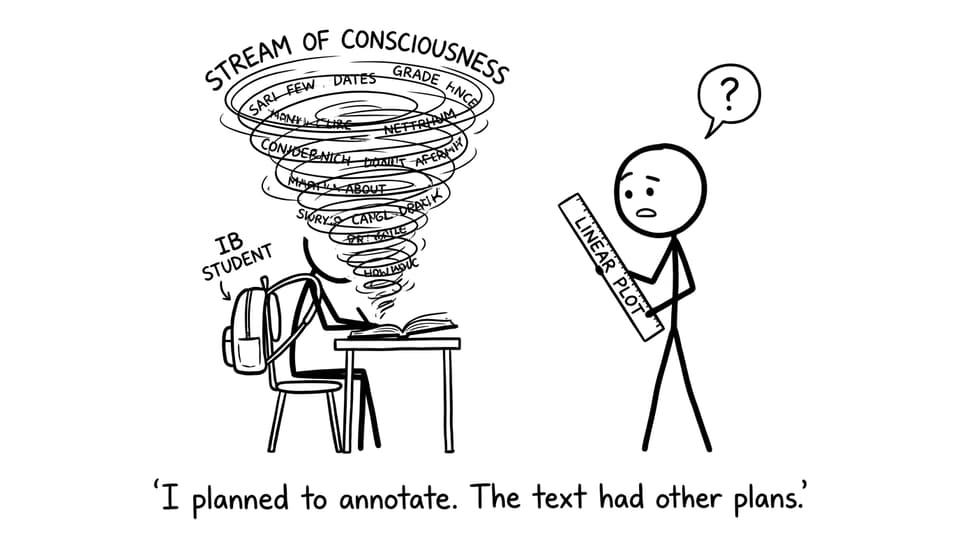
When you first meet Modernism and Postmodernism in IB English, it can feel like the author is actively resisting your highlighter. The timeline jumps. The narrator dodges the truth. The “plot” behaves like a suggestion, not a plan.
But that discomfort is the point. These movements were built for a world that stopped feeling neat. And for IB English exams, they are a gift: once you can name what the writer is doing, you can explain why it matters. That’s marks.
A quick exam checklist for IB English
Use this as your 60-second scan before you dive into analysis in IB English Paper 1 or plan a comparison for Paper 2:
-
Fragmented or non-linear structure (time jumps, montage, disjointed scenes)
-
Interior voice (stream of consciousness, free indirect discourse, intense subjectivity)
-
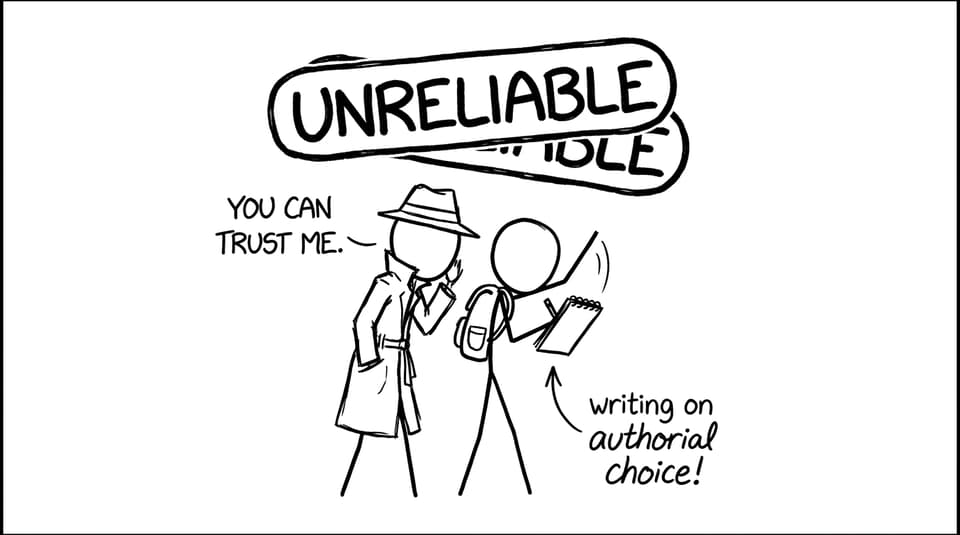
Unstable truth (unreliable narrator, contradictions, competing versions of reality)
-
Self-awareness (metafiction, footnotes, direct address, text commenting on itself)
-
Big ideas under pressure (identity, perception, meaning, language, power)
To strengthen your exam method, pair this checklist with RevisionDojo’s Mastering IB English Paper 1: 7 Expert Strategies and the Step-by-Step Guide to Comparative Literary Essays (Paper 2).
Modernism in IB English: the art of fractured sincerity
Modernism grows out of the early 20th century, when industrial change and global conflict made older, confident storytelling feel dishonest. Modernist writers break the smooth surface of Victorian realism to show what it’s like to live inside a mind.
In IB English, Modernism often shows up as a text that feels fragmented but serious. It may struggle toward coherence, even if it never fully arrives.
Modernist signals to write about in IB English
-
Stream of consciousness or interior monologue: thoughts move by association, not logic.
-
Symbolic landscapes: setting mirrors psychology (city noise, barren rooms, repeating objects).
-
Abrupt shifts: time, perspective, or tone changes without warning.
-
Ambiguity with purpose: the text withholds certainty to mimic human perception.
A strong IB English move is to link form to meaning: “The fragmented structure mirrors the character’s fractured sense of self,” or “The abrupt temporal shifts recreate memory rather than chronology.” If you want practice phrasing those insights, RevisionDojo’s Writing a Commentary for IB English A: Step-by-Step Guide is built for exactly that.
Postmodernism in IB English: when the text knows it’s a text
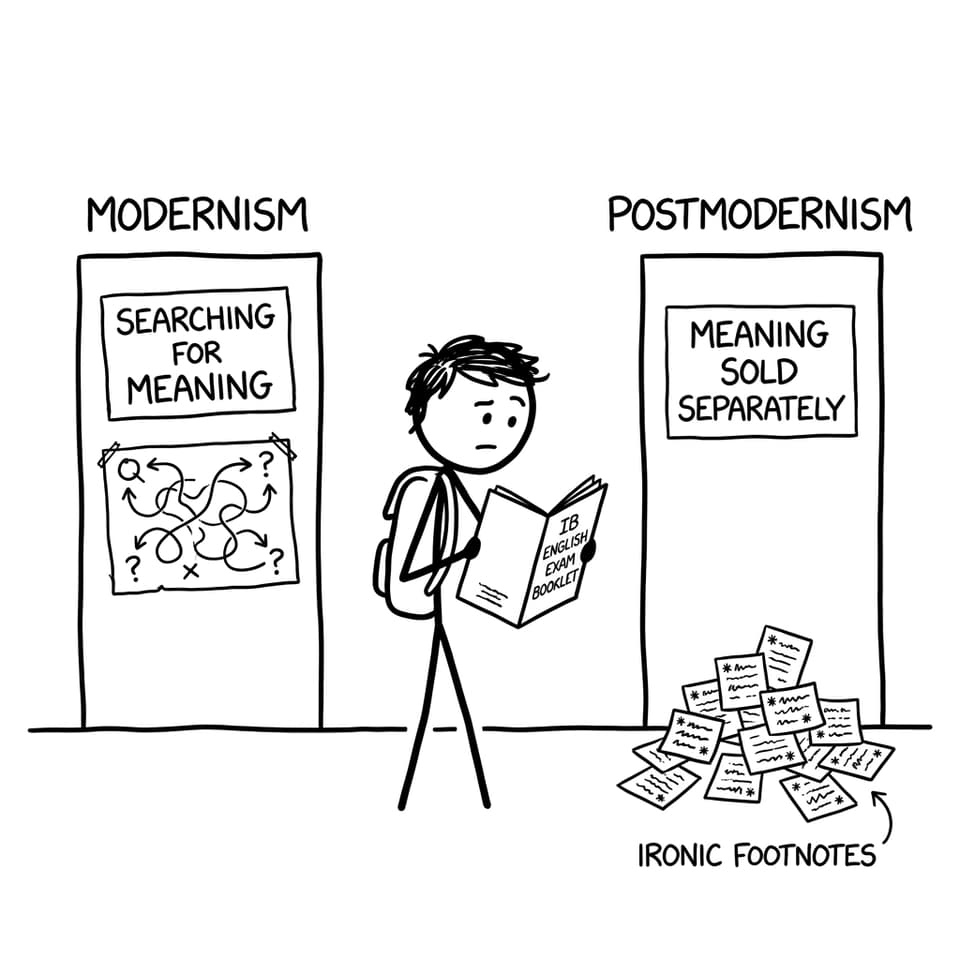
Postmodernism inherits Modernism’s experimentation and then adds a raised eyebrow. Instead of asking, “How do we find meaning in the chaos?” it often asks, “Who decided meaning was stable in the first place?”
For IB English, Postmodernism is where you’ll see playfulness, irony, and deliberate instability. The text may sabotage its own authority on purpose.
Postmodern signals to write about in IB English
-
Metafiction: the story calls attention to its own storytelling.
-
Intertextuality: references, rewrites, or echoes of other texts.
-
Irony as structure: not just a tone, but a worldview.
-
Unreliable narration: truth becomes a contest, not a fact.
When you analyze Postmodernism in IB English, focus on effects: how the uncertainty reshapes your role as reader, how contradictions expose power, how “play” becomes critique.
Modernism vs Postmodernism: what examiners actually reward
The trap in IB English is treating these movements like labels you must prove. Examiners reward something simpler and harder: precise explanation of authorial choice.
Try this comparison frame:
-
Modernism often breaks form to represent consciousness and search for meaning beneath disorder.
-
Postmodernism often breaks form to question meaning itself and expose how truth is constructed.
So if a text feels like it’s reaching toward coherence, it may lean Modernist. If it delights in contradiction, parody, or self-undermining, it may lean Postmodern. But in IB English, you can earn top marks without declaring a final verdict. You can say “Modernist techniques” or “Postmodern tendencies” and then prove it with evidence.
For Paper 2, this becomes a powerful comparative angle. RevisionDojo’s Structuring Your IB English Paper 2 Essay and Understanding the IB English A Literature Paper 2 Exam Structure help you turn movements into paragraph logic instead of trivia.
How to turn movement features into high-scoring IB English paragraphs
A reliable IB English paragraph has three parts:
-
Technique (what you see): fragmentation, metafiction, interior monologue.
-
Effect (what it does): disorients, creates intimacy, undermines authority, forces interpretation.
-
Meaning (why it matters): links to identity, uncertainty, power, memory, truth.
If you want fast, repeatable practice, RevisionDojo’s English A Lang & Lit Resources and Questionbank feature let you drill exam-style prompts and get feedback. When your drafts feel close but not sharp, the IB English Paper 1 Grader helps you align your writing to rubric language. You can also use RevisionDojo Flashcards for movement vocabulary, Study Notes for technique definitions, AI Chat to test thesis statements, Grading tools to tighten structure, Predicted Papers and Mock Exams to simulate pressure, and the Coursework Library and Tutors when you need targeted support.
Closing: make the strange feel usable
Modernism and Postmodernism aren’t obstacles in IB English. They’re shortcuts to better commentary and sharper comparison, because they give you ready-made language for what you’re seeing: fragmentation, uncertainty, self-awareness, unstable truth.
If you want to turn that understanding into exam confidence, build a simple routine: read with the checklist, practice with RevisionDojo’s Questionbank, refine paragraphs with the Grading tools, and simulate pressure with Mock Exams and Predicted Papers. In IB English, clarity is not about making texts simple. It’s about making your thinking precise. RevisionDojo is built to help you do exactly that.
