


In the last week before an IB exam, your brain starts to do a strange thing.
It stops worrying about the syllabus and starts worrying about logistics.
Not the big logistics, like "Am I ready?" or the small ones that feel bigger than they should: What time does my paper start? What if I misunderstand the timetable? Why is someone online calling it time zone 1 vs time zone 2?
If you've been hearing "time zone 1 vs time zone 2 in IB", you're not alone. Students talk about it like it's a secret level in a game: same exam, different timeline, invisible rules.
Here's the calm truth: in IB, your exam experience is designed to be fair globally. Time zones matter for timing, security, and your planning. They do not change what you need to learn.
Quick checklist: time zone 1 vs time zone 2 in IB (in plain language)
Before you spiral, anchor yourself with this:
- The IB uses exam zones (often discussed as "time zones") to run exams worldwide securely.
- Your exam content and grading are the same across zones.
- The difference is when you sit the exam locally, not what you sit.
- Your school (via your coordinator) confirms your exact start time.
- Your job is to plan sleep, transport, and revision pacing around that start time.
If you want the clearest foundation first, read: IB May 2026 Exam Zones Explained (A, B, and C).
What "time zone 1 vs time zone 2 in IB" usually means
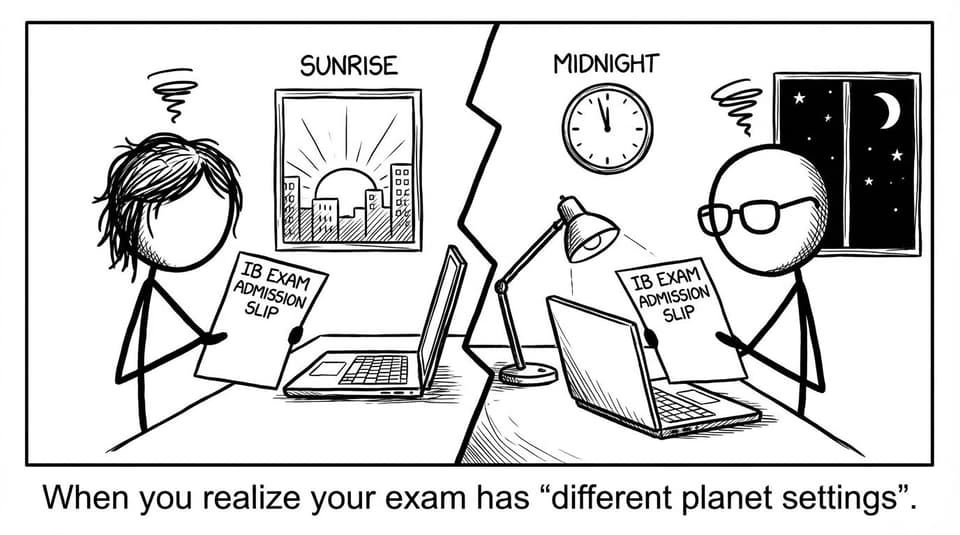
The IB doesn't officially label exams as "time zone 1" and "time zone 2." Students often use those phrases informally to describe:
- different exam zones (A/B/C), or
- different sessions (morning/afternoon), or
- the feeling that someone else in another region sits the exam "earlier" or "later."
So when someone says "time zone 1 vs time zone 2," they're usually trying to compare two groups of students who sit the same IB paper at different local times.
That comparison creates anxiety because it sounds like an advantage.
But in a well-run IB system, the point of exam zones is to reduce unfairness and protect security. You don't win by being earlier or later. You win by being ready.
For practical clarity on the timetable side, this helps: How to Read the IB Exam Schedule Without Getting Confused.
Why the IB uses exam zones (and why you should be glad)
Imagine the IB tried to run a truly simultaneous global exam with one universal start time.
Someone would be writing an essay at 2:00 a.m. Another student would be doing the same paper after a full night's sleep and breakfast. That's not an academic comparison anymore; it's a biology experiment.
Exam zones exist to:
- keep start times reasonable locally
- reduce opportunities for content leaks
- keep assessment conditions fair across regions
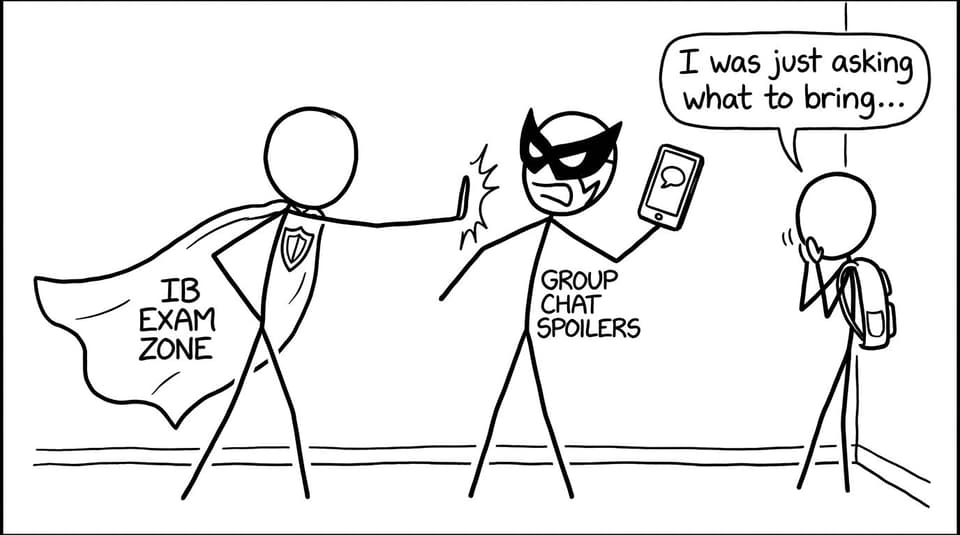
Security is the quiet reason this system matters. If you've ever seen rumors or "discussion" posts online after an exam, you've brushed against what the IB is trying to prevent.
If you want to understand the ethical and practical side, read: What Is Timezone Cheating in IB?.
The only differences that matter for IB students
When people stress about time zone 1 vs time zone 2 in IB, they often focus on imaginary differences (like "their paper is easier"). The real differences are boring, and important.
Your sleep schedule becomes part of your exam technique
If your exam starts earlier than your normal school rhythm, the biggest risk isn't content.
It's arriving half-awake.
Two weeks out, start shifting gradually:
- move bedtime earlier by 15-30 minutes every few days
- practice your "exam morning" routine on a weekend
- do one timed set early in the day to mimic the mental feel
RevisionDojo makes this easier because you can run Mock Exams and timed drills without building your own system from scratch. If you need a pacing framework, use: Time-Controlled IB Tests: Build Speed and Accuracy.
Your planning window changes (not your content)
Different zones can mean your exam starts at a different hour, which changes:
- when you should stop studying the night before
- when you should eat
- how early you should arrive
- how you should warm up (quick flashcards vs heavy practice)
That's where many IB students lose easy marks: not from lack of knowledge, but from arriving stressed and scattered.
Your school is the source of truth
The IB publishes the framework. Your coordinator confirms the actual clock time.
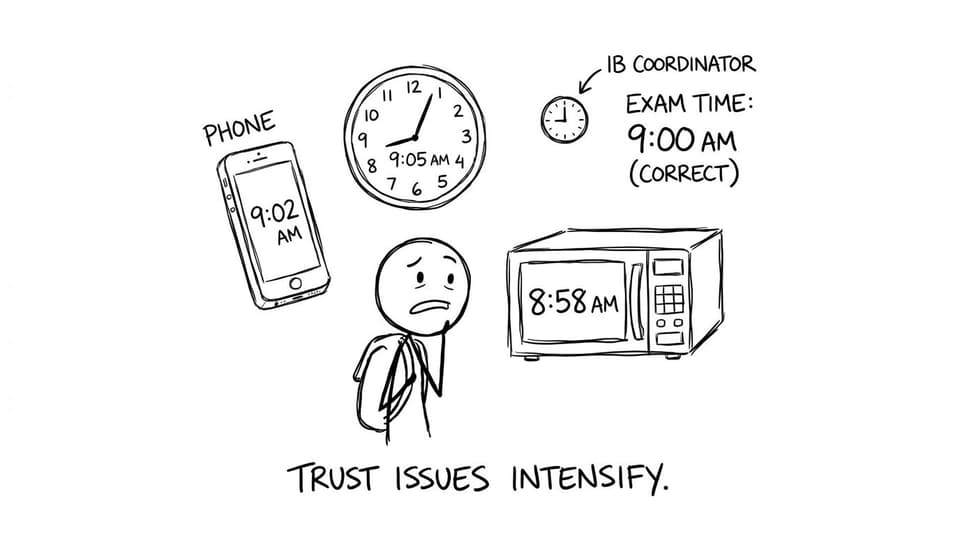
If you're converting times yourself, do it carefully. Even smart students mess this up because clocks lie in small ways (settings, daylight savings, device drift, wrong assumptions).
For step-by-step conversion guidance, use: How to Convert IB Exam Times to Your Local Time (IB May 2026).
How to revise smarter when your IB exam timing feels "weird"
The hidden danger of time zone anxiety is that it steals attention from the only thing that changes outcomes: the quality of your practice.
Here's a simple IB approach that works regardless of time zone 1 vs time zone 2.
Build your revision loop around output, not reassurance
When students feel uncertain, they seek reassurance: new notes, new videos, new opinions.
High scorers do something quieter. They produce answers, then fix them.
A strong weekly loop:
- Study Notes for quick clarity (short, targeted)
- Flashcards daily to keep memory warm
- Questionbank practice for exam-style thinking
- one timed session using Mock Exams or Predicted Papers
- quick feedback using AI Chat and Grading tools
RevisionDojo is built around that loop as a single workspace: Questionbank, Study Notes, Flashcards, AI Chat, Grading tools, Predicted Papers, Mock Exams, Coursework Library, and Tutors.
If you want the broader structure, these are worth saving:
- How to Study for IB Exams: Step-by-Step Guide
- How 45-Point IB Students Prepare for Exams
- 5 Proven IB Revision Hacks Backed by Science
Do "time-matching" practice at least once a week
If your exam will be early, do one practice block early.
Not because early is magical, but because your brain learns context. You want "exam thinking" to feel familiar at that hour.
Use RevisionDojo's Questionbank for short morning sets and build toward timed sessions. Start here if you haven't used it yet: Questionbank.
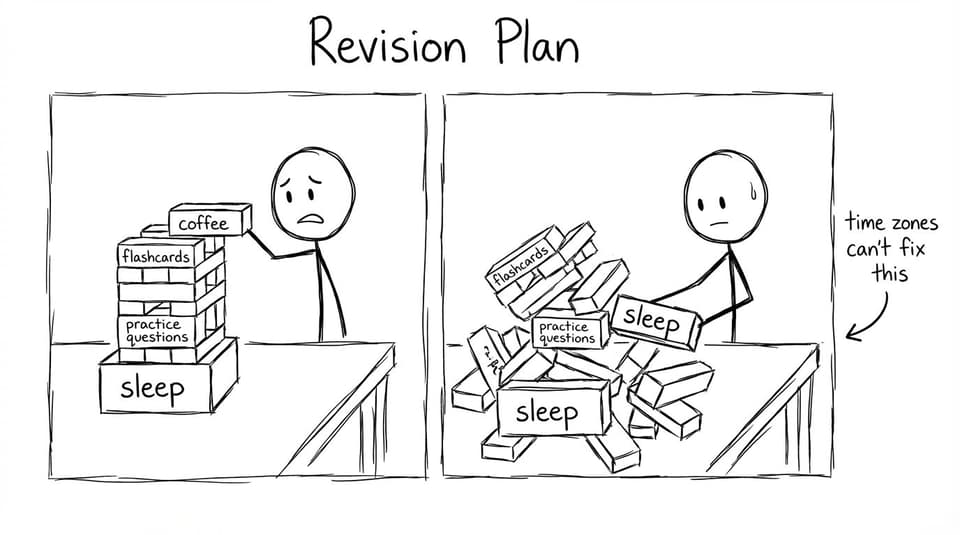
Plan the night before like a minimalist
If time zone 1 vs time zone 2 in IB has you watching the clock, remember this: the night before is not where you become a different student.
A better plan:
- 30-45 minutes: light mixed review (Flashcards + a few questions)
- pack your bag, confirm location, confirm start time
- hard stop for sleep
If you need a calm framework for the final stretch, read: How to Stay Sane During IB Exam Season.
What to do if classmates in another time zone start talking about the exam
This is where the topic becomes not just logistical, but ethical.
If you're hearing "time zone 1 vs time zone 2" in group chats right before an IB paper, you might also hear:
- "What topics came up?"
- "Was it mostly Topic X?"
- "Any surprises?"
Even if it's framed as curiosity, it can cross into exam misconduct. The safest rule is simple: don't ask, don't share, don't read.
Instead, redirect your energy into something you can control:
- do a short RevisionDojo Mock Exam section
- review your error log
- ask AI Chat to explain one concept you keep missing
If you want to see how RevisionDojo positions a full exam-prep workflow, start here: RevisionDojo App: The Smarter Way to Prep for IB Exams.
Closing: treat time zones as logistics, not destiny
Time zone 1 vs time zone 2 in IB can feel like a shadow hanging over your revision. But it's mostly a planning detail that gets louder when you're already tired.
Your advantage won't come from decoding rumors. It will come from building a small, repeatable loop: learn, recall, practise, review, repeat.
That's what RevisionDojo is for: Study Notes when you need clarity, Flashcards when you need memory, Questionbank when you need exam skill, AI Chat when you're stuck, Grading tools and the Coursework Library when coursework pressure leaks into revision, and Predicted Papers and Mock Exams when you need the real feeling without the real stakes.
If "time zone 1 vs time zone 2 in IB" has been living in your head, let it shrink back to its actual size: a clock setting. Then open RevisionDojo and do the next question.