
Introduction: the clock is loud, the paper is quiet
A week before exams, you notice something that feels unfair.
A friend in another country posts their IB timetable and their start times look… different. Earlier. Later. Almost like they are taking a different exam.
That is usually when anxiety finds a new costume: exam zones.
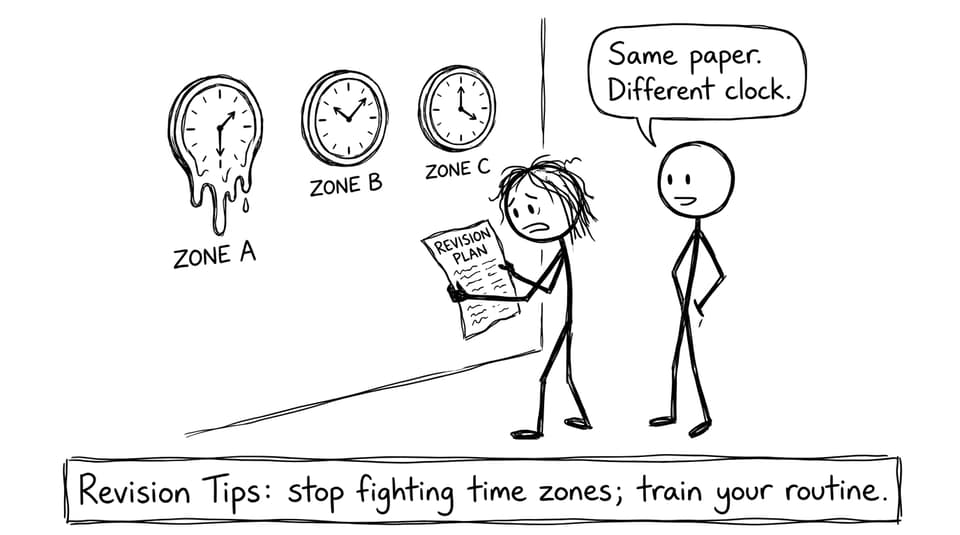
Here is the calm truth for IB May 2026: exam zones (A, B, and C) exist to protect exam security and global fairness. They change timing, not content. Once you understand that, the real work becomes practical: building Revision Tips that match your local start times so exam week feels familiar instead of shocking.
Quick checklist: what you actually need to know
Use this as your one-page reset whenever exam zone confusion flares up.
-
Your exam zone is set by your school’s location (not your passport).
-
Zones A, B, and C sit equivalent papers with the same standards.
-
Zones mainly shift morning and afternoon session start times.
-
You cannot choose a different zone for travel or convenience.
-
Your best Revision Tips are routine-based: sleep, food, and timed practice aligned to your real start time.
If you want a simple way to turn dates and start times into a plan, the RevisionDojo Study Planner is built for exactly that.
What are IB exam zones (A, B, and C)?
IB exam zones are the IB’s way of running a global exam session without creating a security mess.
Because students sit exams across many time zones, the IB groups regions into three zones:
-
Zone A
-
Zone B
-
Zone C
The key point: zones are designed so the IB can schedule papers in controlled windows worldwide. Your zone is not a label of difficulty, and it is not a hint about grade boundaries. The exam you train for is the exam you will sit.
This is why good Revision Tips focus on skills you control: recall, timing, and markscheme thinking.
Why the IB uses exam zones (and why you should be glad)
It is easy to imagine a world without exam zones. It is also easy to see how it breaks.
If one region sat the paper hours earlier than another, content could leak. Even casual conversations can become accidental security issues. So the IB uses exam zones to protect fairness.
In practice, zones help the IB:
-
coordinate equivalent sessions around the world
-
reduce the chance of early access to exam content
-
keep administration consistent across regions
Your takeaway is simple: zones are about security and fairness, not about making life easier. The student advantage is not the zone. The advantage is preparation.
IB May 2026 Exam Zone A explained
Zone A generally covers:
-
Europe
-
Africa
-
parts of the Middle East
Students in Zone A often find their sessions line up with a “typical” school day rhythm: morning exams in the later morning, and afternoon exams in the early-to-mid afternoon (exact times depend on local timetable instructions).
Your best Revision Tips for Zone A are boring in a good way: practice at the time you will actually sit, and protect sleep the night before writing-heavy papers.
To keep your study loop tight, combine clear content review with practice and feedback: How to Study for IB Exams: Step-by-Step Guide.
IB May 2026 Exam Zone B explained
Zone B generally covers:
-
North America
-
Central and South America
Zone B students sometimes notice their session start times look “shifted” compared to Zone A. That is normal. The IB is aligning security windows, not customizing your comfort.
The practical move is to build Revision Tips around timing stamina:
-
schedule at least one timed session weekly (even if it is just a section)
-
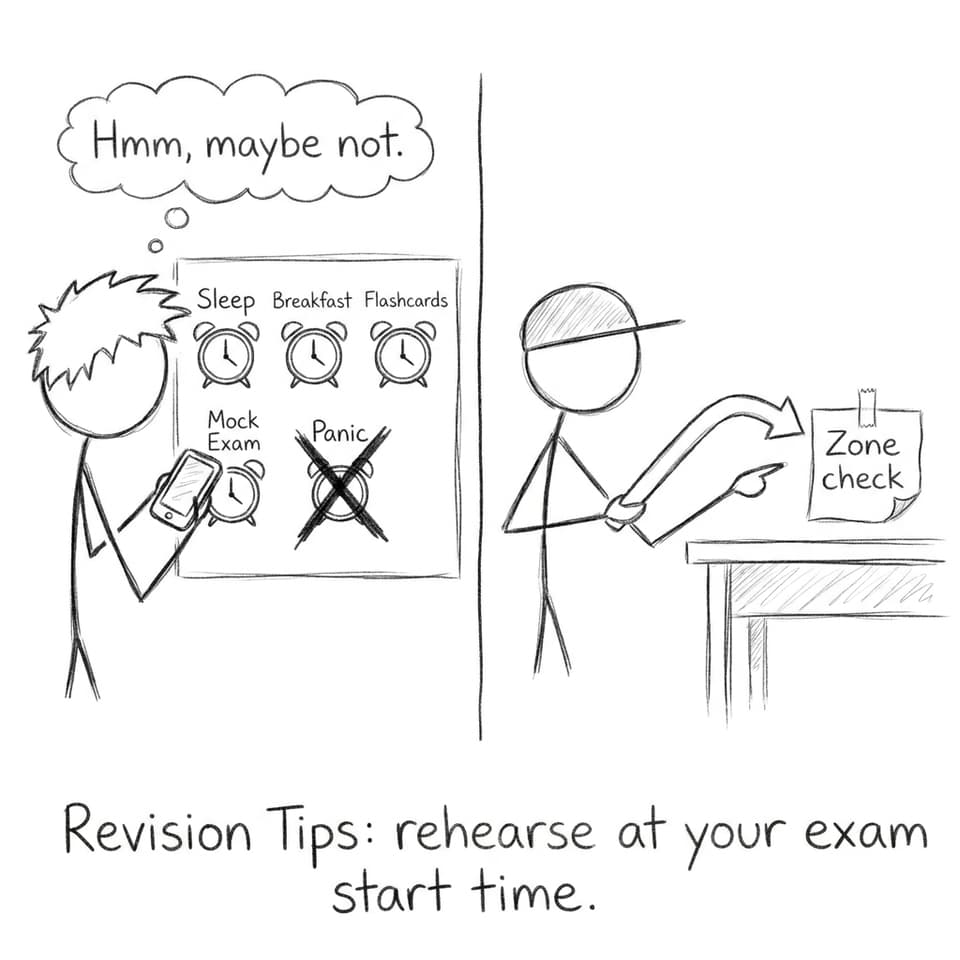
rehearse your pre-exam routine: breakfast, commute, settling time
-
train transitions between papers on back-to-back days
RevisionDojo is designed for this kind of training loop: Study Notes to clarify fast, Flashcards to keep recall sharp, and the Questionbank to drill exam-style prompts with feedback.
IB May 2026 Exam Zone C explained
Zone C generally covers:
-
Asia
-
Australia
-
parts of the Pacific region
Zone C is where students most often say, “Why do my exams start so early?” The answer is still the same: global coordination.
So your Revision Tips need to treat your body like part of your strategy. If your paper starts early, late-night revision is not dedication. It is sabotage.
Two small habits help more than they sound like they should:
-
move your sleep schedule earlier by 15-30 minutes every few days
-
do short morning recall sessions so your brain learns to wake up on command
A surprisingly effective routine is daily spaced repetition. If you need a clean system, start with IB Flashcards with Spaced Repetition (SRS).
What exam zones affect (and what they do not)
Exam zones affect:
-
your local start time for morning sessions
-
your local start time for afternoon sessions
Exam zones do not affect:
-
exam length
-
exam difficulty
-
marking criteria
-
grade boundaries
A useful mental model: you and a student in another zone are reading the same story, just turning the first page at different times.
This is where smart Revision Tips become calming: you stop debating the timetable and start rehearsing your own.
Can you change your exam zone?
No. Your exam zone is assigned by the IB based on your school’s location. It does not change because you are traveling, and it is not something you can request a switch for.
If you are worried about travel or logistics, your best move is to speak to your IB coordinator early. Then return to what you can control: practice, sleep, and feedback loops.
The most common exam zone mistakes (and the fix)
Mistake: comparing start times with friends abroad and assuming something is “off.”
Fix: compare paper structure and skills, not clocks.
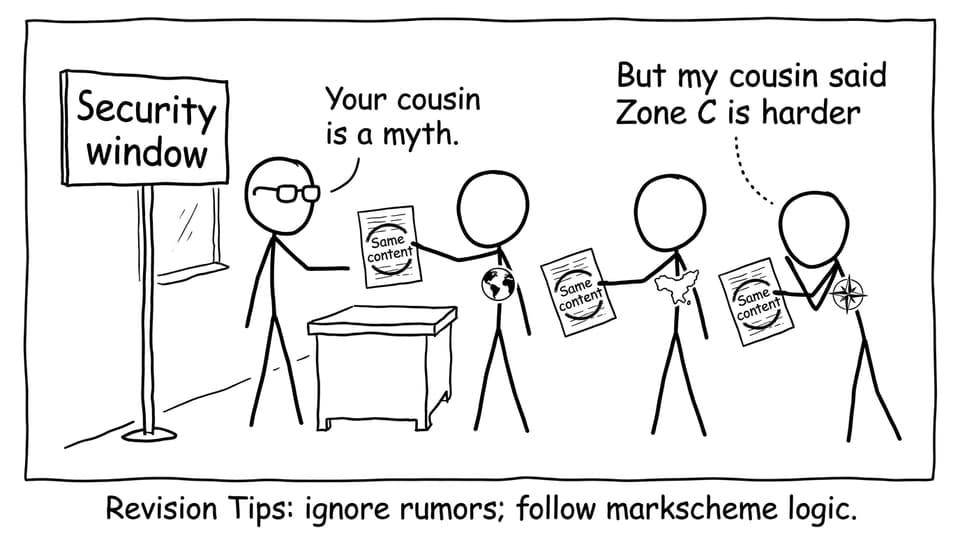
Mistake: believing rumors like “Zone C is harder.”
Fix: build confidence from performance data. Use timed practice, markscheme-aligned feedback, and a mistake log.
Mistake: ignoring start times until exam week.
Fix: do at least 2-3 timed sessions at your real start time in the final month.
For practice that stays focused, RevisionDojo’s Questionbank feature helps you drill by topic and paper style, then tighten weak areas without guessing.
Revision Tips: plan around your zone with a simple loop
The best Revision Tips do not add more hours. They add repeatable structure.
Try this weekly loop and adjust it to your zone start time:
-
Learn (2 sessions): use syllabus-aligned explanations from the RevisionDojo app workflow guide to keep content clean and exam-focused.
-
Remember (daily 10-15 min): run quick recall using IB Flashcards with SRS.
-
Apply (3 sessions): drill targeted sets in the Questionbank.
-
Simulate (1 session): take one realistic paper-style run using IB Predicted Papers to build timing and stamina.
-
Get feedback (fast): use AI Chat to clarify misconceptions, and Grading tools (including the IB Coursework Grader) to keep writing-based subjects honest.
When you want the schedule to stop living in your head, map it onto your exam week using Plan Final IB Revision With the Official Timetable.
FAQ
What exam zone am I in for IB May 2026?
Your exam zone is determined by your school’s geographic location, not by where you were born or where you hold citizenship. In most cases, your IB coordinator can confirm it instantly, and it stays consistent for the session. If you are looking at a timetable online and it does not match your local instructions, trust your school’s timetable first. Exam zones can make start times look surprising when you compare across countries, even though everything is running normally. The most helpful next step is to write your local morning and afternoon start times on one page and plan around those. Once that is done, your Revision Tips can focus on practice and routine rather than uncertainty.
Do exam zones affect exam difficulty or grading?
No, exam zones do not change the difficulty of the papers you sit. They also do not change the marking criteria, the expectations of examiners, or the standards used to award marks. The purpose of zones is timing and security, not creating different versions of the exam experience. It can feel like “different times means different papers,” but that is a psychological trick your stress uses on you. The best way to prove this to yourself is to practice with markscheme logic: when you can consistently earn marks on exam-style questions, rumors lose their power. Build your confidence through Revision Tips that include timed practice, targeted drills, and fast feedback.
Why do my exam start times look earlier or later than my friends’?
Because your friends are likely in a different exam zone, and zones shift sessions to protect global fairness. When people post timetables online, they often forget that the IB is coordinating across continents, not running a single local schedule. Your local start time can be earlier even if the exam is not “earlier” in the global security window sense. This is also why comparing screenshots is rarely useful, and often stressful. Instead, treat your timetable like athletic training: your body performs best when it has rehearsed the same conditions. That is why the most effective Revision Tips here are practical: practice at your start time, adjust sleep gradually, and do at least one full timed run per week close to exams.
Conclusion: the zone is fixed, your routine is not
Exam zones feel dramatic because clocks are visible and preparation is private. But for IB May 2026, Zone A, Zone B, and Zone C all point to the same core reality: the paper is the paper, and the marks come from the same skills.
So make your plan simple. Confirm your zone. Write down your real start times. Then build Revision Tips that train your routine, not your anxiety.
If you want one place to do it all, Questionbank, Study Notes, Flashcards, AI Chat, Grading tools, Predicted Papers, Mock Exams, the Coursework Library, and Tutors when you want a human plan, make RevisionDojo your default study home screen and start with the Study Planner.