
IB exams don't usually break students because the content is impossible.
They break students because the IB asks you to do something strangely adult: stay calm, be precise, and think in public, on a clock, across six subjects, while TOK, the EE, and IAs keep whispering in the background.
If you're wondering how hard are IB exams, you're probably not asking for motivational posters. You want a realistic answer: what makes the IB difficult, who finds it hardest, and what actually moves your grade when time is short.
Below is the honest version, and a plan you can follow.
The quick answer: why IB feels hard
Here's the simplest way to describe IB exam difficulty:
- Volume: lots of syllabus, multiple papers, multiple skills.
- Precision: marks come from specific phrasing, steps, and structures.
- Time pressure: you often know it, but can't produce it fast enough.
- Switching costs: your brain changes "modes" all day (Math to English to sciences).
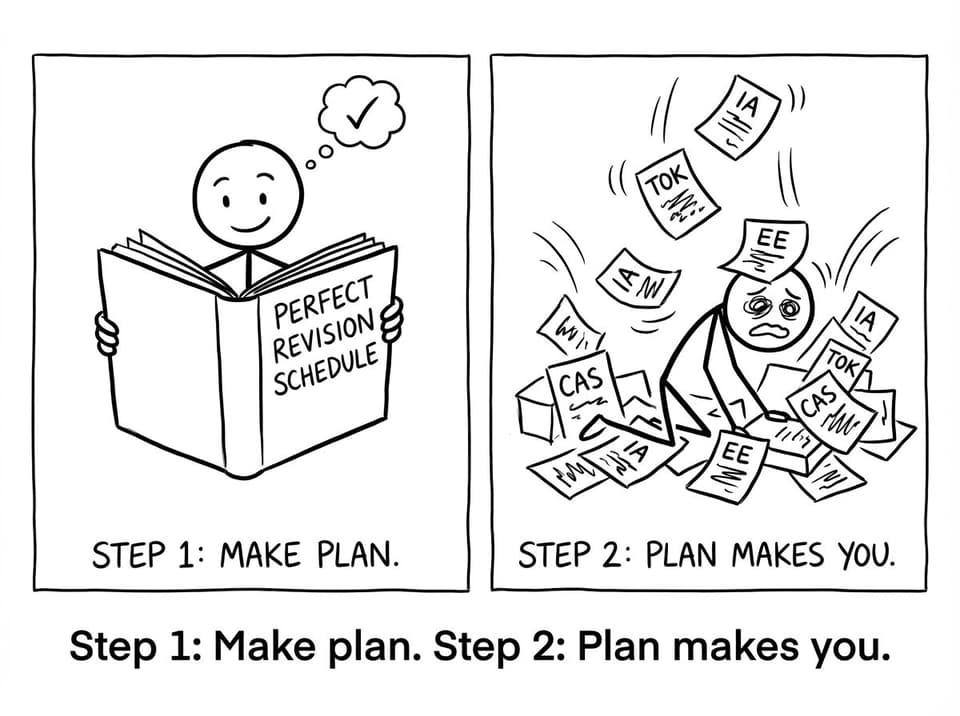
- Background load: TOK, EE, IAs, and CAS drain attention even when you're "not revising."
The hard part is not that the IB wants genius.
It's that the IB rewards repeatable performance.
A practical checklist: are you preparing the way IB exams reward?
Use this as a weekly check-in for IB revision:
- Can you name the next paper you're training for (not just the subject)?
- Do you do active recall daily (Flashcards or quick quizzes)?
- Do you do exam-style questions 3-5 times per week?
- Do you run at least one timed session weekly?
- Do you review mistakes as patterns (not as isolated failures)?
If any of these are missing, IB exams will feel harder than they need to.
A good all-in-one way to run this loop is the RevisionDojo for IB hub, where you can move from Study Notes to Flashcards to Questionbank to Mock Exams without rebuilding your system every day.
What "hard" actually means in IB: three types of difficulty
Most students talk about IB difficulty as if it's one thing. It's not. There are three different hard problems hiding under the same word.
Content difficulty: the honest syllabus problem
Yes, some IB subjects are content-heavy. Sciences can feel like learning a new language. History can feel like carrying a library in your head. Math can feel like a staircase where you're missing three steps.
But content difficulty is usually the most solvable part.
Why? Because content can be chunked. It can be tested. It can be spaced. It can be revisited.
This is exactly what Study Notes are for: quick clarity, syllabus alignment, and fewer hours lost rewriting what you already "kind of" know.
Technique difficulty: the markscheme is the real exam
In the IB, you can understand something and still lose marks.
That's the part that feels unfair until you realize the truth: exams are not philosophy seminars. They're scoring systems.
Technique difficulty shows up as:
- misreading command terms (explain vs evaluate)
- not using data or evidence when it's required
- writing "a lot" but not writing "credit-worthy"
- skipping the final step that earns the last mark
Technique improves fastest through high-quality practice plus feedback.
That's why students lean on the RevisionDojo Questionbank and the guide Comprehensive IB Question Bank: Thousands of Practice Questions. The goal isn't random grinding. It's learning what earns marks in your subject, then repeating it until it becomes automatic.
Stamina difficulty: your brain as a battery
The IB exam season is a sequence of long days. Even strong students underperform when fatigue changes their decision-making.
You start rushing.
You stop planning.
You forget obvious things.
Stamina is trained, not wished for. The cleanest way is weekly timed exposure using Mock Exams and predicted sets.
If you want a structured method, follow How to Run Timed IB Mock Exams in RevisionDojo (Exam Mode + Test Builder).
Who finds IB exams hardest (and why)
The IB doesn't punish intelligence. It punishes mismatched preparation.
Here are the students who typically find IB exams hardest, and the real reason:
The "I'm a notes person" student
If you mainly reread and rewrite, you may feel productive while staying untested. The IB doesn't grade comfort. It grades recall and application.
Fix: switch to a loop: Study Notes for clarity, then Questionbank for proof, then Flashcards for retention.
Start with Notes + Flashcards + Question Bank (Free).
The "I'll start after coursework" student
Coursework expands to fill the space you give it. In the IB, waiting for a quiet season is like waiting for the ocean to stop moving.
Fix: protect small daily recall and one weekly timed session, even during IA/TOK/EE peaks. Use the Coursework Library and Grading tools to keep coursework from becoming a fog.
The "I only do full papers" student
Full papers are valuable, but too slow for building weak-topic accuracy. You end up repeating the same mistakes with different questions.
Fix: do focused drills first. If you need a framework, see Custom IB Question Banks: Focus on What You Need Most.
What makes IB exams feel harder than other exams
Many school exams reward recognition: "Have you seen this before?"
The IB rewards production: "Can you generate an answer that matches a markscheme under constraint?"
That difference creates three common shocks:
The IB wants "trained writing," not just writing
Especially in essay-based subjects, the IB is looking for structure: argument, evidence, evaluation, clear signposting. You can't improvise that at speed unless you've practiced it.
This is where RevisionDojo's AI Chat and Grading tools become unusually useful: draft a response, get feedback aligned to criteria, then rewrite with purpose.
The IB loves command terms
Command terms are the steering wheel. If you don't respond to the verb, you can be "right" and still be low-scoring.
A practical habit: underline the command term, then write a tiny plan that matches it.
For exam-day execution, keep IB Exam Day Checklist: The Ultimate Guide open the week before your first paper.
The IB punishes vague revision
"Revise Biology" is not a task.
"Do 20 questions on Topic 2.3 and review errors" is.
If you want a full blueprint for turning vague stress into a routine, use How to Study for IB Exams: Step-by-Step Guide.
A calm, high-ROI plan to make IB exams feel easier
Here's a simple weekly structure that makes IB exams less mystical.
Daily (10-20 minutes): keep recall alive
- Use Flashcards (spaced repetition)
- Focus on definitions, steps, key examples, command-term templates
4-6 times per week (45-90 minutes): one topic block
- Read one slice of Study Notes
- Immediately do Questionbank questions on that exact slice
- Log mistakes as patterns ("I ignore units," "I don't evaluate")
Weekly (60-120 minutes): one timed exposure
- Timed section or full Mock Exam
- Review with discipline: what was content, what was technique, what was pacing?
If you struggle with anxiety as exams approach, pair the plan with How to Beat IB Exam Anxiety (Without Burning Out). The core idea is exposure: timed practice makes the real IB paper feel familiar.
Closing: IB is hard, but it's not random
The IB is hard in the way a long hike is hard: not because one step is impossible, but because you have to keep stepping when your brain wants certainty that the path works.
The good news is that IB exams reward the same simple loop across every subject: understand, recall, apply, review, repeat, then add timing until pressure feels familiar.
RevisionDojo was built to make that loop easier to run: Study Notes to cut through noise, Flashcards to keep memory alive, a Questionbank to train exam technique, AI Chat to unblock confusion fast, Grading tools and a Coursework Library to reduce coursework uncertainty, and Mock Exams plus Predicted Papers to rehearse the real thing. When you're ready for human support, Tutors can tighten your strategy and raise your ceiling.
If you want the IB to feel less hard, don't search for a new secret.
Build a system. Then let the repetitions do what they always do: make the hard thing familiar.