

Do You Need to Study Every Topic for IB?
It usually starts the same way.
You open your IB syllabus, scroll, and feel your brain do that quiet thing it does when the task is too big to name. Not panic, exactly. More like a slow, logical dread. Because the list is long, and time is short, and every topic looks equally important when you are tired.
So you ask the question most IB students eventually ask: Do you need to study every topic for IB?
The honest answer is uncomfortable and freeing: you need coverage, but you do not need perfection. The IB rewards students who can produce under exam conditions, not students who can hoard information. Your job is to build a system that turns limited time into reliable marks.
If you want an all-in-one way to do this, RevisionDojo is built for exactly that kind of exam-focused IB preparation: Study Notes to get clarity fast, Flashcards to make memory stick, a Questionbank to practise what the IB actually asks, AI Chat to get unstuck in minutes, Mock Exams and Predicted Papers to build stamina, plus Grading tools, a Coursework Library, and Tutors when you need a human voice.
The fast checklist: study smarter (not everything)
Use this as your weekly IB decision filter:
- Know the assessment: which paper(s) and question types decide your grade?
- Identify high-yield topics: the ones that show up often and connect to other topics.
- Diagnose weaknesses with questions: let performance tell you where time matters.
- Aim for "secure 5/6/7 marks" answers: not "I read the chapter once."
- Keep a small "risk list": topics you will only touch if time remains.
A good practical starting point is the workflow in How to Study for IB Exams: Step-by-Step Guide.
Why "study every topic" feels responsible (and why it often fails in IB)
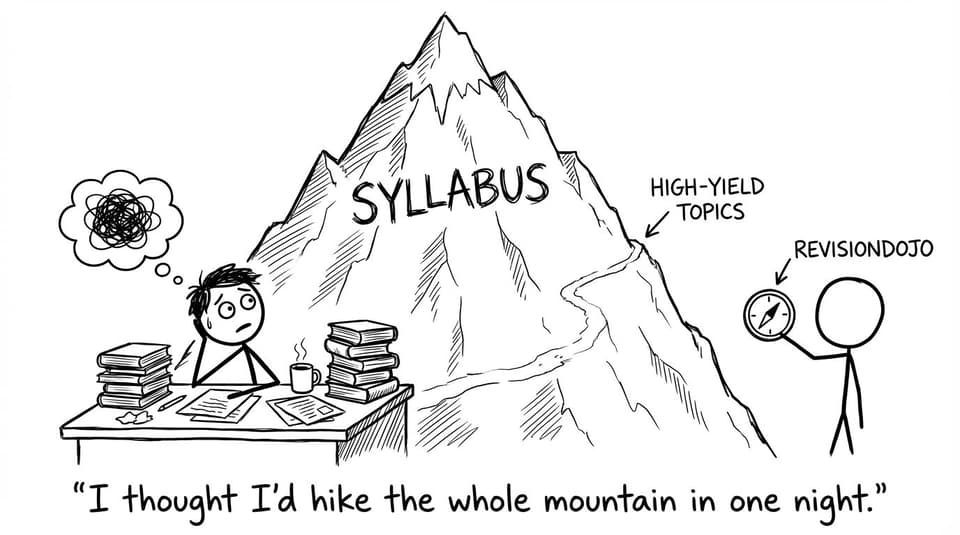
In the IB, the syllabus is a map, not a contract that says every corner will be examined equally. Yet when students revise, they often treat the map like a checklist. The emotional logic is simple: if you touch everything, you cannot be surprised.
But the IB does not reward "touched." It rewards retrieved and applied.
Here is the trap: broad coverage without depth creates a kind of fragile confidence. You recognize words. You remember reading something about it. Then the exam asks you to evaluate, justify, compare, or derive under time pressure, and recognition collapses.
That is why active practice tends to beat passive coverage. If you need proof, read how a Questionbank changes revision from "I hope I know it" to "I can do it": Comprehensive IB Question Bank: Thousands of Practice Questions.
What "enough" looks like for IB: the Minimum Effective Coverage model
Think of IB revision like packing for unpredictable weather. You do not bring every outfit you own. You bring layers that handle most conditions.
Minimum Effective Coverage means:
- You can answer common question types in your subject without freezing.
- You have memorized the definitions, formulas, and processes that are repeatedly tested.
- You have practised under time limits enough that pacing is not a mystery.
- You have a plan for what happens if a weird topic appears.
That last point matters. IB exams sometimes pull from edges of the syllabus. The goal is not to eliminate risk, but to price it correctly.
RevisionDojo helps here because it turns your studying into a loop: read targeted Study Notes, lock them in with Flashcards, then prove it with the Questionbank. That loop is how "enough" becomes visible.
How to decide what to skip (without gambling your IB grade)
Skipping topics blindly is just procrastination with better branding. Skipping topics strategically is what high scorers do when time is real.
Use these four filters.
Frequency filter: what appears often?
Some content is simply asked more frequently because it sits at the heart of the course. In many IB subjects, core themes and common skills recur even when the surface topic changes.
To operationalize this, do not start with the textbook. Start with exam-style questions. When you practise, patterns show up quickly.
If you want an efficient way to find targeted questions by topic and command term, the guide IB Question Search Engine: Find Questions by Keyword is a practical shortcut.
Connectivity filter: what unlocks other topics?
Some topics are "hub topics." Learn them and several other areas get easier.
Examples (by principle, not by subject):
- A core model that reappears in different contexts
- A method you use in multiple papers
- A set of definitions that powers longer explanations
These are high-return IB topics because they compound.
Weakness filter: what currently loses you marks?
The most rational IB revision question is not "what haven't I studied?"
It is: "What costs me marks when I'm timed?"
That is why diagnostic practice is so valuable. RevisionDojo's analytics and instant feedback (via Jojo AI) make it easier to spot recurring errors, then convert them into a small daily plan.
If your revision currently feels scattered, RevisionDojo App: The Smarter Way to Prep for IB Exams shows how the platform is designed as a feedback system, not a content dump.
Risk filter: what is low probability but high impact?
Some topics are rare but can hurt if they appear and you know nothing.
For these, aim for a survival level:
- One page of notes
- A tiny flashcard deck
- A handful of questions
This is where bite-sized resources help you touch the edge topics without donating your entire week. See Bite-Sized IB Study Notes: Learn Complex Topics Simply.

The IB strategy that actually works: depth-first, then breadth
Most students do the opposite. They go breadth-first: skim everything, feel busy, and hope the exam hits what they skimmed.
A better IB approach is:
- Depth-first on core topics (so you can earn marks reliably)
- Breadth later (so surprises do not destroy you)
Here is a simple structure you can repeat per subject.
Build your "secure marks" base
Pick 3-6 topics that:
- appear often,
- connect widely,
- match your weak areas.
Then run this loop 3-5 times:
- Read a short set of Study Notes
- Do 20-40 Questionbank questions on that exact subtopic
- Turn mistakes into Flashcards
- Ask AI Chat to explain the hardest mistake in a new way
This is where RevisionDojo shines as an IB engine: Notes, then Flashcards, then Questionbank, then AI Chat, repeating until your answers look like the markscheme.
Add timed practice earlier than you think
Many IB students delay timed practice because it feels unpleasant.
But timed practice is how you learn what you actually know.
Once per week, do a timed block using Mock Exams or Predicted Papers, then review mistakes while they are still emotionally fresh.
If you want a clear method, follow How to Run Timed IB Mock Exams in RevisionDojo (Exam Mode + Test Builder).
You can also explore subject-specific Predicted Papers directly from hubs (example pages):
A realistic plan for the final weeks of IB revision
You do not need a heroic schedule. You need a repeatable one.
Weeks 6-4 before exams: tighten the core
- 60% Questionbank (targeted sets)
- 20% Study Notes (only what you will immediately apply)
- 20% Flashcards (daily, short)
- 1 timed session per week (mini mock)
If you need help building a timetable that respects HL/SL load, use IB revision timetable.
Weeks 4-2 before exams: expand safely
- Keep core topics in rotation
- Add "risk topics" at survival level
- Increase timed practice to 2 sessions per week
- Use Jojo AI Grading tools for structured feedback on written responses
Final 2 weeks: convert knowledge into speed
- Prioritize timed papers and marking reviews
- Turn every repeated error into a flashcard
- Reduce new content unless it is high-yield
- Protect sleep (yes, it counts as IB revision)
For the mindset piece of staying human while you study, IB Exams Without Pausing Your Life is worth reading.
Closing: you don't need to study every topic for IB; you need a system
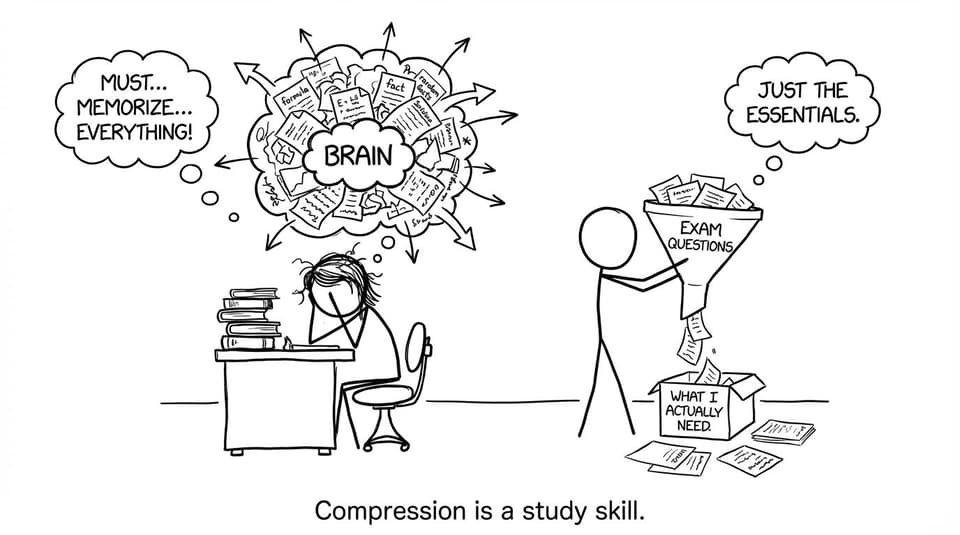
The IB is not asking whether you are the kind of person who can memorize an entire syllabus.
It is asking whether you can take what you know, under time pressure, and shape it into the answer the markscheme recognizes.
So no: you do not need to study every topic for IB in the same way, to the same depth, with the same time.
You need coverage plus competence. You need deep mastery of high-yield areas, a survival plan for the rest, and enough timed practice that the exam feels familiar.
If you want that process to feel simpler, build it on RevisionDojo: practise with the Questionbank, learn with Study Notes, retain with Flashcards, clarify with AI Chat, pressure-test with Mock Exams and Predicted Papers, sharpen writing with Grading tools, use the Coursework Library for exemplars, and lean on Tutors when you need a human guide.
Your IB syllabus is a mountain. The goal is not to carry the mountain.
It is to walk the path that gets you to the top.