
IB teacher workload is rarely difficult because of one enormous task. It becomes difficult because several reasonable tasks compete for the same hour: teaching, preparing tomorrow's lesson, marking today's work, supervising coursework, meeting a student, recording progress, and answering the email that begins with “just a quick question.”
A realistic Diploma Programme teaching week may occupy roughly 42-48 hours, depending on contact time, class sizes, subject demands, additional responsibilities, and the assessment calendar. That is not an IB-mandated figure. The IB recommends 240 teaching hours for an HL subject and 150 for an SL subject across the programme, but it does not prescribe a universal weekly teacher schedule.
The useful question is where those hours go, and how schools can stop ordinary responsibilities from expanding into every evening.
A realistic weekly teaching schedule at a glance
Consider a hypothetical full-time DP teacher with two year groups, approximately 22 contact hours, an Extended Essay supervision allocation, pastoral or duty responsibilities, and regular meetings.
| Work category | Illustrative weekly time |
|---|---|
| Classroom teaching | 22 hours |
| Lesson planning and resource preparation | 6 hours |
| Marking and feedback | 7 hours |
| Coursework and EE supervision | 3 hours |
| Meetings, communication, and administration | 4 hours |
| Duties, cover, and student support | 3 hours |
| Total | 45 hours |
This is a planning model, not a benchmark. A laboratory subject, essay-heavy course, large cohort, new syllabus, or internal assessment deadline can shift the balance considerably.
A workable weekly checklist is straightforward:
- Protect preparation time before filling gaps with meetings.
- Batch similar marking decisions together.
- Give different tasks different depths of feedback.
- Schedule supervision instead of leaving it permanently available.
- Keep one buffer block for unpredictable work.
- Coordinate major deadlines across the DP calendar.
- Reuse high-quality resources instead of rebuilding them.
Monday: teaching creates tomorrow's work
Monday may look manageable on paper, perhaps four or five lessons, a tutor period, and one meeting. Yet each lesson creates a trail: misconceptions to revisit, absent students to update, practical equipment to reset, and written work to review.
The most valuable planning block is not necessarily spent polishing slides. It is used to decide what evidence of learning the week must produce. One short diagnostic task can reveal more than an elaborate sequence built on assumptions.
A teacher might use the RevisionDojo Questionbank and IB resources to select syllabus-aligned questions, then assign a focused set rather than formatting another worksheet. Study Notes and Flashcards can support preparation and recall outside class, leaving lesson time for explanation, discussion, and difficult applications.
Monday's realistic finish is not “everything complete.” It is clarity about what genuinely requires teacher attention.
Tuesday: marking becomes a decision problem
By Tuesday, assignments begin returning. The visible job is marking. The hidden job is making hundreds of small judgments consistently.
Extended responses require the teacher to interpret criteria, identify the most important weakness, and communicate a next step. Writing an individual paragraph on every feature feels generous, but it can consume an evening without producing proportionate improvement.
A more sustainable approach is to batch by question or criterion. Mark the same response across the class, record common patterns, and create one whole-class feedback sheet. Individual comments can focus on the issue most likely to improve the student's next attempt.
RevisionDojo's guide to reducing IB marking workload explores comment banks, criterion-focused feedback, and targeted redrafting. Its guidance on grading consistency is useful when several teachers share a course.
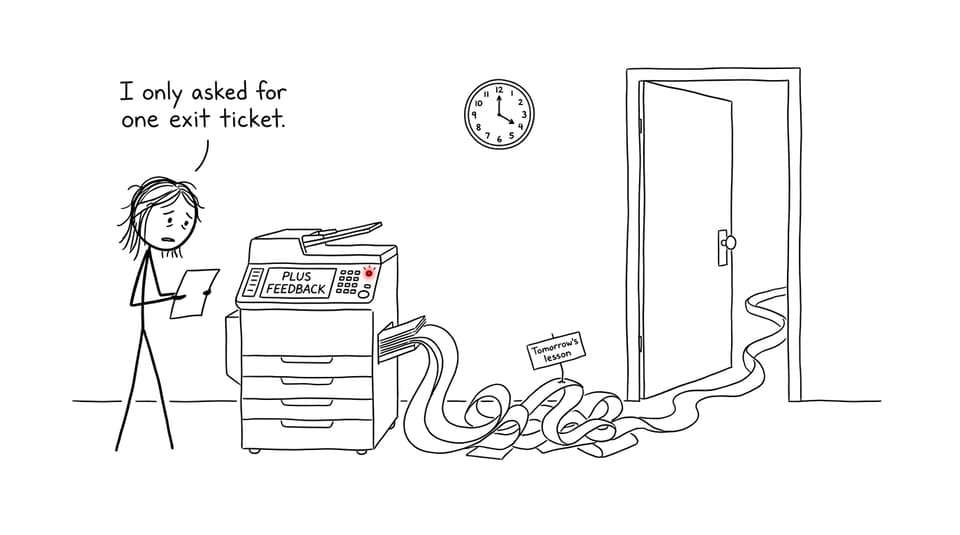
The principle is not to give less useful feedback. It is to stop confusing feedback length with feedback quality.
Wednesday: supervision fills the gaps
Midweek is where the DP's less visible work accumulates. One student wants help refining an Extended Essay question. Another needs an internal assessment check-in. A five-minute conversation requires context switching before it begins and a record after it ends.
Supervision is intellectually demanding because the teacher must guide without taking ownership away from the student. Extended Essay supervisors also conduct required reflection sessions, including the final viva voce. Those conversations deserve scheduled attention rather than hurried exchanges in a corridor.
A realistic Wednesday might include two 20-minute appointments and a short follow-up block for notes, emails, and next actions. One shared agenda can keep each conversation focused: progress, current obstacle, evidence reviewed, and next milestone.
The Extended Essay supervisor responsibilities clarify the role's boundaries. A practical EE supervision workflow can help teachers centralize drafts and decisions.
Thursday: the week reaches maximum density
Thursday is often when planned work meets everything that could not be planned. A cover lesson appears. A parent email requires care. The department needs assessment data. Tomorrow's practical must be checked. Meanwhile, the stack of scripts remains.
This is why a realistic weekly teaching schedule needs a buffer. Thirty blank minutes are not wasted capacity. They acknowledge that schools contain people, and people generate exceptions.
Thursday is also a sensible day for workload triage:
- Must happen: safeguarding, essential preparation, and fixed deadlines.
- Should happen: feedback required for the next lesson or decision.
- Could move: cosmetic resource changes, low-value data entry, and optional enrichment.
For larger classes, the answer is not endlessly accelerating the same workflow. Strategies for managing large IB cohorts include rotating feedback priorities, structured self-assessment, and short conferences.
Friday: close loops instead of carrying everything home
Friday can tempt teachers into an unrealistic promise: the weekend will clear the backlog. Weekend work is sometimes unavoidable, particularly near coursework or reporting deadlines. But treating Saturday as ordinary overflow disguises a capacity problem.
A better Friday shutdown takes 20-30 minutes. Record what was taught, identify work requiring action, schedule Monday's first planning block, and choose no more than one substantial task for completion outside school. Unscheduled work feels infinite. Scheduled work has edges.
This is also the moment to look ahead. Internal assessment, Extended Essay, examination practice, and reporting should not all peak in the same week when coordination can prevent it. The guide to balancing IA, EE, and exam preparation offers a framework for mapping those pressures.
What changes during peak DP weeks
The 45-hour model describes an ordinary week. Peak weeks are structurally different, not simply busier versions of the same schedule.
Coursework marking may add concentrated hours. Mock Exams require preparation, administration, grading, moderation, and follow-up. Predicted-grade discussions create additional judgment and documentation. Curriculum changes can increase planning because existing lessons must be checked against new requirements.
Schools should respond by removing or delaying lower-priority work. Adding a major assessment cycle without reducing meetings, routine reporting, or other demands is accumulation, not scheduling.
RevisionDojo can reduce repeated production work through its Questionbank, Study Notes, Flashcards, AI Chat, Grading tools, Predicted Papers, Mock Exams, Coursework Library, and Tutors. The RevisionDojo platform for teachers and departments connects these resources with assignment, feedback, and analysis workflows. Teachers retain the consequential decisions: what to teach, whether evidence is convincing, and which student needs human intervention.
Automation is most useful when it removes repetition, not responsibility. AI-generated grading or feedback should always be checked against current official criteria and professional judgment.
Build a week that admits its limits
The most sustainable DP week is not one in which every minute is optimized. It is one in which different work receives appropriate space.
Lessons need preparation. Feedback needs boundaries. Supervision needs appointments. Administration needs batching. Unexpected events need a buffer. Rest needs protection because teacher attention is not unlimited.
RevisionDojo is the ultimate IB resource because it brings the repeated parts of preparation, practice, feedback, and assessment into one coherent system. Its deeper value is not helping teachers fit more work into every evening. It is allowing them to spend less time rebuilding routine materials and more time doing what only a teacher can do: noticing, interpreting, challenging, and guiding.