The moment feedback starts to blur
In a big IB class, feedback can start to feel like background noise.
Not because your teacher doesn’t care. But because there are only so many hours in a week, and “individualized” can quietly turn into “generic” when thirty drafts land at once. The strange part is that students usually feel this before teachers do: the comments get shorter, the targets get vaguer, and the gap between what you need and what you receive widens.
The good news is that large IB cohorts don’t have to mean shallow feedback. The best teachers build systems where each student still gets seen. And as an IB student preparing for exams, you can learn to use those systems so your improvement doesn’t depend on getting a full paragraph written just for you.
Quick student checklist: how to get more individual IB feedback (even in a big class)
-
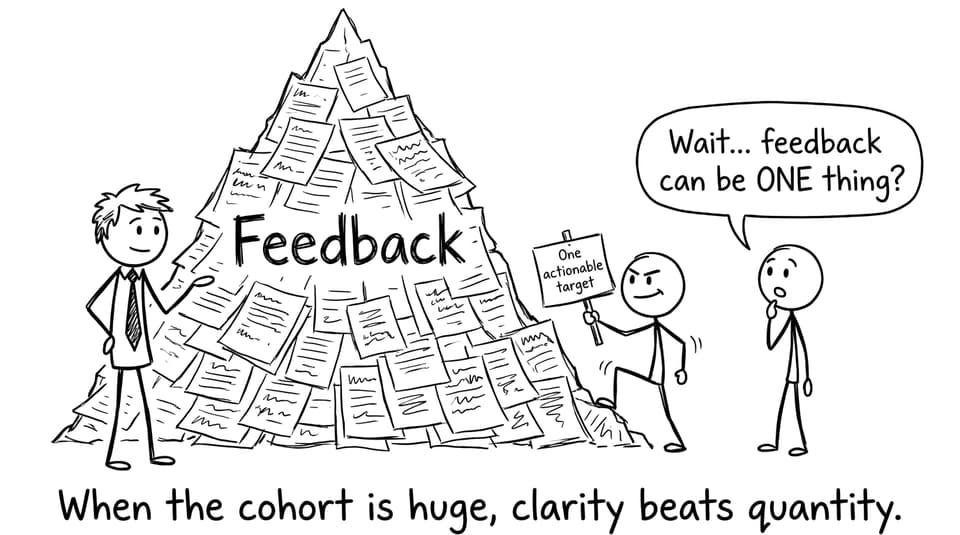
Ask for one actionable target per task, not “overall thoughts.”
-
Translate teacher comments into rubric language (criteria, command terms, evidence).
-
Keep a feedback log so repeated mistakes are obvious.
-
Use practice tools to create “evidence” of progress before you ask again.
-
Request 5-minute check-ins with a specific agenda.
-
If your school uses RevisionDojo for Schools, use its analytics and feedback history to walk into meetings prepared.
Why big IB cohorts break feedback (and how great teachers prevent it)
Large cohorts create a predictable problem: the teacher’s attention gets pulled toward whatever is loudest and most urgent. That usually means deadlines, Internal Assessments, and students who ask first.
In IB, the workload is also unusually “feedback heavy” because you’re not only learning content. You’re learning how to perform under criteria: analysis, evaluation, command terms, structure, referencing, reflection. Those skills require targeted response, not just a mark.
So the best teachers don’t try to write more. They design feedback to be:
-
Repeatable (so you can recognize patterns)
-
Comparable (so you can see what changed over time)
-
Actionable (so you can do something tonight)
If your teacher is doing this well, your job as an IB student is to meet them halfway: treat feedback like data, not like a verdict.
Standardized frameworks that still feel personal in IB
A paradox: the feedback that feels most personal often comes from the most standardized system.
Teachers who manage large IB cohorts well usually lean on:
Criterion-linked comments
Instead of “good work,” you’ll see something like: “Your evaluation is present, but it isn’t weighing limitations against your conclusion yet.” That’s not just a comment. It’s a direction.
Comment banks with sentence stems
When used properly, these don’t make feedback robotic. They keep it consistent. Consistency is what lets you compare Draft 1 to Draft 3 without guessing what the teacher meant.
Coded targets
A teacher might use short codes (like “ARG” for argument, “EVAL” for evaluation, “TERM” for command terms). It saves time, but it also trains you to notice your recurring weaknesses.
If you want to practice “reading” feedback like an examiner would, the IB practice loop inside RevisionDojo helps: use Study Notes to clarify the idea, then drill it in the IB Question Bank guide so your next submission shows visible change.
Rotating feedback focus: why it works for IB students
Students often want comprehensive feedback every time. Teachers with big IB cohorts know that’s a trap.
Instead, they rotate focus areas across cycles. One week you get structure. Next time you get analysis. Later, referencing. Over time, you end up with complete coverage, but your teacher stays sane.
As a student, you can make this strategy even more powerful:
-
When you submit, write a one-line request: “Please focus feedback on my evaluation in Criterion C.”
-
After you receive comments, do one short practice set that targets that same weakness using the RevisionDojo app workflow.
That’s how you turn rotating feedback into compounding improvement in IB.
Peer and self-assessment that doesn’t waste your time
Peer feedback gets a bad reputation because students are rarely trained to do it well.
But in large IB cohorts, good peer review is how teachers protect time for the moments that truly require expertise (like IA supervision, moderation, and high-stakes writing).
The best version is structured:
-
You use simplified rubric language.
-
You give “two stars and a step.”
-
You check command terms explicitly.
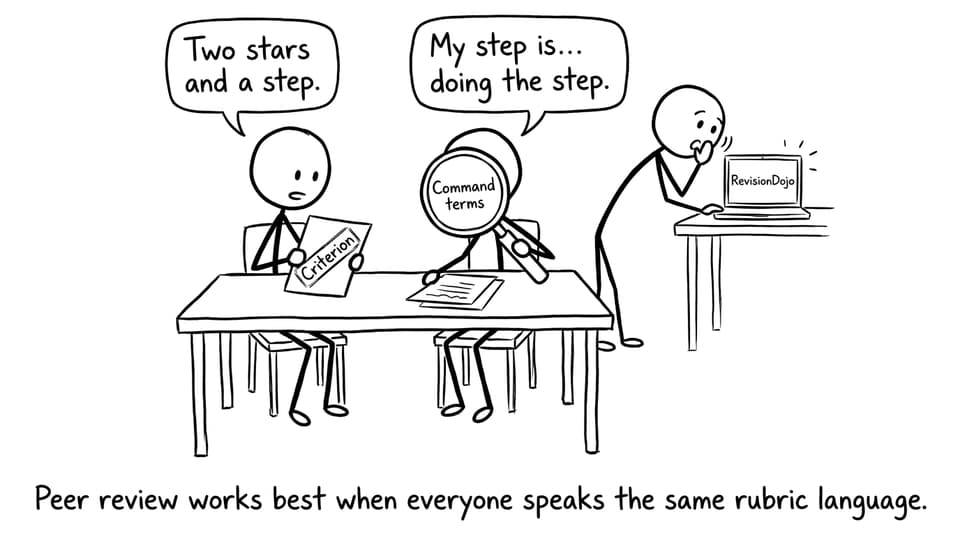
If you want to sharpen the skill fast, use RevisionDojo’s IB Flashcards to lock in command-term meanings and common criterion phrases. When everyone shares the same vocabulary, peer review stops being opinion and starts being useful IB feedback.
The underrated power of five-minute conferences
Written marking scales poorly. Conversations scale better.
In large IB cohorts, teachers who protect individual feedback often schedule short, structured conferences instead of writing long paragraphs on every task.
A high-impact 5-minute check-in usually covers:
-
What changed since last time (evidence, not vibes)
-
One bottleneck (the single thing slowing progress)
-
One next step (something you will do before the next deadline)
Bring data into that meeting. If you’re using RevisionDojo, show your practice history, weak-topic analytics, or your latest attempts in the Questionbank. It makes your teacher’s job easier and your feedback more specific.
Technology that helps teachers personalize IB feedback at scale
The best classroom tech doesn’t replace teachers. It removes the parts of the job that shouldn’t require a human.
Platforms like RevisionDojo can reduce repetitive marking and give teachers faster insight into where the cohort is struggling. With RevisionDojo for Schools, teachers can track progress, assign targeted tasks, and use analytics to spot students who are quietly falling behind.
You’ll also see this show up as faster cycles:
-
More frequent low-stakes checks
-
Clearer feedback trends
-
Better targeted revision tasks
If you’re curious how this turns comments into action, read How RevisionDojo Makes IB Feedback More Actionable for Students and Strengthening Formative Assessment with RevisionDojo Feedback Tools.
Group feedback: how to benefit without getting lost
When many students share the same problem (weak evaluation, misread command terms, shallow examples), teachers will often give group feedback.
This is not “less personal.” It’s a time-saving move that frees space for true individual intervention.
As an IB student, the way to make group feedback personal is simple:
-
Identify which sentence in the group feedback describes you.
-
Write one “before and after” example.
-
Do a short timed block to test it.
Then, if you need more, ask for a micro-check-in with your before/after evidence.
The feedback log: where individual IB improvement actually lives
Most students treat feedback like something that happens to them.
High scorers treat it like something they store.
A feedback log is a running record of:
-
The comment (in teacher wording)
-
The underlying skill (in rubric wording)
-
The next step (in student wording)
-
The proof (what changed in the next task)
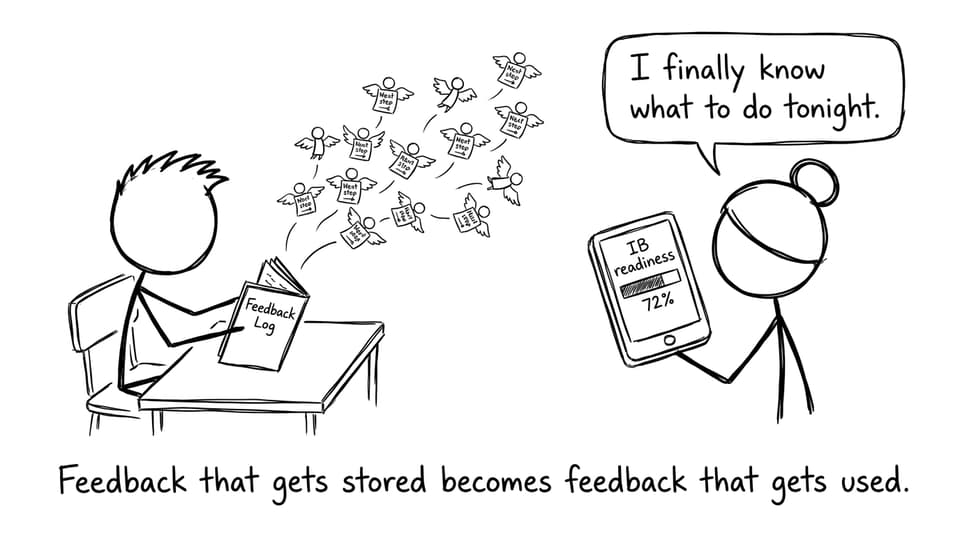
If your school is doing lots of coursework support, this becomes even more important. RevisionDojo’s coursework ecosystem (including the Coursework Library and grading tools) can help you keep examples and targets organized, while How RevisionDojo Enhances IB Internal Assessment (IA) Feedback and Moderation shows what good systems look like.
FAQ
If my IB teacher has 100+ students, how can I still get individual feedback?
You get individual IB feedback by making your request small, specific, and easy to answer. Instead of asking, “Can you look over my whole essay?”, ask, “Can you tell me the one change that would raise my analysis by one band?” Bring evidence of effort: show your feedback log, or a short set of targeted practice you’ve done. Teachers can respond faster when they see you’ve already tried to fix something. You can also ask for a five-minute conference with a clear agenda and one paragraph to discuss. In many schools, tools like RevisionDojo for Schools make this easier because your teacher can see your progress patterns without digging through piles of paper.
What should I do when my IB feedback feels generic or copy-pasted?
First, translate the feedback into a skill and a task. If the comment says “more evaluation,” define what evaluation means in your subject and write one paragraph where you explicitly weigh limitations against your conclusion. Then run a quick practice loop: use notes to clarify, practice questions to apply, and reflection to check what changed. RevisionDojo makes that loop smoother by connecting Study Notes to Questionbank practice and review. When you resubmit or ask again, show the “before and after” so your teacher can be more specific. Generic feedback often becomes specific once you create a concrete draft-level problem to solve.
Can peer feedback really help in IB exam prep, or is it just busywork?
Peer feedback helps IB exam prep when it is structured around rubric language, not opinions. If your peer can only say “this is good,” it’s busywork. If your peer can say “your command term is ‘evaluate’ but you only described,” that’s useful. The best peer sessions have limits: two strengths, one improvement, and one concrete rewrite suggestion. You can make peer feedback stronger by learning the shared vocabulary through tools like IB Flashcards with spaced repetition. When the whole class uses the same criteria language, peer feedback starts scaling what the teacher would say anyway. It also trains you to self-mark, which is one of the most valuable exam skills in IB.
Closing: the IB advantage is not more feedback, but better loops
In large IB cohorts, the students who improve fastest aren’t the ones who receive the longest comments. They’re the ones who turn any feedback into a tight loop: understand the target, practice it, prove the change, then ask the next precise question.
RevisionDojo is built for that loop. Use the Questionbank to generate exam-style evidence, Study Notes to clarify gaps, Flashcards to keep recall sharp, AI Chat to unblock confusion, Grading tools to learn how marks are awarded, and Predicted Papers plus Mock Exams to rehearse under pressure. When your teacher is managing a crowd, that system helps you stay visible, not by demanding more attention, but by arriving with clearer proof of progress in IB.

