You can study for months, do hundreds of practice questions, and still end up one point short of your target. That’s the quiet heartbreak of the IB: sometimes the difference between “made it” and “almost” isn’t a whole subject; it’s the core.
In the IB Diploma Programme, “bonus points” are not a myth or a teacher’s motivational phrase. They’re real points that can lift your final score when your six subjects are already doing their part.
What are bonus points in the IB?
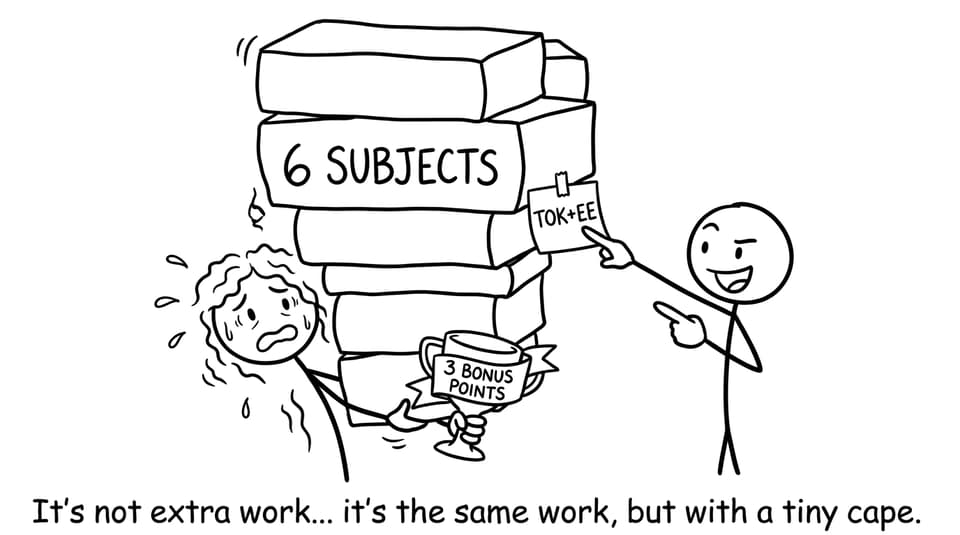
In the IB, bonus points (also called core points) are up to 3 extra points added to your total diploma score.
Here’s the simple picture:
-
You take six IB subjects, each graded 1 to 7 (max 42 points).
-
Your Theory of Knowledge (TOK) and Extended Essay (EE) combine to give 0 to 3 bonus points.
-
That creates the familiar maximum IB score of 45.
If you want the full scoring system laid out cleanly, RevisionDojo’s guide on how IB points work is a helpful one-tab reference.
How are IB bonus points calculated?
Bonus points in the IB come from a matrix that combines your final grades in:
-
TOK (A to E)
-
EE (A to E)
Different combinations award different outcomes: 0, 1, 2, or 3 points.
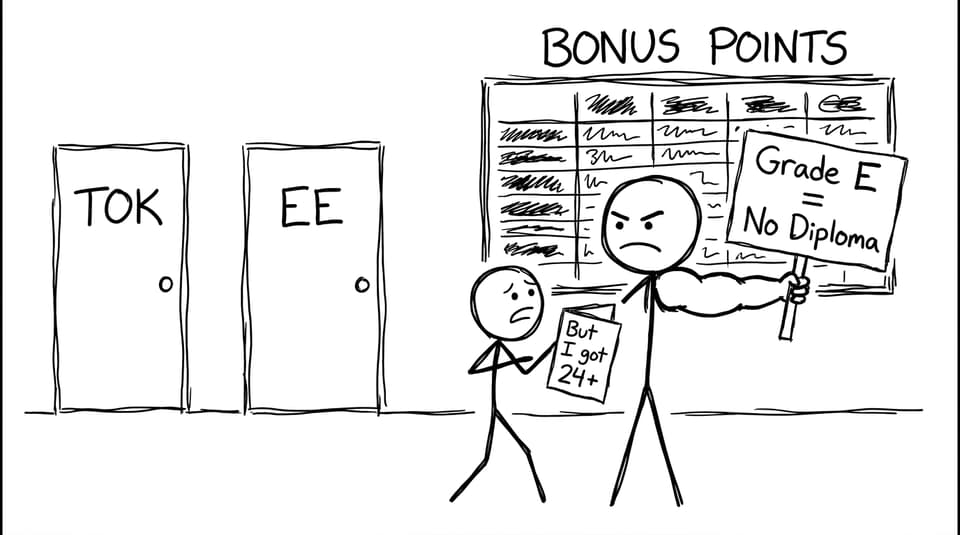
The part students underestimate is the rule underneath the matrix: a grade E in TOK or EE can mean no diploma, even if your subject total looks “safe.” For TOK specifics, see IB TOK requirements explained. For a deeper dive into how EE affects scoring, read how the EE adds points to your IB Diploma score.
How to earn the full 3 bonus points in IB
While the matrix has multiple paths, the most common ways students reach 3 core points are:
-
A in TOK + A or B in EE
-
A in EE + A or B in TOK
-
B in TOK + B in EE
Notice what this implies: you don’t need perfection, but you do need consistency. In the IB, bonus points reward students who can do two things at once: think clearly (TOK) and research carefully (EE).
A practical checklist for better TOK and EE grades
Use this as a weekly reset when you feel behind:
-
For TOK: choose two real-life examples you can explain in detail (not just name-drop).
-
For TOK: write claim + counterclaim for each example, then evaluate which is stronger.
-
For EE: tighten your research question until it’s answerable in 4,000 words.
-
For EE: add evaluation, not just description (what does the evidence prove and what can’t it prove?).
-
For both: get feedback early, when changes are cheap.
For TOK structure support, use Structuring for Success in IB TOK Essays and Comprehensive Guide to IB TOK Essay Structure. For EE planning, start at the IB Extended Essay Guides hub.
Why IB bonus points matter more than they look
In the IB, three points is rarely “just three points.” It can be:
-
the cushion that takes you from a risky total to a diploma-safe total,
-
the jump from a strong score to a scholarship-competitive one,
-
or simply the difference between meeting a conditional offer and negotiating for time.
More importantly, TOK and the EE shape the skills that show up everywhere in the IB exams: making an argument, choosing evidence, and explaining limits.
How RevisionDojo helps you earn IB bonus points
RevisionDojo is built for the full IB loop, not only subject revision. When TOK and EE get stressful, students usually need structure and fast feedback.
You can use:
-
Study Notes and Flashcards to keep subject content moving while coursework runs in the background
-
The Questionbank to protect your subject points (the 42 still matter)
-
AI Chat to unstick arguments, examples, and evaluation
-
Grading tools and the Coursework Library to improve TOK/EE drafts with rubric-aware guidance
-
Tutors when you need a human to diagnose what’s actually holding your core marks back
If you’re rebuilding your routine, this guide on how to study for IB exams without burning out pairs well with core work.
Final takeaway: treat IB bonus points like part of your score, not a “bonus”
In the IB, bonus points are only worth three points on paper. In real student life, they’re often the points that change your ending.
If you want the calmest path, build a system: protect your subject grades with RevisionDojo’s Questionbank, keep recall alive with Flashcards, use AI Chat when you get stuck, and tighten TOK/EE drafts with Grading tools and the Coursework Library. Then, when results day arrives, you won’t be hoping for bonus points; you’ll know you earned them.