

Starting IB Math AA can feel strangely disorienting. You may understand every classroom example, finish the assigned exercises, and still freeze when a test changes the wording or combines two familiar ideas.
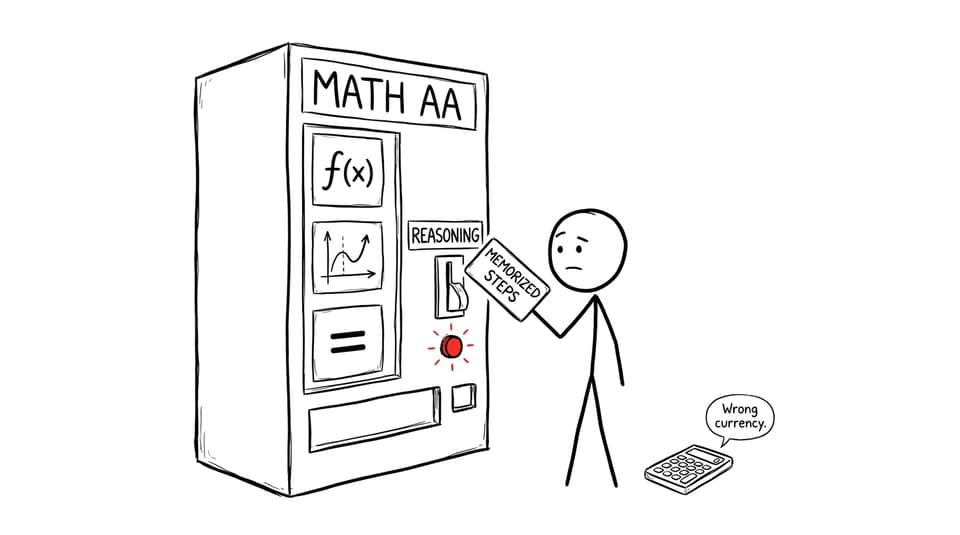
That is the biggest of the IB Math AA first term struggles: the course expects you to choose and justify a method, not merely reproduce one. The adjustment is less about suddenly encountering impossible mathematics and more about learning to transfer familiar knowledge into unfamiliar situations.
The good news is that transfer can be trained. During your first term, concentrate on algebraic fluency, method selection, written reasoning, and honest analysis of mistakes. Those habits create a foundation for everything that follows.
The first-term adjustment checklist
Use this checklist before concluding that you are simply “bad at Math AA.”
- Check whether algebra, indices, equations, and function notation are genuinely secure.
- Practise questions that do not announce the required method.
- Write enough working to make your reasoning visible.
- Record the first incorrect decision, not only the final wrong answer.
- Reattempt mistakes without looking at the solution.
- Ask for help when the same weakness appears three times.
The IB Math AA resource hub can keep this process organized by topic and level, rather than leaving you to collect disconnected explanations.
Why IB Math AA feels different so quickly
Official IB course expectations emphasize problem-solving, mathematical communication, inquiry, and reasoning in familiar and unfamiliar contexts. That changes what it means to “know” a topic.
Suppose you have learned how to solve a quadratic equation. A routine exercise might tell you to factorize. A more demanding question may describe intersections between a line and a curve, leaving you to form the quadratic, decide how to solve it, and interpret the roots. The underlying algebra has not disappeared. It has been hidden inside a decision.
This is why students often describe the course as moving too fast even when the individual lessons look manageable. Their procedural knowledge may be adequate, but each new chapter increases the number of methods they must distinguish between.
The shift is especially visible in functions. Students must move between equations, graphs, domains, transformations, and compositions without treating them as separate subjects. The beginner’s walkthrough to IB Math AA functions is useful when notation feels familiar but its meaning remains uncertain.
Recognizing the real source of your struggle
A disappointing first test does not tell you what needs repairing. You need a more precise diagnosis.
| What happens | Likely cause | Best response |
|---|---|---|
| You cannot begin | Method-selection gap | Label the known information and possible target |
| Your approach is right but collapses | Algebraic fluency gap | Drill the exact manipulation separately |
| Your answer is correct but loses marks | Communication gap | Show substitutions, restrictions, and conclusions |
| You understand solutions but cannot repeat them | Passive-learning gap | Close the solution and reconstruct it from memory |
The most expensive mistake is responding to every weakness by rereading notes. Notes help when a concept is unclear. They do little when the real problem is choosing a method under pressure.
A better starting point is the Number and Algebra topic hub. If rearranging expressions, manipulating fractions, or handling indices consumes too much attention, later reasoning becomes harder because your working memory is occupied by basic operations.
Adjusting to IB Math AA through deliberate transfer
Transfer improves when practice contains variation. Doing ten nearly identical exercises can build speed, but it may also teach you to react to superficial clues. Mixed questions force you to ask a more valuable question: What mathematical structure is present here?
For each problem, pause before calculating and write three short prompts:
- Given: What information or relationship do I have?
- Wanted: What must I find, prove, or interpret?
- Bridge: Which concept connects the two?
For example, if a problem gives two graph intersections and asks about a parameter, the bridge may be simultaneous equations or the discriminant condition . Naming that bridge is the central act of mathematical problem-solving.
Use the Math AA Questionbank to practise one subtopic first, then add a few questions from earlier material. RevisionDojo’s Grading tools can help you inspect the quality of your working, while AI Chat is most useful when you request a hint or ask why a method applies instead of immediately requesting a complete solution.
A first-term routine that actually repairs weaknesses
A sustainable routine is more useful than a heroic weekend. Aim for four focused sessions each week, adapted around your school workload.
Learn and reconstruct
Read a short section of Study Notes and follow one worked example. Then close the explanation and reproduce the reasoning unaided. If you cannot explain why one line follows another, the method is not yet secure.
Practise one skill with variation
Complete 5-8 questions on the same concept, but avoid choosing only identical formats. The Functions Questionbank, for example, lets you move across notation, graphs, inverses, and transformations while staying within one connected topic.
Build an error log
For every meaningful mistake, record:
- the earliest incorrect line;
- whether the cause was concept, algebra, interpretation, notation, or time;
- one repair rule;
- the date you will reattempt the question.
“Careless mistake” is rarely a useful diagnosis. “Expanded incorrectly because I skipped the middle term” gives you something concrete to change.
Revisit old material
Once a week, complete a mixed 20-30 minute set. This prevents the first unit from fading as the class moves forward. RevisionDojo Flashcards can support definitions and method triggers, but questions must remain the centre of mathematical study.
For a broader weekly structure, follow this IB Math study routine for busy students or review the recommended order for studying IB Math topics.
What not to do during the first term
Do not respond to one poor result by jumping immediately into full Mock Exams or Predicted Papers. Those tools become valuable when you have enough syllabus coverage to practise timing, stamina, and method selection across topics. Early in the course, short targeted sets usually provide clearer feedback.
Do not copy model solutions line by line. Recognition creates a comforting illusion of understanding. Instead, read one step, hide the solution, and predict the next step before checking.
Finally, do not let a repeating gap remain unnamed. If the same issue survives several correction cycles, use a RevisionDojo Tutor for focused human support. Save the Coursework Library for guidance when your mathematical exploration begins, rather than allowing coursework concerns to distract from first-term foundations.
The goal is not to avoid struggle
The first term is often the first time mathematics asks students to become decision-makers rather than procedure-followers. That can feel like lost confidence, but it is usually evidence that the nature of the work has changed.
Your task is to make that change visible. Strengthen the algebra underneath the course. Practise choosing methods. Show your reasoning. Revisit mistakes until the repaired method works without assistance.
RevisionDojo is the ultimate IB resource for running that cycle in one place: Study Notes and Flashcards establish knowledge, the Questionbank tests transfer, AI Chat and Grading tools explain weak decisions, and later, Mock Exams, Predicted Papers, the Coursework Library, and Tutors support the next stage. The adjustment becomes manageable once every difficult question leaves behind a useful lesson.