

Functions are the quiet characters that appear in every chapter of IB Math AA. You meet them early, you think you understand them, and then they show up later wearing a disguise: an inverse, a transformation, a trig model, a derivative question that suddenly asks about “behavior.”
Most IB students don’t struggle because functions are complicated. They struggle because functions are everywhere and the brain tries to store them as a list of shapes instead of a single idea: a relationship.
Here’s a beginner-friendly walkthrough of functions in IB Math AA that stays conceptual but still feels exam-useful. And if you want a structured path, RevisionDojo’s topic hub for IB Math AA Functions links Notes, Flashcards, Videos, and the Questionbank so you can move from understanding to marks without guessing what to do next.
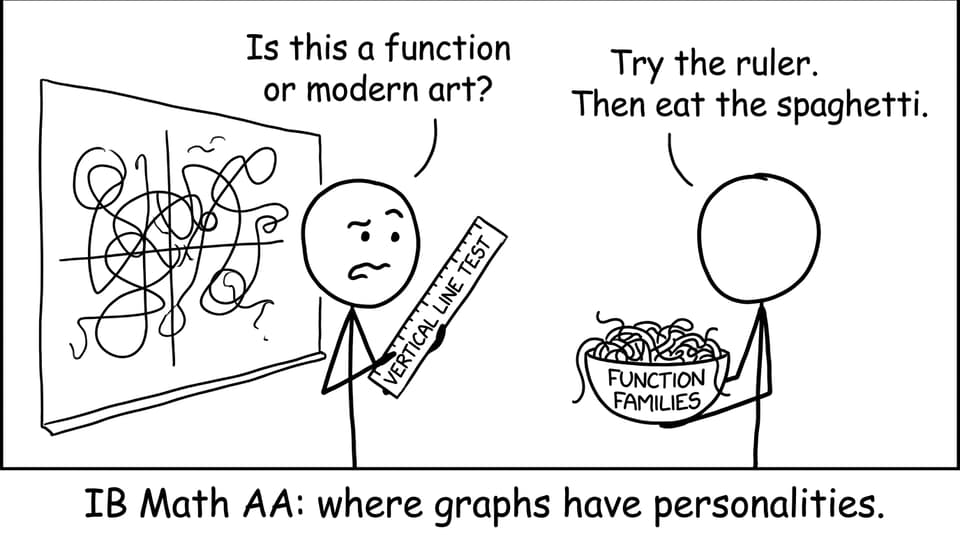
Quick overview checklist (do this before you revise)
If you want functions to stop feeling slippery, use this small IB routine:
-
Open the Functions topic hub and pick one subtopic (not five).
-
Learn the core definition: input, output, domain, range.
-
Practice reading graphs before solving algebra.
-
Drill one skill set (transformations, inverses, or compositions) in the Questionbank.
-
Finish with 5-minute Flashcards review to lock in terms and notation.
RevisionDojo makes that loop easy because the platform threads together Study Notes, Flashcards, AI Chat, and Grading tools so each revision session ends with a clear next step.
What a function is (and why IB cares)
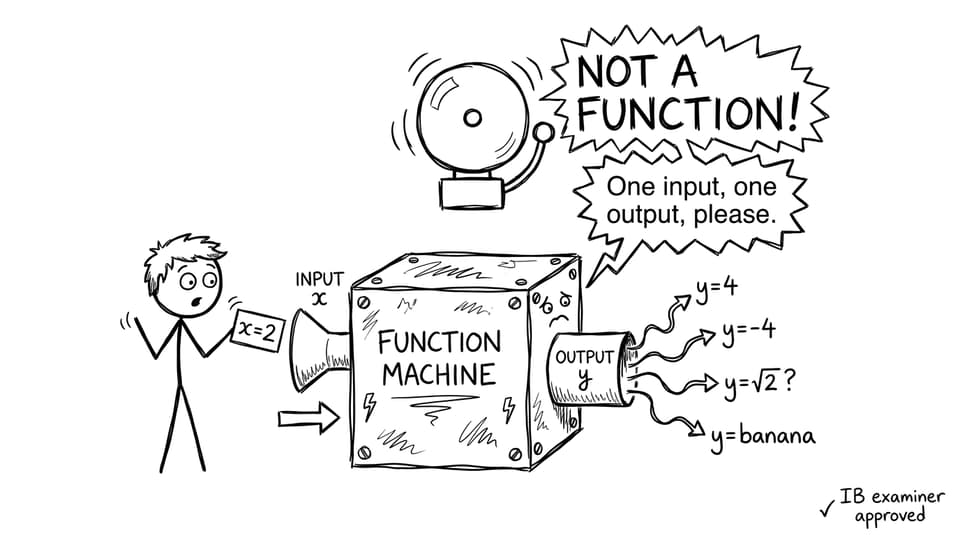
In IB Math AA, a function is a rule that assigns each input to exactly one output.
-
Input is usually (x)
-
Output is usually (y) or (f(x))
Example:
[
f(x)=2x+3 \quad \Rightarrow \quad f(2)=7
]
That definition sounds small, but it’s a power tool. Once you trust “one input gives one output,” you can:
-
interpret graphs confidently,
-
restrict a domain to make an inverse possible,
-
describe behavior (increasing/decreasing),
-
connect straight into calculus.
A quick test the IB loves is the vertical line test: if a vertical line hits a graph more than once, you’ve found an input with multiple outputs, so it’s not a function.
The function families you must recognize in IB Math AA
The IB doesn’t expect you to memorize every possible curve. But it does expect instant recognition of the common families and their key features.
Linear and quadratic functions
-
Linear: constant rate of change, straight line, gradient (m).
-
Quadratic: parabola, turning point, axis of symmetry.
These are the “grammar” of graphs in IB Math AA. If you want formulas in one place for quick exam recall, RevisionDojo’s IB Math AA Data Booklet is a clean reference that pairs well with practice.
Exponential and logarithmic functions
These show up constantly in modeling, solving equations, and inverse relationships.
A smart way to learn them is together: exponentials and logs are like two doors in the same hallway, one opening in and the other opening out. For targeted coverage, use SL 2.9 Exponential and logarithmic functions.
Trigonometric and rational functions
Trig is where transformations become unavoidable, and rational functions are where domain restrictions stop being optional.
If you want exam-style trig graph practice, the circular functions unit is a good crossover: SL 3.7 Circular functions: graphs, composites, transformations.
Domain and range: the marks students donate for free
Domain and range are not “extra details” in IB Math. They’re where a lot of method marks live.
-
Domain: all allowed inputs (x)
-
Range: all possible outputs (y)
Example:
[
f(x)=\sqrt{x-2}
]
You must have (x-2\ge 0), so the domain is (x\ge 2). The range is (y\ge 0).
This matters because later, inverses and composite functions often fail unless the domain is restricted. If you want question sets specifically built around this skill, go straight to SL 2.2 Functions, notation, domain, range and inverse as reflection (Questionbank).
Transformations: the IB “spot the difference” game
Transformations are how IB Math AA tests whether you read functions as relationships rather than pictures.
Here are the core moves:
-
Vertical shift: (f(x)+c) moves up/down.
-
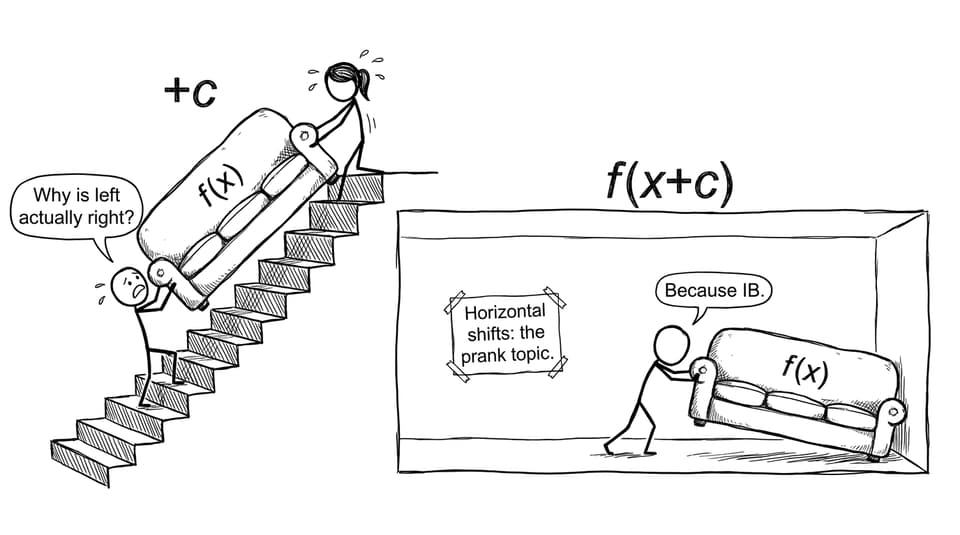
Horizontal shift: (f(x+c)) moves left/right (this is the one that tricks people).
-
Reflection: (-f(x)) flips in the (x)-axis, (f(-x)) flips in the (y)-axis.
-
Stretch/compression: (af(x)) vertical scale; (f(bx)) horizontal scale.
The fastest way to make these stick is to practice “predict then check”: predict the movement, then verify with two quick points.
RevisionDojo’s SL 2.11 Transformation of functions is a good place to revise the rules, then immediately apply them.
Inverses and compositions: where functions become a system
Once you’re comfortable with single functions, IB Math AA starts asking what happens when functions interact.
Inverse functions
An inverse function “undoes” a function.
-
Swap (x) and (y)
-
Solve for (y)
-
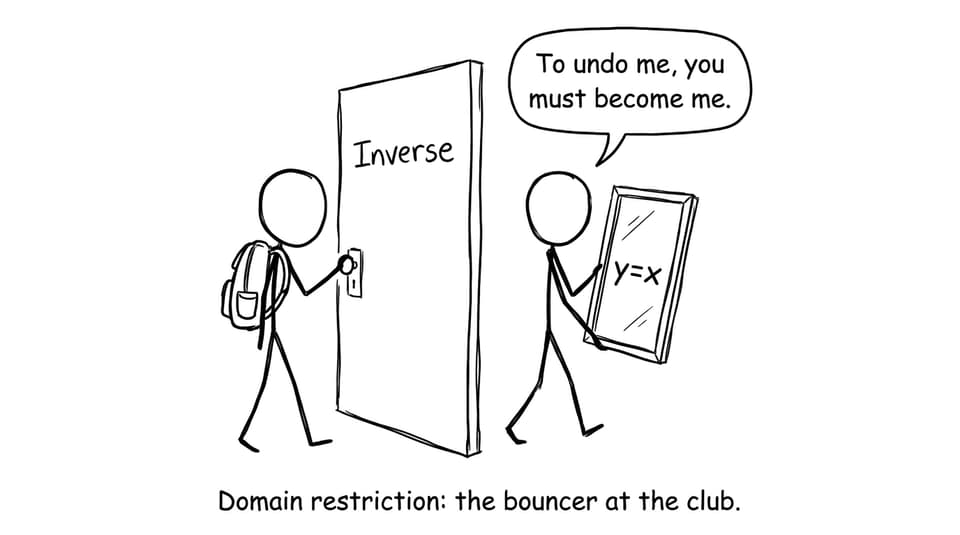
Restrict the domain if needed so the inverse is still a function
The graph idea is just as important: an inverse reflects in the line (y=x). That’s why domain and range switch roles.
Composite functions
Composition is plugging one function into another:
[
(f\circ g)(x)=f(g(x))
]
Example:
If (f(x)=2x+3) and (g(x)=x^2), then (f(g(x))=2x^2+3).
At higher levels, these questions become about domain restrictions and “what is defined where.” That’s exactly the kind of precision IB examiners reward.
Why functions are the doorway to calculus in IB
A lot of IB students feel like calculus is a separate world. It isn’t. Calculus is basically a new way to talk about how functions behave.
-
Differentiation asks: how fast is the function changing?
-
Integration asks: what total change or area builds up under the function?
Even before heavy calculus, you’ll be asked to describe increasing/decreasing behavior. If you want a clean bridge topic, use SL 5.2 Increasing and decreasing functions (Notes). And when you’re ready to drill, the Calculus Questionbank is perfect for building timed confidence.
A practice loop that works for IB exams
Understanding functions is necessary, but IB marks are earned through method and accuracy under time.
Try this 3-step loop (20 to 40 minutes):
-
Study Notes (8 minutes)
Pick one subskill (like domain restriction for inverses). -
Questionbank set (15 minutes)
Do 5 to 8 questions. Use timed conditions once you’re stable. -
Fix one mistake properly (10 minutes)
Write a one-line diagnosis: “I forgot to restrict the domain” or “I reversed the horizontal shift.”
RevisionDojo supports this style of practice because you can move from topic Notes to targeted Questionbank sets, then use AI Chat to explain a specific error in markscheme language. Add Flashcards at the end for quick retrieval practice, and you’ve got a system you can repeat all year.
Closing: make functions your calm topic
When IB Math AA feels heavy, functions are the place to rebuild confidence because they connect everything: algebra, graphs, trig, modeling, and calculus. If you can see a function as a relationship with a domain, a range, and a behavior, the syllabus stops looking like separate chapters and starts looking like one story told in different voices.
If you want that story organized for you, start with RevisionDojo’s IB Math AA Functions hub, then use the Questionbank and Mock Exams to turn understanding into exam performance. Add Flashcards for recall, AI Chat for quick explanations, and the Coursework Library and Tutors when you need deeper support. The goal is simple: fewer surprises on exam day, and more marks you can actually feel you earned.