

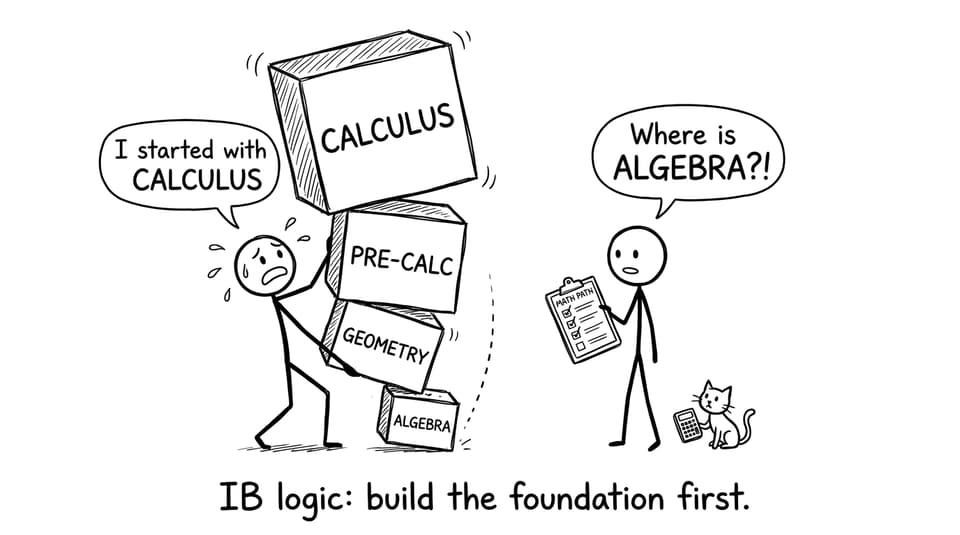
If you have ever sat down to revise IB Math and felt a strange kind of panic, it is often not because you are "bad at math." It is because you are trying to build the roof before the walls.
Most IB students don’t struggle with effort. They struggle with sequence. They jump into calculus because it feels important. They avoid algebra because it feels embarrassing. Then everything starts to wobble: the rules blur, the steps feel random, and even easy questions become slow.
This guide shows a calm, logical order for studying IB Math topics so each idea has something solid to stand on. Along the way, you will see how RevisionDojo turns that order into a real plan using Study Notes, Flashcards, Questionbank practice, AI Chat, Grading tools, Predicted Papers, Mock Exams, a Coursework Library, and Tutors.
Quick checklist before you choose your IB study order
Keep this short list open while you plan your week. It prevents the most common IB mistakes.
-
Confirm your route: Math AA or AI, SL or HL
-
List your topics (or open a topic hub and scan the headings)
-
Identify 2 foundations you will not skip (usually algebra and functions)
-
Decide your feedback loop: notes → practice → error log → re-practice
-
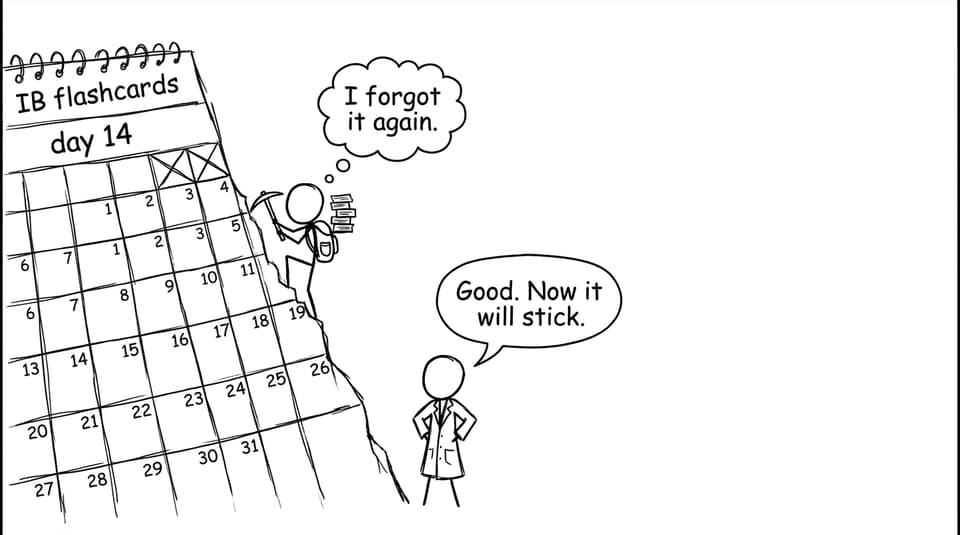
Schedule review loops every 10–14 days so earlier topics do not fade
For quick navigation, start at the International Baccalaureate (IB) hub and then jump into your exact course area.
Why the right order matters in IB Math
The IB does not reward memorising isolated steps. It rewards connected thinking.
A function question quietly tests algebra. A calculus optimisation question quietly tests functions and graphs. A statistics inference question quietly tests algebraic manipulation and interpreting context. When you study out of order, every question becomes a surprise quiz on prerequisites.
The right sequence does something underrated: it reduces cognitive load. You spend less mental energy asking, “What am I supposed to do?” and more energy executing.
The best order to study IB Math topics (the foundation-first sequence)
Different schools teach chapters in different orders. That is normal. But for revision, most IB students benefit from a foundation-first sequence that mirrors how skills depend on each other.
Start with number sense and algebra fluency
This is the grammar of IB Math. If it is shaky, everything feels harder than it should.
Focus first on:
-
indices, surds, and logarithms
-
factorising and expanding (including quadratics)
-
rearranging formulas and solving equations/inequalities
-
algebraic fractions and simplifying expressions
On days when motivation is low, do something simple but powerful: read a short section of Study Notes, then immediately do a small set of questions.
Use RevisionDojo’s course hubs to anchor this phase (and avoid random resources):
Then master functions and graphs
Functions are where IB Math stops being “just calculations” and becomes “thinking.” Graphs are the visual language of the course.
Your order here should be:
-
function notation, domain/range, inverse as a concept
-
transformations (shifts, stretches, reflections)
-
key features: intercepts, turning points, asymptotes
-
modelling with common families (linear, quadratic, exponential, etc.)
If you are in AI, you will see functions everywhere in modelling and technology work. If you are in AA, functions are the doorway to calculus.
RevisionDojo makes this easier because you can pair topic explanations with targeted practice:
Add sequences and series once algebra feels automatic
Sequences and series look innocent until they ask you to manipulate formulas quickly. That is why they belong after algebra and basic function skills.
Study order:
-
arithmetic sequences (nth term, sum)
-
geometric sequences (nth term, sum)
-
interpreting patterns and proof-style reasoning (especially AA HL)
A practical IB habit: convert the “trigger cues” into Flashcards (e.g., “When is it geometric?” “What does common ratio mean?”). Spaced repetition turns these into reflexes.
Move into geometry and trigonometry to build spatial reasoning
Geometry and trig are where many IB students lose time, not marks. The problem is usually not understanding -- it is hesitation.
Sequence:
-
coordinate geometry basics (gradient, midpoint, distance)
-
radians and arc length/sector area
-
trig ratios and graphs (sin/cos/tan)
-
identities and equation solving (more depth for AA)
When you practise, use the Questionbank to keep the difficulty rising slowly, not suddenly. Then ask RevisionDojo AI Chat to explain your exact error pattern (not just the answer).
Study calculus after functions and graphs are strong
Calculus is central to IB Math AA, and still important for AI. But calculus is only “hard” when the function skills underneath are weak.
A clean study progression:
-
limits and continuity (conceptual comfort)
-
differentiation rules and interpretation as slope/rate
-
applications: tangents, optimisation, kinematics-style contexts
-
integration as accumulation/area, then techniques and applications
RevisionDojo has both topic notes and focused question sets for this stage:
When you start timing practice, use Mock Exams to build stamina and the Grading tools to see where method marks leak away.
Add statistics and probability once algebra is comfortable
Statistics and probability are often the most “story-like” part of IB Math. The math is not always complicated, but the interpretation is.
Order:
-
descriptive statistics (mean, variance, standard deviation)
-
probability rules (including conditional probability)
-
distributions (binomial, normal where relevant)
-
inference, correlation and regression, and interpreting results
For AA students, start here:
For AI students, the AI Number and Algebra Questionbank is a good foundation anchor (because algebra still drives accuracy):
If you want a thoughtful angle on why IB rewards interpretation (and why marks disappear when you skip it), read: Why Does IB Care About Interpretation More Than Precision in Maths.
Finish with vectors and 3D reasoning (especially AA HL)
Vectors tend to feel “new” because they mix algebra with geometry. That is why they belong late in your revision order.
Sequence:
-
vector basics: magnitude, direction, unit vectors
-
vector equations of lines (and planes for HL)
-
intersections and geometric applications
If you are in AA HL, consider working with a Tutor for one session here. Vectors are often a confidence issue more than a knowledge issue.
How to turn the right order into a weekly plan (without burning out)
A strong IB plan has two gears: learning gear and consolidation gear.
-
Learning gear (60–70%): Study Notes → 10–20 targeted Questionbank questions → log mistakes.
-
Consolidation gear (30–40%): Mixed review sets across old topics + Flashcards.
A simple weekly rhythm:
-
Mon/Wed/Fri: one core topic block (e.g., functions or calculus)
-
Tue/Thu: one support block (e.g., algebra fluency or trig)
-
Weekend: one timed set + review loop
RevisionDojo’s Flashcards make the review loop realistic in busy weeks:
Common sequencing mistakes IB students make
These patterns show up every year.
-
Treating calculus as a starting point, not a destination built on functions
-
Doing probability before you can manipulate algebra cleanly
-
Avoiding weak topics until the final month (they do not magically improve under stress)
-
Revising only “chapters,” not connections (IB questions love connections)
-
Doing endless untimed practice without feedback from markscheme logic
If you recognise yourself here, the fix is not more hours. It is a better order, plus feedback. Use Questionbank explanations, AI Chat for error diagnosis, and Grading tools to see what the examiner would actually reward.
Closing: study IB Math like a story, not a lottery
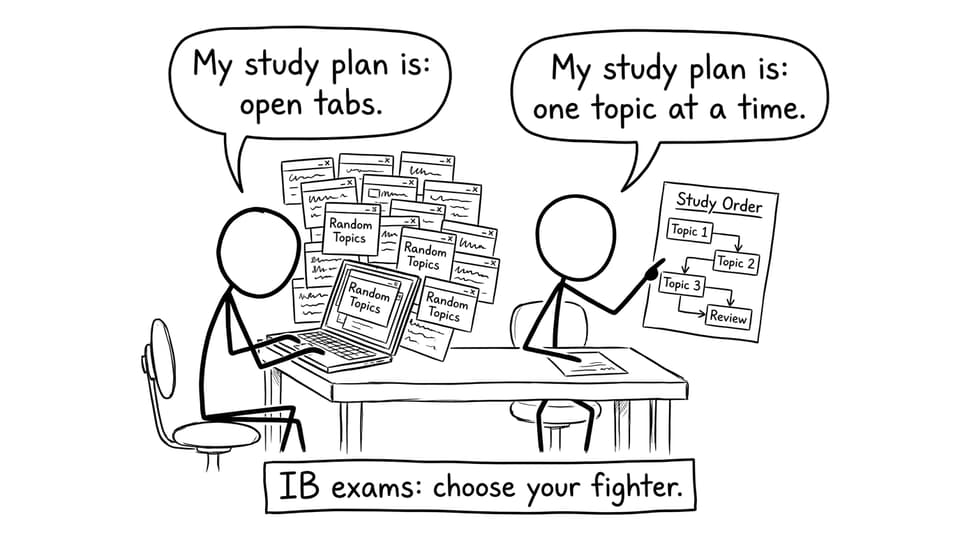
A good IB revision plan feels like turning pages in a book. Each chapter explains the next. A bad plan feels like pulling random topics from a hat and hoping the exam matches what you grabbed.
If you want the calmer version, build your sequence: algebra → functions → sequences → trig/geometry → calculus → statistics/probability → vectors, with review loops throughout. Then let RevisionDojo make it practical: Study Notes to learn, Flashcards to retain, Questionbank to apply, AI Chat to diagnose mistakes, Grading tools to tighten method marks, and Mock Exams and Predicted Papers to test readiness. When you need human guidance, the Coursework Library and Tutors keep you moving.
Open your course hub, pick today’s topic, and let the order do the heavy lifting. That is how IB Math becomes manageable -- and then, quietly, it becomes yours.