

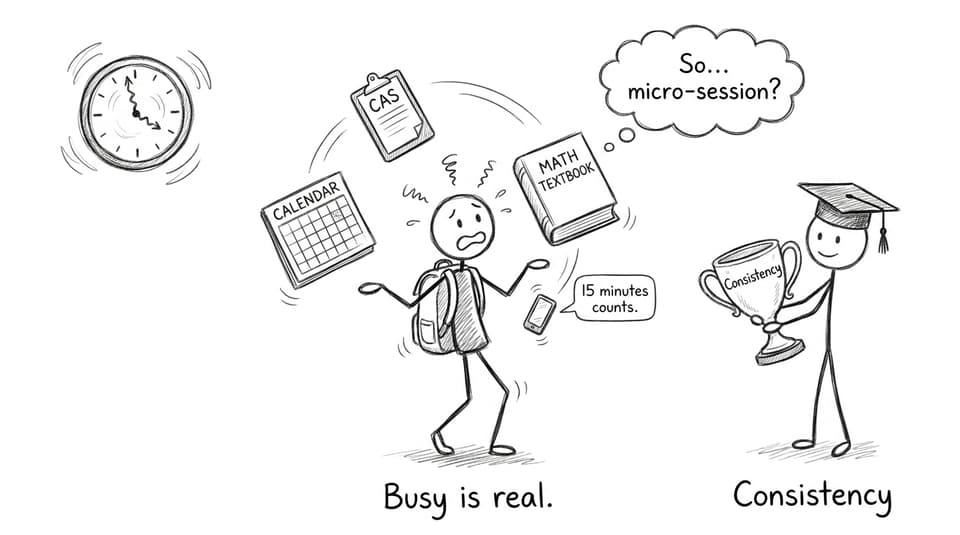
If you have ever opened your IB math book and felt your chest tighten, you are not alone. The strange part is that the overwhelm often shows up right when you are trying to do the responsible thing: revise. You look at the syllabus, remember your IA, CAS, and the other subjects, and your brain quietly decides there is no point starting.
That feeling is not a character flaw. In IB, it is usually a systems problem.
A busy student does not need a longer to-do list. They need a routine that survives real life: missed buses, late training, surprise quizzes, and the weeks where the calendar feels like it is leaning on your shoulders. This guide builds an IB math study routine that works in small pieces, compounds over time, and still leaves you with enough energy to think.
The 10-minute setup checklist (do this once)
Before you begin any IB routine, set the rails so you do not have to “feel motivated” each day.
-
Choose your course path: AA or AI, SL or HL (start from the right hub: IB Mathematics Analysis and Approaches Resources).
-
Pick your daily minimum: 25 minutes on weekdays, 45 minutes on one weekend day.
-
Identify 3 weak topics and 2 strong topics (you will rotate them).
-
Decide your loop: Notes to Flashcards to Questionbank.
-
Book one weekly exam rehearsal slot (even if it is short).
If you want one place to run the whole system, use RevisionDojo as your home base: Study Notes for clarity, Flashcards for recall, Questionbank for targeted practice, AI Chat for stuck moments, plus Grading tools, Predicted Papers, Mock Exams, the Coursework Library, and Tutors when you want extra structure.
The core idea: busy IB students win with micro-sessions
Most IB students try to revise math like it is a weekend event. But math is closer to a language: you keep it by touching it often.
A good IB routine is not about heroic study days. It is about lowering the friction so you can start in five minutes. When you can start, you can finish. When you can finish, you can repeat.
Here is the routine in one sentence:
Learn one idea, retrieve it from memory, then prove it with questions.
That is why the sequence matters.
Your daily IB Math routine (25-35 minutes)
This is designed for students who are genuinely busy. The goal is not to “cover everything” today. The goal is to build exam-ready habits that keep working.
Notes (8-10 minutes): learn the method, not the chapter
Start with one small concept from a clean explanation. If you are AI, this often means interpretation and modeling. If you are AA, it often means algebraic technique and calculus structure.
A helpful companion guide is How to Revise IB Math AA and AI Effectively, especially if you keep slipping into rereading.
If you are in Math AI and your understanding feels scattered, use How to Use RevisionDojo Notes to Simplify IB Math AI Concepts to build a tighter “explain it back” habit.
Flashcards (7-10 minutes): active recall, not recognition
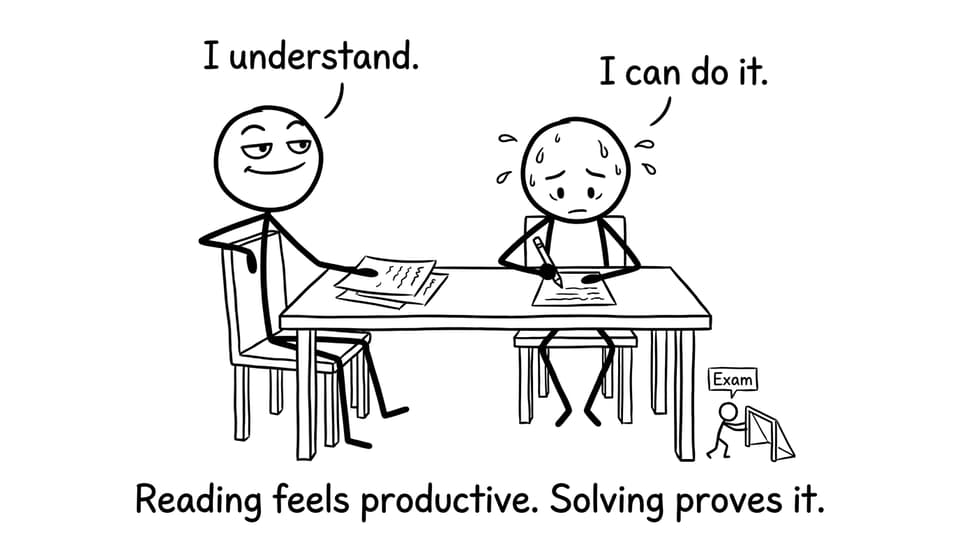
Flashcards are where busy IB students quietly pull ahead. You are training your brain to produce an idea on command, which is what exam pressure demands.
Do this:
-
Say the definition or formula out loud before flipping.
-
Write one line of meaning (what the formula does, not just what it is).
-
Flag anything that feels wobbly.
For a deeper system, use How to Use Flashcards to Learn IB Math Definitions. It is especially useful when your memory feels fine at home but collapses under time.
Questionbank (8-15 minutes): prove you can do it
End with questions. Always.
Two or three high-quality questions beat twenty rushed ones because you actually review the mistakes. Use IB Math: Targeted Revision Using the Questionbank as your template for choosing what to practice and how to learn from the markscheme logic.
The weekly IB rotation that prevents panic
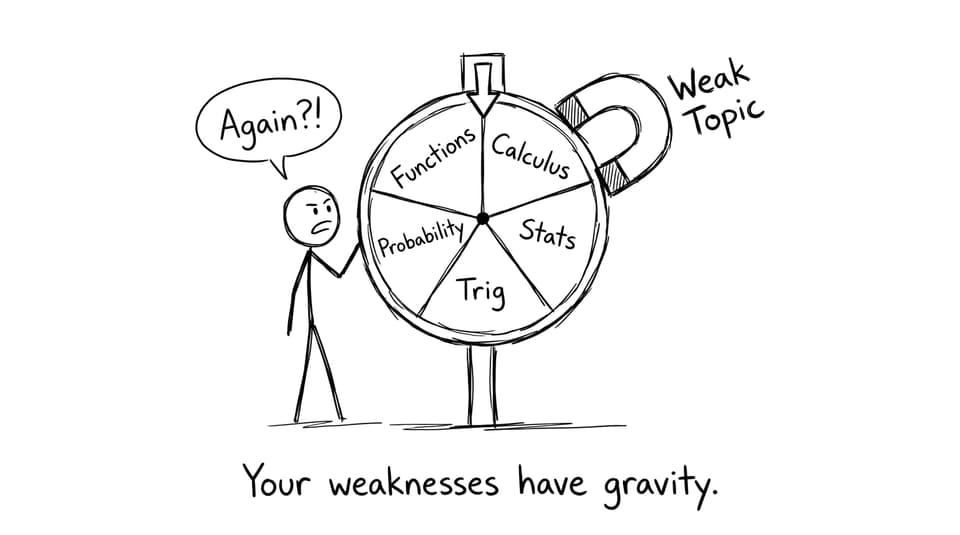
Busy students often revise whatever feels urgent. In IB math, that becomes a trap: you keep repeating comfortable topics and avoid the ones that cost marks.
Instead, rotate with intention.
Your 5-day topic loop
-
Day 1: Weak Topic A
-
Day 2: Weak Topic B
-
Day 3: Strong Topic (confidence + speed)
-
Day 4: Weak Topic C
-
Day 5: Mixed review (error log + old mistakes)
That rotation gives you repetition without boredom. It also makes the hard topics show up again before you forget them.
If you want examples of what “strong” topic work looks like (especially for high-level content), see How to Master IB Math AA HL Topics Efficiently.
The 45-minute weekend consolidation (the secret weapon)
Pick one weekend day. Make it boring. Make it repeatable.
Block A (15 min): Reattempt 4-6 questions you previously missed.
Block B (15 min): One focused note skim to reconnect the method (not a full reread).
Block C (15 min): Timed mini-set (even 10 minutes counts) + quick reflection.
This is where RevisionDojo feels like an IB advantage rather than “another resource.” You can move from Notes to practice to feedback without losing time searching.
Add exam simulation without burning your schedule
Most IB students wait too long to practice timing. Then the first time they feel pressure is the real exam.
Once per week, do a small simulation:
-
20-30 minutes timed
-
No interruptions
-
Review immediately afterward
To build those rehearsals, use How to Use RevisionDojo's Mock Exam Builder to Simulate IB Conditions. When you are closer to exams, layer in realistic full-paper practice using IB Predicted Papers by IB Examiners (Free) to train stamina and decision-making.
If you want a quick boost plan for the final stretch, keep 10 Quick IB Revision Hacks Before Math Exams bookmarked.
A simple error log that makes IB practice actually work
Here is the part most students skip.
After each session, write one line:
-
What went wrong?
-
Why did it go wrong?
-
What will I do next time?
That is it. No essays.
Over a month, your error log becomes a map of how you lose marks. And in IB math, fixing your personal patterns is often worth more than learning one more technique.
Closing: make your IB routine small enough to keep
The students who score well in IB math are rarely the ones who “found motivation.” They are the ones who built a routine that still worked on busy days.
Keep it simple: one idea, one recall session, a few questions, and a short review of what went wrong. Do that for long enough and your confidence stops being a mood and becomes evidence.
If you want the most efficient setup, open RevisionDojo and run the loop with Study Notes, Flashcards, and the Questionbank, then rehearse timing with Mock Exams and IB Predicted Papers by IB Examiners (Free). Your IB schedule will not get less busy, but your math can get calmer, clearer, and more automatic.