Join 650k+ students breezing through the IBReady to breeze through the IB?
Starting IB can make one decision feel larger than it really is. You are not merely choosing subjects. You are trying to predict which kind of student, university applicant, and working adult you might become.
Here is the direct answer: in the IB DP vs CP comparison, the Diploma Programme offers a broad academic curriculum built around six subjects and a shared core. The Career-related Programme combines at least two Diploma Programme courses with career-related study and a distinct four-part core. Neither programme is automatically better or easier. The right choice depends on whether you want broad academic preparation or a more applied route connected to a career field.
For new students, especially those entering IB DP1, the useful question is not, "Which programme sounds more impressive?" It is, "Which structure gives me the best environment in which to do sustained, meaningful work?"
IB DP vs CP at a glance
Feature
IB Diploma Programme
IB Career-related Programme
Main focus
Broad academic study
Academic and career-related learning
DP subjects
Six
At least two
Subject levels
Usually three HL and three SL, although four HL subjects are permitted
Available DP courses may be taken at HL or SL, subject to school provision
Core
Theory of Knowledge, Extended Essay, and Creativity, Activity, Service
Personal and professional skills, language and cultural studies, community engagement, and reflective project
Additional study
No separate career qualification required
A career-related study selected or provided by the school
Overall result
Diploma scored out of 45, subject to passing conditions
Career-related Programme Certificate based on completing its required components
Best suited to
Students seeking academic breadth and widely understood university preparation
Students who want academic study connected to a particular professional area
min read
min read
min read
min read
Your school determines which subjects and career-related studies are available. Before deciding, request its current course handbook rather than assuming every IB school offers the same combinations.
The IB Diploma explained
The Diploma Programme is designed for students aged 16-19. Its structure is deliberately broad: students study six subjects while completing three core components.
Students normally select one subject from each of the main subject groups, although permitted alternatives exist. At least three and no more than four subjects are studied at Higher Level, with the remainder at Standard Level. HL courses represent 240 recommended teaching hours, while SL courses represent 150.
The three DP core components are:
Theory of Knowledge, often called TOK, which examines how knowledge is produced, justified, and challenged
The Extended Essay, an independent research paper of up to 4,000 words
Creativity, Activity, Service, usually shortened to CAS, which requires ongoing experiences and reflection rather than a points score
Each subject receives a grade from 1 to 7, creating a maximum subject total of 42. TOK and the Extended Essay can contribute up to three additional points, so the highest possible diploma score is 45.
A total of 24 points is the minimum threshold for the diploma, but reaching 24 alone does not guarantee it. Students must also satisfy the IB's other passing conditions, including requirements covering core completion, grades, HL and SL point totals, and academic integrity. RevisionDojo's guide to how the IB works provides a broader introduction, while its explanation of the minimum IB score for university separates diploma requirements from university offers.
A DP scoring example
Imagine that a student receives these final subject grades:
6+6+5+5+5+4=31
If their TOK and Extended Essay combination earns two additional points, the total becomes:
31+2=33
That calculation is simple. The deeper issue is balance. A student cannot safely neglect a difficult HL subject simply because the total appears healthy; all diploma passing conditions still apply.
How the Career-related Programme works
The Career-related Programme is not a shortened Diploma Programme. It has a different purpose and architecture.
CP students complete three connected elements:
At least two Diploma Programme courses
A career-related study
The four-component CP core
The DP courses provide academic depth. The career-related study provides applied learning in an area such as business, engineering, health, design, hospitality, or digital media, depending entirely on what the school offers. It may lead to a qualification from another awarding body, but the exact provider, assessment, and recognition vary by school and country.
The current CP core includes personal and professional skills, language and cultural studies, community engagement, and the reflective project. Personal and professional skills develops capabilities such as communication, ethics, and workplace readiness. Language and cultural studies develops linguistic and intercultural understanding. Community engagement connects sustained action with real community needs. The reflective project asks students to investigate and reflect on an ethical issue arising from their career-related study.
The IB assesses the reflective project, while schools assess the other three core components. DP courses retain their normal IB assessment structure. Unlike the Diploma Programme, however, the CP is not presented as one combined score out of 45.
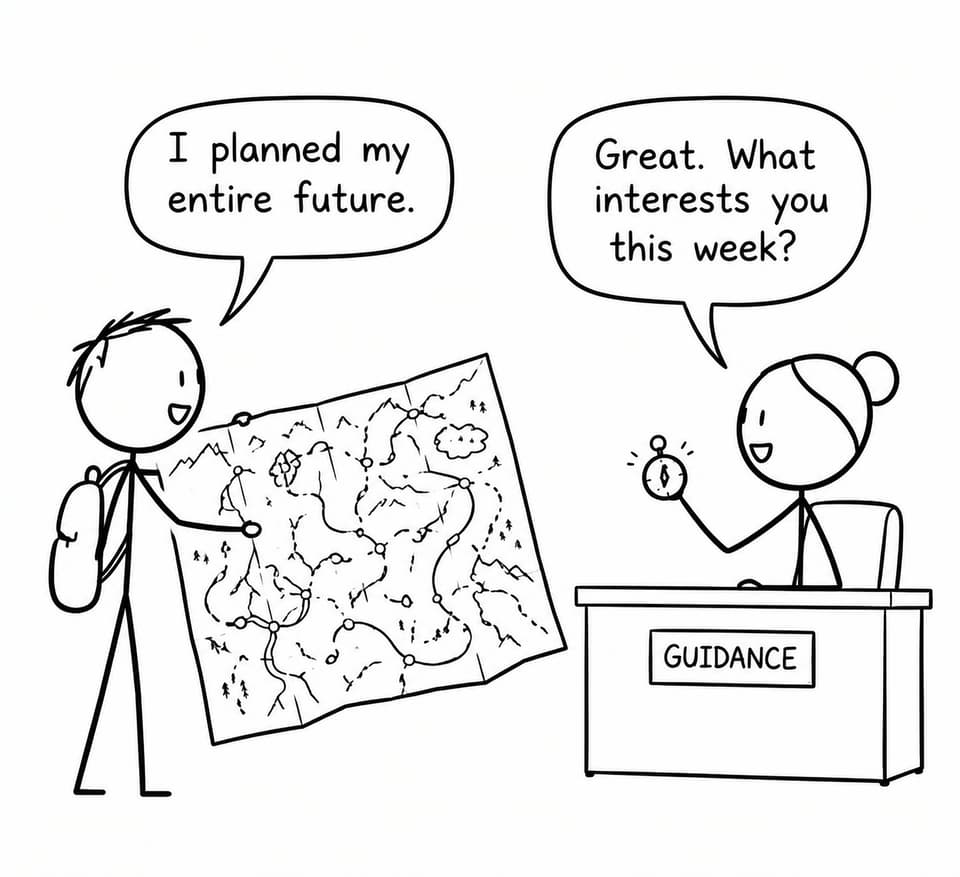
A student unfolds an enormous future map while an adviser asks what interests them this week
A CP pathway example
Consider a student interested in digital design. Their school might allow them to study DP Visual Arts and DP Business Management alongside a career-related qualification in creative media. Their reflective project could investigate an ethical issue connected to that field, such as manipulative interface design or the ownership of AI-generated work.
This is not an official subject combination or a universal CP package. It is an illustrative example of how academic courses, applied study, and ethical reflection can reinforce one another. The actual pathway depends on the school's approved provision.
Which programme is harder?
The honest answer is that difficulty takes different forms.
DP creates pressure through breadth. Six subjects compete for attention alongside TOK, the Extended Essay, CAS, internal assessments, and final examinations. A student may be strong in science but still need to manage languages, mathematics, and analytical writing.
CP reduces that particular kind of breadth, but it replaces it with integration. Students must manage DP coursework, career-related requirements, community engagement, and a substantial reflective project. Applied work also demands consistency, collaboration, and professional responsibility. Calling CP the easy option misunderstands what it asks students to do.
A useful comparison is to ask which type of difficulty fits you:
Do you enjoy moving among several academic disciplines?
Do you want to preserve a wide range of university options?
Do you learn best through theory, practical application, or a mixture?
Are you genuinely interested in the career-related study available at your school?
Can you verify that your likely universities recognize your proposed route?
University recognition and future options
The Diploma Programme is generally the more immediately understood route for broad university admission because it produces a standardized total and includes six subjects. Universities may publish an overall IB requirement, specific HL grades, or both.
CP recognition is growing, but policies differ among institutions, countries, and degree programmes. A university might accept the CP for one course while requiring particular DP subjects or an additional qualification for another. Highly regulated or subject-specific degrees can impose precise prerequisites regardless of which IB route you follow.
Do not rely on a general statement that a university "accepts IB." Check the exact degree page, the required qualifications, subject prerequisites, and entry year. If the policy is unclear, contact admissions with the full name of your career-related qualification and your intended DP courses.
For students still choosing, RevisionDojo's guide to changing IB subjects after year one explains why early corrections are usually safer than late ones. Its comparison of the MYP and DP is also useful if you are moving into the Diploma Programme from earlier IB study.
What IB DP1 students should do now
DP1 is a common school term for the first year of the Diploma Programme. It can feel forgiving because final examinations remain distant. In reality, the first year is where manageable habits either form or quietly fail to form.
Start with this checklist:
Confirm that your HL choices match likely university prerequisites.
Record every internal deadline in one calendar.
Create a weekly review block for each subject.
Practise retrieval and exam-style application, not only rereading.
Track grades by topic so that averages do not hide specific weaknesses.
Ask about subject changes as soon as a mismatch becomes clear.
If considering CP, verify the career qualification and university recognition in writing.
RevisionDojo can serve as the central system for that work. Its IB study features bring together the Questionbank, Study Notes, Flashcards, AI Chat, Grading tools, Predicted Papers, Mock Exams, Coursework Library, and Tutors. The purpose is not to use every tool every day. It is to choose the right tool for the next problem.
For example, use Study Notes and AI Chat to clarify a concept, then answer Questionbank problems without assistance. Use Grading tools to identify weaknesses in the response rather than treating the score as a verdict. Later, Predicted Papers and Mock Exams can help you practise complete assessment conditions, while the Coursework Library helps you study structure without copying another student's work. The IB Coursework Grader can then support criteria-based review of your own draft.
Make the choice around the work
Programme names matter less than daily fit. DP rewards students who can sustain broad academic attention. CP rewards students who want rigorous academic learning connected to an applied direction. Both require organization, reflection, and a willingness to improve work after feedback.
If you are already in DP1, begin by recording your current subject scores and the topics behind them. A free RevisionDojo account gives you one place to save that starting point, practise weak areas, and track how your score changes across the year. That is useful because progress rarely arrives as one dramatic leap. More often, it is a collection of small corrections that finally become visible.