
If you’ve ever asked, “How does IB work?” it’s probably because the program doesn’t just teach content; it teaches a way of thinking. And that can feel unsettling at first.
Most courses reward the student who remembers the most. IB also rewards memory, sure, but it adds something else: you’re expected to use knowledge under pressure, show judgment, and explain your reasoning in a way an examiner can reward. The moment you realize that, the program starts making sense. Not easier. Just clearer.
This guide breaks down how IB works (especially the Diploma Programme), how assessment and grading fit together, and how to study in a way that actually matches what IB exams demand.
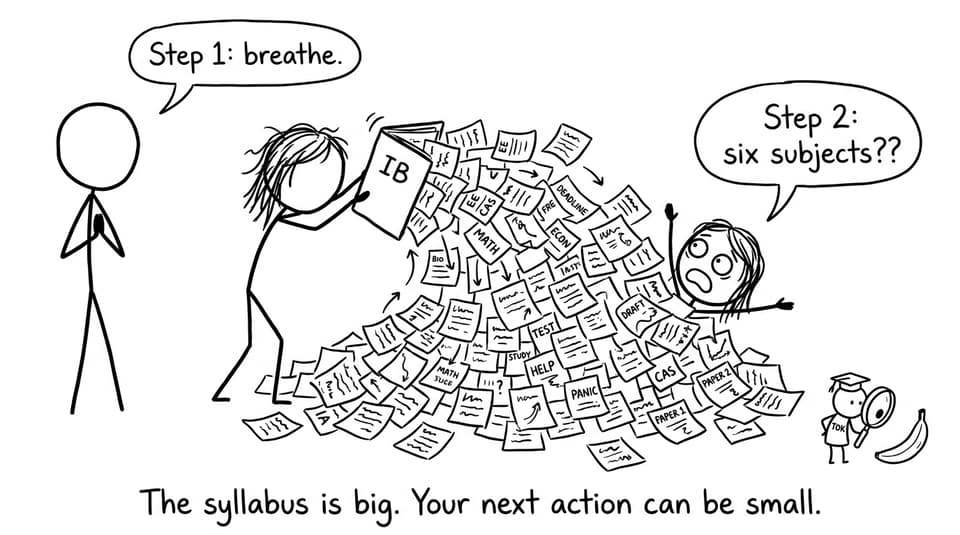
The IB in one page (quick checklist)
If you want the fastest mental model of IB, use this:
-
Pick six subjects across six groups (usually 3 at HL, 3 at SL)
-
Complete the core: TOK, EE, CAS (DP)
-
Do internal assessments (IAs) during the course (teacher-marked, externally moderated)
-
Sit external exams at the end (externally marked)
-
Earn points: 1-7 per subject (up to 42) + up to 3 bonus points from TOK/EE = 45 max
-
Diploma awarded if you meet requirements (including CAS completion) and reach the minimum points threshold
When students struggle with IB, it’s often not because they “didn’t study enough.” It’s because they studied in a way that didn’t match this structure.
How IB is structured (PYP, MYP, DP, CP)
The International Baccalaureate includes four programmes:
-
PYP (Primary Years Programme): ages 3-12
-
MYP (Middle Years Programme): ages 11-16
-
DP (Diploma Programme): ages 16-19
-
CP (Career-related Programme): ages 16-19
Exam-focused students usually mean the IB DP, because that’s where final exams, IAs, and the 45-point scoring system live.
For a broader overview of RevisionDojo’s IB coverage and tools, start at the International Baccalaureate hub or the RevisionDojo for IB page.
How the IB Diploma Programme (DP) curriculum works
The DP is built like a balanced meal. You can choose what you like, but you can’t only eat dessert.
The six subject groups in IB DP
In IB, you typically choose one subject from each group:
-
Studies in Language and Literature
-
Language Acquisition
-
Individuals and Societies
-
Sciences
-
Mathematics
-
The Arts (or a second subject from another group)
You usually take three Higher Level (HL) subjects and three Standard Level (SL) subjects. HL goes deeper and is assessed accordingly, which matters for time management and revision planning.
If you want to see how resources are organized by subject, explore a subject hub like IB Biology resources to get a feel for how IB content becomes notes, practice, and exam-style drills.
The IB core: TOK, EE, and CAS
The core is where IB gets its reputation for being “more than academics.” It’s also where many students quietly lose time.
-
TOK (Theory of Knowledge) trains you to ask: “What counts as knowledge here?” That habit shows up in essay-based subjects, even when the paper isn’t called TOK.
-
EE (Extended Essay) is a 4,000-word independent research project. It teaches you to think like a university student earlier than you expected.
-
CAS (Creativity, Activity, Service) isn’t graded with points, but it is required to earn the diploma.
The trick is to treat the core as scheduled work, not as background stress.
How IB assessment works (and why it feels different)
Assessment in IB is split into internal work (IAs and other coursework components) and final external exams. The weightings vary by subject, but a common pattern is that IAs contribute a smaller portion of the final grade, while exams contribute the majority.
Internal Assessments (IAs): what they are really testing
An IA is not just “a project.” In IB, it’s a controlled chance to show skills that exams can’t fully measure: investigation, communication, practical technique, oral analysis, or research design.
Most students underestimate IAs because they’re done at home or over weeks. But the best students treat IAs like a marks-based product. Every paragraph, data choice, and explanation has a job: earn criteria marks.
RevisionDojo supports this style of work through its Grading tools and Coursework Library (so you can see what strong criteria-aligned work looks like) and through AI Chat that helps you refine clarity and structure without losing your own voice.
External assessments: the exam you train for
External assessment is what most people picture when they say IB exams: timed papers, command terms, structured markschemes, and a style of writing that rewards precision.
This is where students often discover a hard truth: you can know the topic and still lose marks if your response doesn’t match what the question is asking.
That’s why deliberate practice matters. RevisionDojo’s Questionbank is built around exam-style IB questions with instant feedback, so your revision becomes a loop: attempt, review, fix, repeat.
How IB grading works (1-7, up to 45)
Every IB subject is graded from 1 to 7, with 7 as the highest.
-
Six subjects x 7 points each = 42 points max
-
TOK + EE combine for up to 3 additional points
-
Total maximum = 45 points
To earn the diploma, students must typically reach a minimum total (commonly 24 points) and satisfy additional requirements (including CAS completion and other conditions that can affect diploma eligibility).
The deeper point isn’t the number. It’s what the scale does to your decision-making.
In IB, you don’t need to be perfect. You need to be reliably good at the things examiners reward. That means:
-
answering the question in the language of the command term,
-
showing working and reasoning,
-
choosing examples and evidence that fit,
-
avoiding time traps.
A practical way to study for IB exams (without drowning)
Most IB students are not short on effort. They’re short on feedback loops.
Here’s a calm, repeatable structure:
Build understanding (notes-first, but briefly)
Use notes to clarify, not to comfort. RevisionDojo’s notes are designed for that: structured, syllabus-aligned explanations you can return to quickly.
-
Start with Digital IB Study Notes
-
Or browse the wider collection in IB Subject Note Collections
Then stop reading and switch to doing.
Build recall (small daily sessions)
Memory in IB isn’t optional. It’s just not sufficient on its own.
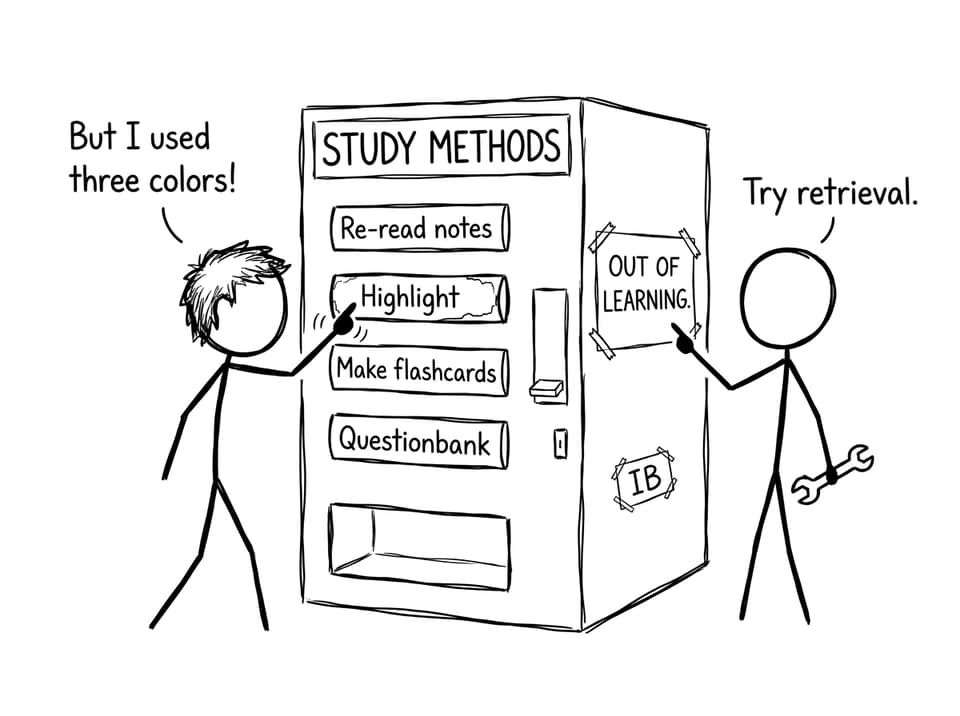
Use IB Flashcards with Spaced Repetition for short daily retrieval sessions, or explore how the system works in IB Flashcard System: Active Recall for Better Memory. The key is consistency: 7-12 minutes a day beats two-hour flashcard marathons that vanish after a week.
Build exam skill (Questionbank + feedback)
This is where grades move.
Use the Questionbank feature to filter by topic, drill weak areas, and learn the markscheme patterns. If you want a guided approach, read IB Question Bank: How to Use It Effectively.
Build stamina (Mock Exams + Predicted Papers)
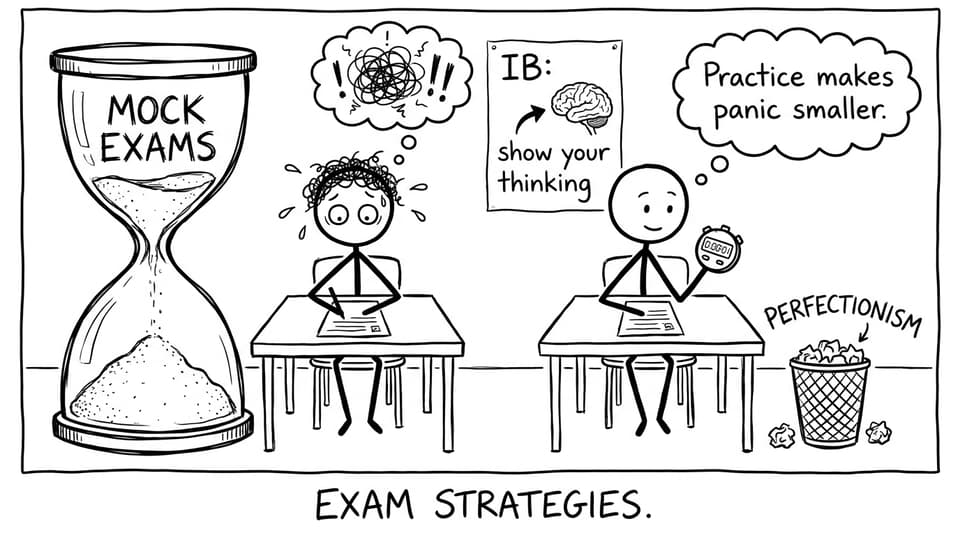
Stamina is a skill. And IB exams punish students who only practiced in “low-pressure mode.”
Use timed practice to make exam day feel familiar:
-
For strategy, use IB Predicted vs Specimen Papers: What They Mean
If you’re close to finals, the rhythm matters more than the heroics. A helpful companion is IB: The Last 2 Weeks Before Exams (What Matters).
When to get help (and what kind)
There’s a quiet mistake many high-achieving IB students make: they wait to ask for help until they’re already behind.
RevisionDojo’s AI Chat is ideal when you’re stuck on a concept at 11:43 p.m. and need a clean explanation or a markscheme-style example. But sometimes you need a human to watch how you think, spot the habit that’s costing marks, and correct it fast.
That’s where Tutoring on RevisionDojo fits, especially for exam technique, TOK/EE structure, and subjects where feedback makes the biggest difference.
If you’re curious how tutoring works on the platform, Top IB Tutors Worldwide: Access to the Best Educators is a useful overview.
Closing: the calm truth about how IB works
The most important thing to understand about IB is that it’s not a test of how much you can endure. It’s a test of how well you can build a system: six subjects, a core, deadlines, and exams that reward clear thinking.
When you study the IB the way it’s designed (using active recall, targeted question practice, and timed rehearsal), the program stops feeling like a fog. You can see what matters, what doesn’t, and what to do next.
If you want one place to run that whole system, RevisionDojo brings it together: Study Notes, Flashcards, Questionbank, AI Chat, Grading tools, Predicted Papers, Mock Exams, a Coursework Library, and Tutors when you want human support. Start at the RevisionDojo homepage and build your next small step today.