
The night before an IB exam has a particular kind of silence. Not peaceful silence--the kind where your brain starts flipping through memories like a messy drawer. You know you studied. You remember sitting at your desk for hours. But when you try to pull out the exact definition, method, or “why it works” explanation, your mind hands you… static.
That gap isn’t laziness. It’s design.
Most IB students were taught to treat notes like a record of learning. But long-term retention needs notes to behave like a machine for remembering: built to trigger recall, strengthen connections, and return at the right intervals. That’s where RevisionDojo comes in--because its Notes ecosystem connects naturally to Flashcards, the Questionbank, AI Chat, and timed practice so your studying doesn’t end at “I read it.”
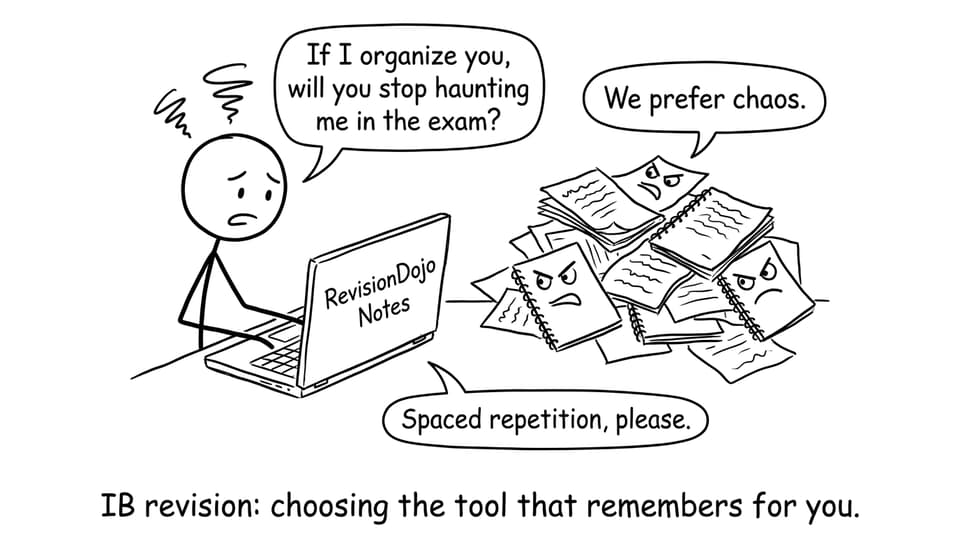
Quick retention checklist for IB students
Use this as your “don’t overthink it” setup before you write a single new page of notes:
-
Pick one IB subject and one topic (small enough to finish today).
-
Open RevisionDojo Study Notes as your reference spine.
-
Write your own “teach-it-back” summary (3--6 sentences).
-
Add one worked example or application (not just a formula/definition).
-
Convert your weak points into RevisionDojo Flashcards.
-
Do a short practice set in the Questionbank.
-
Schedule spaced reviews: 1 day, 3 days, 7 days, 14 days, 30 days.
This loop is simple, but it’s how durable IB memory gets built.
Why most IB notes don’t stick (and what to do instead)
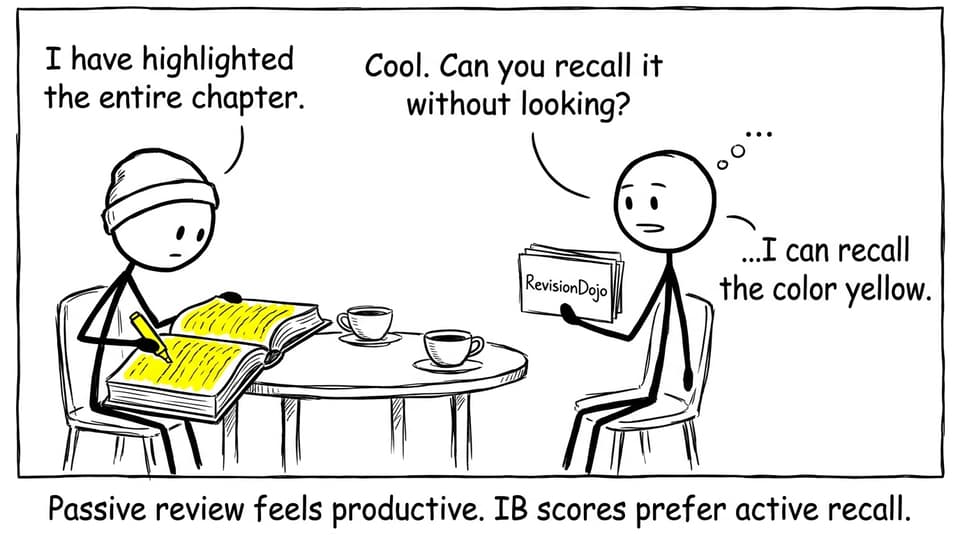
Traditional note-taking is often passive: you copy what looks important, you underline what feels “testable,” and you tell yourself you’ll “learn it later.” The problem is that your brain confuses recognition with recall. You can recognize a concept when you see it, but the exam asks you to produce it.
The shift for IB success is this: notes shouldn’t store information. Notes should train retrieval.
RevisionDojo supports that shift because you can move from “read” to “recall” quickly: read examiner-aligned notes, ask Jojo AI Chat to clarify what’s fuzzy, turn key lines into flashcards, then prove it with exam-style questions.
If you want the bigger strategic picture, the workflow is also laid out in RevisionDojo App: The Smarter Way to Prep for IB Exams.
Use RevisionDojo Notes for IB retention the right way
Write “explain it to a tired future me” summaries
Your future self will not be motivated. They’ll be tired, stressed, and speed-reading. So write for that person.
After each lesson or revision block, write a compact explanation in your own words:
-
Define the concept plainly.
-
Add one “how to spot it in a question” clue.
-
Add one common mistake.
You can use RevisionDojo Digital IB Study Notes: Access Anywhere, Anytime as a model for the kind of clarity that survives pressure. For IB, clarity beats completeness.
Organize notes around connections, not chapters
The IB doesn’t assess “Chapter 9.” It assesses skills and relationships: how ideas collide, how assumptions change outcomes, how definitions drive methods.
Inside RevisionDojo Notes, structure each topic like a map:
-
Core idea (one sentence)
-
Key sub-ideas (3--5 bullets)
-
Connections (where else it shows up)
-
Triggers (“If the question says X, I should think Y”)
Math students can see how that structure looks in practice via Effective Note-Taking Strategies for IB Math Students. The principle is the same across sciences, humanities, and languages: organize by how you’ll retrieve it.
Pair every definition with an example (and a non-example)
Long-term retention in IB is often pattern recognition: you see a prompt, you recognize the structure, you run the method.
So every note section should include:
-
a clean example (what “right” looks like)
-
a non-example (a tempting wrong turn)
This is especially powerful when you later practice in the Questionbank, because your notes will already contain the “trap door warnings” your brain needs.
Add one “why it works” line to every method
Memorization decays quickly. Understanding decays slowly.
For every method, add one sentence that explains the logic. This is the line that saves you when the question is unfamiliar or twisted.
If you get stuck, use RevisionDojo’s AI Chat to ask for a mark-scheme-friendly explanation, then rewrite it in your own voice. That rewriting step matters: it turns borrowed clarity into personal memory.
Convert notes into active recall with IB Flashcards
Notes become retention when they become questions.
After you finish a note section, immediately convert key points into flashcards. Keep each card to one idea:
-
definition cards
-
steps-of-method cards
-
application cards (“When would I use this?”)
-
misconception cards (“What’s the classic mistake?”)
RevisionDojo’s flashcard ecosystem is designed for this, and it’s worth reading Flashcard Techniques for Long-Term Retention in IB to avoid making pretty but useless cards.
Use spaced repetition like a calm, repeatable ritual
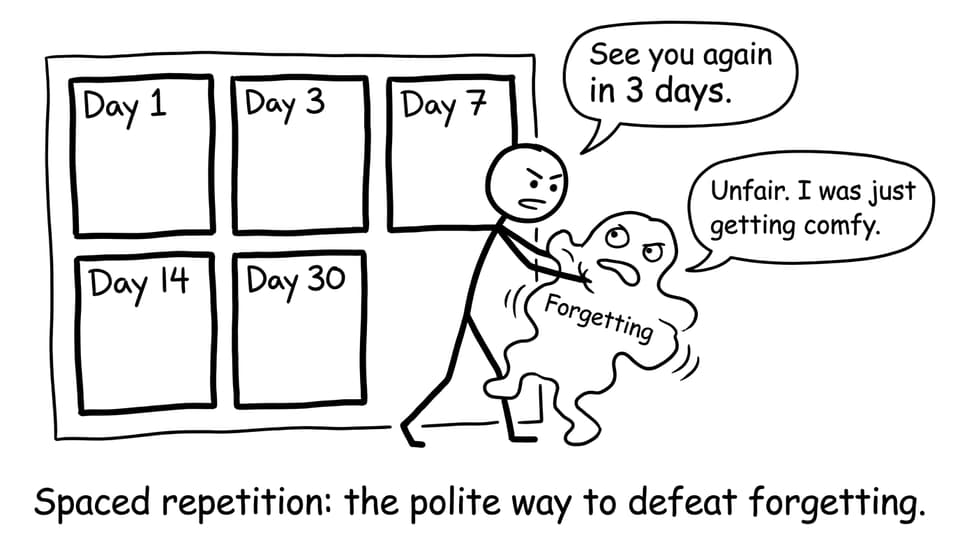
Spaced repetition is not a productivity hack. It’s a promise to your future self: “I will meet this information again before it fades.”
A simple schedule many IB students can sustain:
-
Day 1: quick recall check
-
Day 3: second retrieval
-
Day 7: stabilize
-
Day 14: strengthen
-
Day 30: long-term lock
RevisionDojo Flashcards handle the rhythm, so you’re not relying on willpower alone. Learn the system basics at IB Flashcards with Spaced Repetition (SRS).
Close the loop with Questionbank practice (notes -> marks)
Retention isn’t the end goal. Performance is.
After reviewing notes and flashcards, do a small set of exam-style questions. Then update your notes based on what the questions revealed:
-
add a “mistake pattern” box
-
add a better example
-
rewrite one unclear sentence
That loop is the heart of modern IB studying: learn, recall, apply, refine.
If you need a structured approach for practice, use IB Question Bank | How to Use It Effectively and keep your practice targeted rather than random.
Common retention mistakes IB students make with notes
-
Copying notes without transforming them into your own words.
-
Making notes too long to review, then skipping reviews entirely.
-
Separating notes from practice, so you never discover what you truly don’t know.
-
Rereading instead of recalling, which feels productive but fades fast.
-
Not updating notes after feedback, so the same errors repeat.
For a broader revision framework that includes notes, recall, and timing, keep 10 Proven Study Techniques for IB Students bookmarked.
Conclusion: turn IB notes into a memory system, not a scrapbook
The students who look “naturally good” at IB revision often aren’t smarter. They’re just running a quieter system: small notes, constant recall, honest practice, frequent correction.
RevisionDojo is built for that system. Use Study Notes as your clarity base, convert what matters into Flashcards for spaced repetition, and prove it in the Questionbank. When you need fast help, lean on AI Chat. When you’re ready to pressure-test, bring in Mock Exams and Predicted Papers. And if coursework is adding stress, use the Coursework Library and Grading tools to get criterion-focused guidance.
If you want retention that lasts beyond next week’s quiz and shows up on exam day, treat your IB notes as a living system. Start one loop today, then let RevisionDojo keep it consistent tomorrow.
