
A small, familiar panic (and why it matters)
The moment usually arrives late.
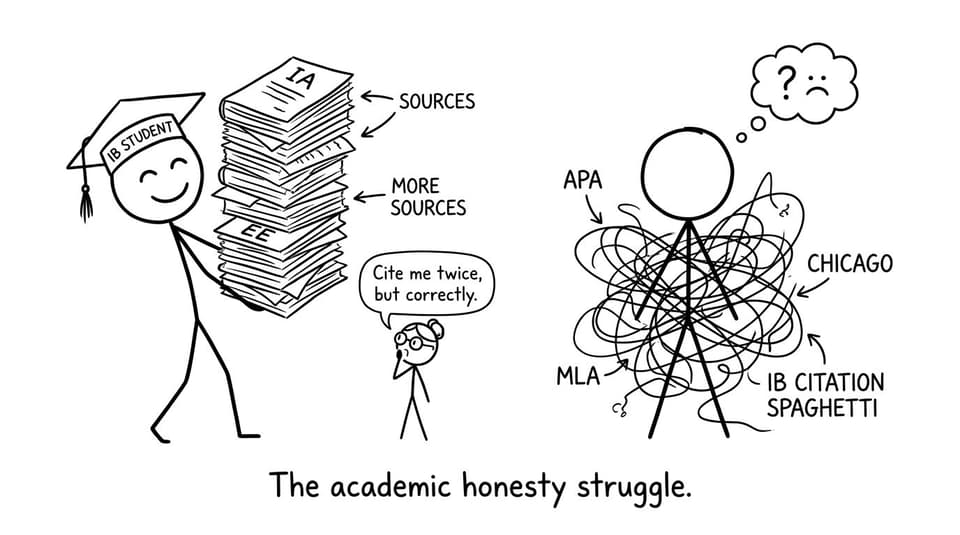
You're deep in your IA, and you finally find the perfect journal article: credible, specific, and written in that calm academic voice you wish you could borrow. You cite it, you build a paragraph around it, and you feel something rare in IB life: relief.
Then, weeks later, you open your EE planning doc and realize the same article fits again. And the question hits you like a notification you didn't want to see: Can you use the same sources in your IA and EE?
Yes, often you can. But the word "can" is not the word you're actually looking for.
What you're really asking is: Can I reuse sources without risking academic honesty issues, losing marks, or accidentally blurring two pieces of work into one?
This guide is built to answer that precisely, with IB-safe boundaries and practical steps, so your IA stays clean, your EE stays original, and your stress stays manageable.
Quick checklist: reusing sources between IA and EE
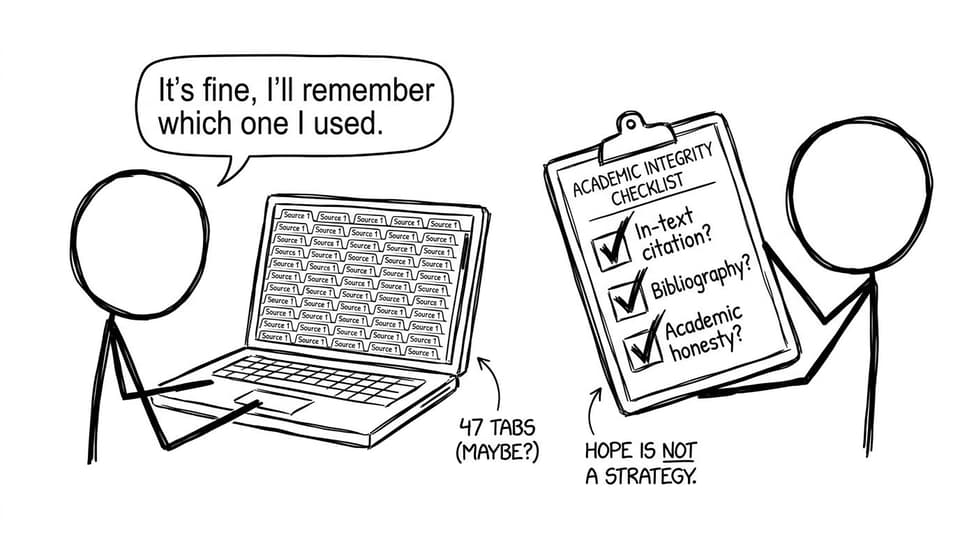
Use this checklist before you copy a single citation from your IA into your EE (or the other way around):
- Is the research question different? Your EE must be its own investigation, not an "extended IA."
- Are you reusing the source, not the writing? Reusing a source is usually fine; reusing your paragraphs is not.
- Can you justify why the source is relevant in both contexts? If yes, you're acting like a researcher.
- Have you cited it freshly in each document? Each submission needs its own in-text citations and bibliography.
- Is your analysis new? In an IA, your analysis might be tighter and narrower; in an EE, it should deepen, challenge, and extend.
- Have you kept a research log? If questions arise, your process protects you.
If you want a broader overview of how an IA works across subjects, start with IB Internal Assessment: A Complete Guide.
The direct answer: can you use the same sources in your IA and EE?
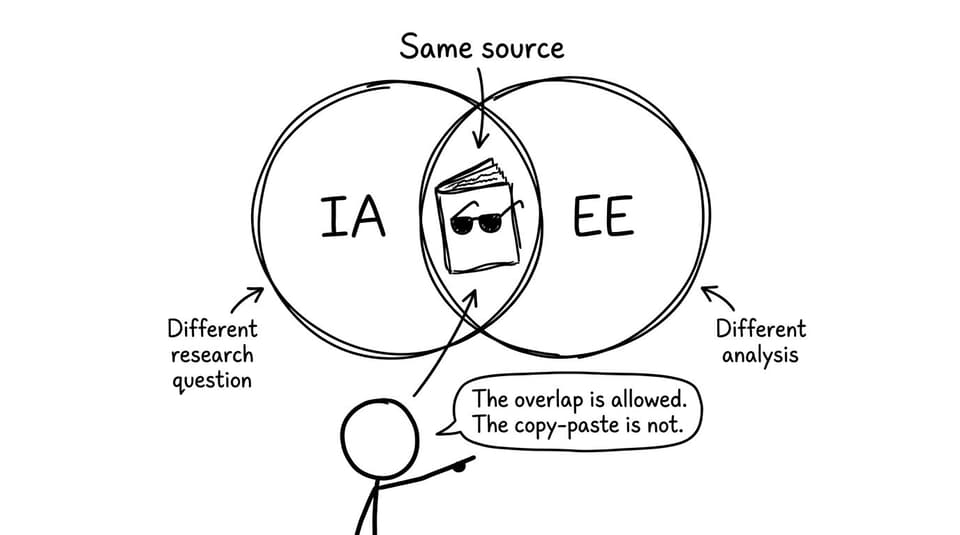
In most cases, you can use the same sources in your IA and EE.
The IB does not ban you from reading the same books, articles, databases, or reports for two different pieces of work. That would be unrealistic. Good sources are good sources, and researchers routinely use foundational texts across multiple projects.
What the IB does care about is:
- Originality of the submitted work (your argument, structure, reasoning, and interpretation)
- Academic honesty (clear citation and no misrepresentation)
- Distinct assessment tasks (your IA and EE must not become duplicates)
So the safe principle is this:
Reusing sources is usually allowed. Reusing your own writing or submitting overlapping work is where you get into trouble.
If you're unsure how strict the rules are around honesty, read How to Uphold Academic Integrity in IB Assessments before you draft.
Why this question is so common (and honestly, sensible)
IB students are not lazy for asking this. They're optimizing.
An IA rewards focused investigation. An EE rewards sustained, analytical argument. Naturally, you try to build a "source bank" that serves both.
That instinct is good.
It becomes risky only when optimization turns into shortcutting, like:
- lifting the same background section from your IA into your EE
- recycling the same analysis but changing a few words
- using the same structure and claim progression in both
A strong IA teaches skills that scale into the EE, but it should not become the EE itself. If you want a grounded explanation of that progression, read How IA Skills Transfer Directly to the Extended Essay.
The line you can't cross: sources vs. self-plagiarism
It helps to separate three things:
Reusing sources (usually fine)
If the same academic article is relevant to both your IA and EE, citing it in both is normal. You are allowed to learn from the same scholarship twice.
Reusing ideas (fine, if the work is new)
You can carry interests across assessments. For example, an IA might explore a narrow angle (a single case study), while the EE expands to compare multiple cases or apply a different framework.
Reusing your own writing (dangerous)
This is the part many students miss: self-plagiarism.
Submitting the same (or highly similar) text, analysis, or argument across two assessed components can be treated as academic misconduct, even if it is "your own." The issue is not ownership; it's misrepresenting the originality of the submitted work.
For practical referencing habits, use How to Cite Sources Correctly in Your IA. It's written for the IA, but the habits transfer perfectly to EE writing.
When reusing sources is a smart strategy (and when it's a trap)
Smart strategy: "anchor sources"
Most great projects have 3-6 anchor sources you return to repeatedly.
Using an anchor source in both your IA and EE can be efficient and academically sound if:
- you ask different questions of it
- you use it for different purposes (definition in IA; critique in EE)
- you build new analysis around it each time
Trap: "same source, same function, same paragraph"
The problem isn't the source. It's the repetition.
If Source X becomes the same background paragraph in your IA and EE, you've effectively duplicated assessed work. Even if your citations are correct, the originality is thin.
A quick way to test this:
- If you deleted every citation, would your IA and EE still look meaningfully different?
If the honest answer is "not really," you need to redesign.
Practical ways to reuse sources without reusing your IA
Build two bibliographies from one research vault
Make one research vault (your master reading list), but export two separate bibliographies:
- IA bibliography: only what you actively used
- EE bibliography: only what you actively used
Same vault, different outputs. This is how real research projects stay clean.
Rewrite your thinking, not your phrasing
If you used a study in your IA introduction, you can still use that study in your EE introduction, but you should:
- present it through a new lens
- integrate it into a different chain of reasoning
- connect it to a broader debate
The goal is not to hide repetition; it's to show growth.
Change the level of analysis
A simple upgrade pattern:
- IA: apply the source to your specific investigation
- EE: evaluate the source's assumptions, compare it with another author, and use it to build a defensible argument
If you're building more analytical writing for the EE, How to Make Your IB Extended Essay Analytical is a strong reference point.
Use RevisionDojo exemplars to see what "clean reuse" looks like
One of the easiest ways to understand boundaries is to see polished work.
RevisionDojo's Coursework Exemplars Hub makes it easier to spot how students cite shared foundational sources while keeping their analysis original.
For Math specifically, this is a clear walkthrough: Using IA/EE Exemplars to Improve Your IB Math IA.
What examiners and teachers are actually looking for
In your IA, teachers and moderators want to see your investigation: a focused aim, relevant evidence, and personal engagement with the task. In your EE, examiners want to see an extended argument: sustained reasoning, critical thinking, and a clear relationship between evidence and conclusion.
That means your sources are not the main event. Your thinking is.
If you want to align your IA with expectations, the subject guides inside RevisionDojo's IB Internal Assessment Guides are designed to keep you criterion-focused.
And for the EE side, start with IB Extended Essay Guides to keep your structure and engagement on track.
How RevisionDojo helps you keep your IA and EE distinct
This is where students often need something more than advice: they need a system.
RevisionDojo helps you keep your IA original and your EE original with tools that reduce accidental overlap:
- Coursework Library: compare strong exemplars so you understand what originality looks like in practice.
- Grading tools: upload drafts and get criterion-aligned feedback that highlights where your work is too descriptive or too recycled.
- AI Chat: sanity-check whether your EE plan is genuinely distinct from your IA topic and outline.
- Study Notes and Flashcards: separate "content learning" from "coursework writing" so you don't end up copying your revision notes into your IA.
- Tutors: get targeted guidance on research question design and scope so your IA and EE don't collapse into one project.
- Questionbank, Predicted Papers, Mock Exams: protect your exam prep time so the IA doesn't eat the weeks you need for timed practice.
If you're also navigating AI use, this is worth reading: What AI Tools Are Safe and Approved for Educational Use?.
Closing: the calm rule that saves you
If you remember one thing, let it be this:
Your IA and EE can share sources, but they can't share a soul.
The sources are just the raw material. What the IB assesses is the shape you carve from it: your choices, your reasoning, your honesty, your voice.
So reuse the book. Reuse the article. Reuse the dataset.
But rebuild the thinking.
When you want that rebuild to feel clearer and less lonely, RevisionDojo is designed for exactly this moment: use the Coursework Library to see what clean originality looks like, the Grading tools to check rubric alignment, AI Chat to stress-test your plan, and then protect your exam results with Questionbank, Study Notes, Flashcards, Predicted Papers, and Mock Exams.
Your IA can be the start of your research confidence. Your EE can be the proof that you earned it.