
If you have ever felt your German vocabulary evaporate the moment someone says, “So, tell me what you see,” you are not alone. The IB German Ab Initio oral exam is a strange little moment: fifteen minutes of preparation, then a conversation where you are graded on being human in a language you are still building.
The good news is that this is exactly why IB Languages orals can become your strongest assessment. They reward preparation that is portable, not a memorized script, but a toolkit you can carry into any question. This 2025 edition guide breaks down the format, the rubric, and the habits that reliably raise marks.
Along the way, you will see how to use RevisionDojo as your training ground for IB Languages speaking: targeted prompts, realistic timing, fast feedback loops, and practice that feels like the exam.
Quick checklist for the IB Languages German oral
-
Learn the oral map: prep, presentation, follow-up, general conversation
-
Train one visual stimulus per week, then increase to 3 per week in the final month
-
Build 10 reusable “expansion patterns” (opinion + reason + example + comparison)
-
Practice “repair phrases” for when you blank
-
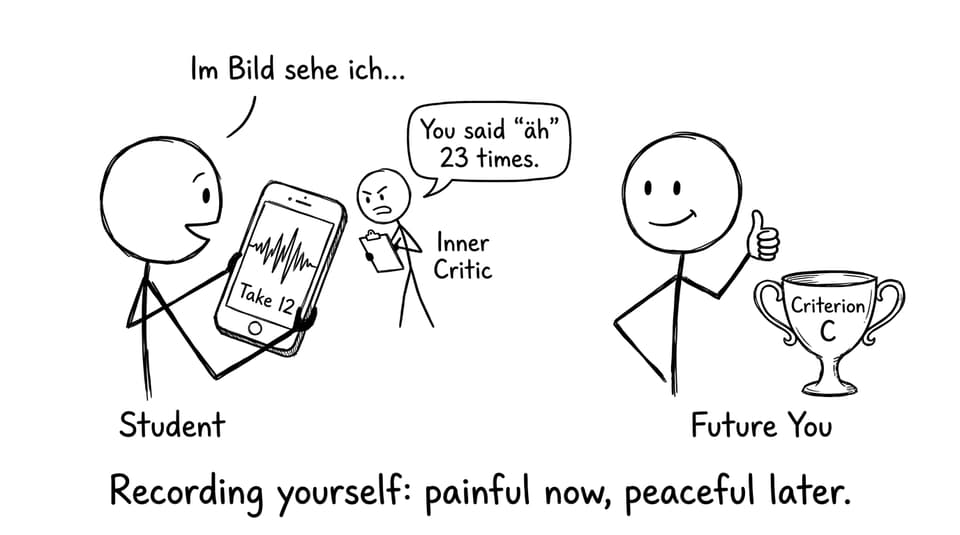
Record yourself twice a week and track one improvement target each time
-
Add one cultural reference per theme (small, accurate, expandable)
-
Simulate the full timing weekly using RevisionDojo resources
For the full course context, keep this hub open: IB German Ab Initio resources.
What the IB German Ab Initio oral exam looks like (2025)
The oral is short, but it has distinct gears. When students underperform, it is usually because they stay stuck in one gear (often “description”) and never shift into “opinions, reasons, culture, comparison.”
In IB Languages terms, your job is to show you can communicate under pressure, not to show you know rare vocabulary.
The three parts you must rehearse
-
Presentation (3-4 minutes): Describe and interpret the visual stimulus and connect it to a course theme.
-
Follow-up discussion (4-5 minutes): Respond to questions about what you said and develop ideas.
-
General conversation (5-6 minutes): Move to other themes and speak more naturally.
If you want the big-picture structure of the whole course (including weightings), use: IB German Ab Initio exam format (2025 guide).
How the oral is marked (and how to aim your practice)
Most students revise like the exam is testing “German knowledge.” The rubric is more specific. It rewards decisions: how you structure, how you keep interaction going, how clearly you get meaning across.
Criterion A: Language
This is vocabulary and grammar control, yes, but it is also clarity. Clean, understandable German beats fast, messy German.
To prioritize the grammar that actually shows up in speaking, review: Most important grammar topics in IB German Ab Initio.
Criterion B: Message
This is where you win marks by staying relevant and building answers. In IB Languages, “message” is basically: did you answer the question, and did you develop it beyond one sentence?
Criterion C: Interactive skills
This is the hidden multiplier. If you keep the conversation alive by asking for clarification, using fillers, responding naturally, so you often outperform students with better vocab but weaker interaction.
For mistakes that frequently sink interactive skills, read: Top mistakes in IB language oral exams (and fixes).
IB Languages strategy: build a “toolkit,” not a script
A script feels safe until the examiner changes one detail. Then your brain tries to find the next memorized line, and the conversation collapses.
Instead, build a toolkit of flexible parts you can recombine.
A simple structure for the visual stimulus
Use this four-step flow every time:
-
What is literally there? (people, setting, action)
-
What does it suggest? (problem, benefit, tension)
-
Which theme fits best? (identities, experiences, human ingenuity, social organization, sharing the planet)
-
What is your angle? (opinion + reason + example + comparison to your life)
To revise themes efficiently, use: Themes and topics in IB German Ab Initio (2025).
Expansion patterns that raise your score fast
In IB Languages orals, short answers are the silent mark killer. Train expansions you can apply anywhere:
-
Opinion + weil + reason
-
Example from personal life
-
Comparison (in my country vs in Germany/Austria/Switzerland)
-
One advantage, one disadvantage
-
A small “future” statement (plans, hopes, consequences)
Even beginner German can do this. The goal is not complexity. The goal is development.
Use fillers like a professional, not as panic noise
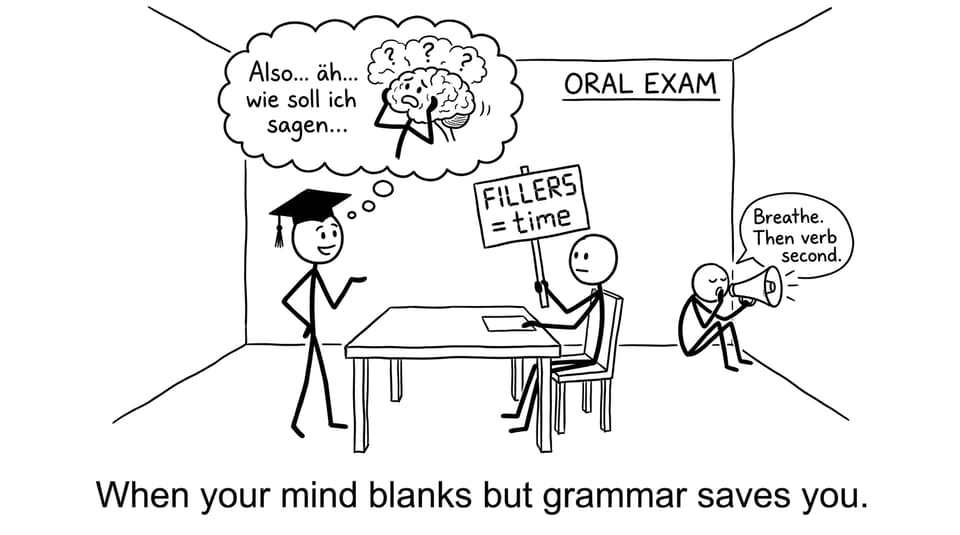
Fillers are not cheating. They are conversation. In fact, for IB Languages, fillers can protect your grammar because they give you time to plan word order.
High-utility options:
-
Also...
-
Naja...
-
Ich denke, dass...
-
Wie soll ich sagen...
-
Einerseits... andererseits...
Pair fillers with a “repair phrase”:
-
Könnten Sie das bitte wiederholen?
-
Ich habe die Frage nicht ganz verstanden.
-
Ich meine... (then rephrase)
The 15-minute prep: what to do, minute by minute
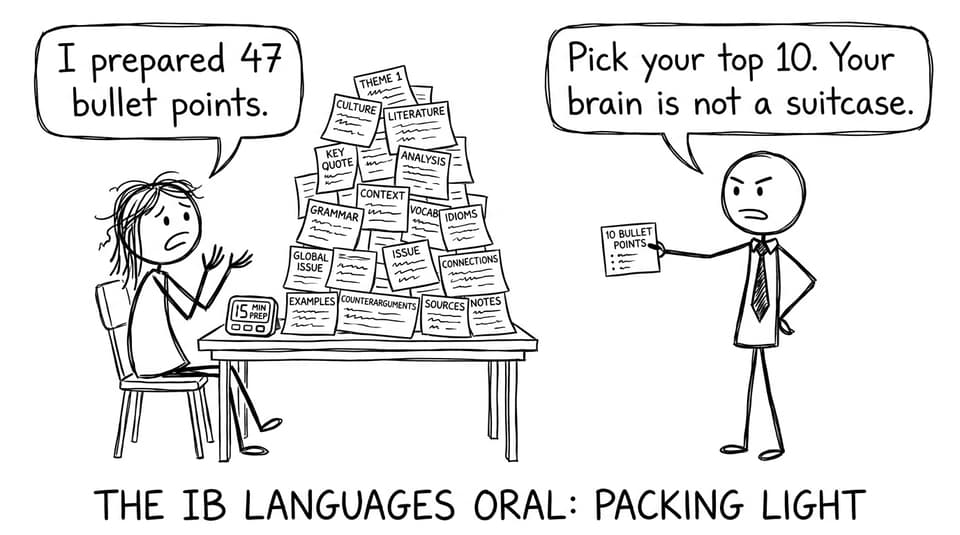
Most students waste prep time trying to write full sentences. You cannot read a speech in this oral, and scripts tend to sound unnatural.
Try this instead:
-
Minutes 1-3: Choose the theme and write 6-8 nouns you can definitely use.
-
Minutes 4-7: Write 4 “verbs you trust” (e.g., gibt, macht, zeigt, braucht) and 3 connectors (weil, aber, obwohl).
-
Minutes 8-11: Draft three expansion routes (opinion, example, comparison).
-
Minutes 12-15: Rehearse aloud once, slowly, focusing on clear pronunciation.
This is where RevisionDojo becomes a quiet advantage: you can practice the same prep routine using structured materials, then tighten your timing.
How RevisionDojo trains IB Languages speaking (without chaos)
Good oral practice has two ingredients: repetition and feedback. RevisionDojo helps you do both without guessing what to do next.
-
Use Study Notes to anchor theme vocabulary and common structures.
-
Turn your best phrases into Flashcards so they become automatic.
-
Use AI Chat to simulate unpredictable follow-up questions (the part most students avoid).
-
Use Grading tools to get criteria-aligned feedback on clarity, development, and structure.
-
Run Mock Exams to simulate real timing and nerves.
-
Use Predicted Papers to target likely theme angles without relying on memorization.
-
Use the Coursework Library for exemplars and standards.
-
If you need human accountability, work with Tutors.
A good starting point for building consistent oral practice habits is: Mastering Language B oral practice and How to improve your Language B speaking skills.
Common mistakes (and the calm fix)
Over-describing the picture
If you only list objects, you run out of time before you earn “message” marks.
Fix: Describe for 45-60 seconds, then switch to meaning: “What does this show about society?”
Speaking too fast
Speed feels like confidence, but it often reduces accuracy.
Fix: Slow down and let pauses exist. In IB Languages, clear beats quick.
Avoiding complex sentences entirely
You do not need fancy German, but you do need some range.
Fix: Use one subordinate clause per answer (weil/obwohl/dass) and keep the rest simple.
Missing cultural awareness
Culture does not mean a history lecture. It means showing you recognize German-speaking contexts.
Fix: Prepare small cultural anchors per theme. For example, public transport, recycling norms, school systems, or festivals.
For a culture-specific guide, use: How IB German Ab Initio exams test cultural awareness.
Closing: make the oral feel predictable
The students who succeed in IB Languages orals are not the ones with perfect German. They are the ones who made the exam feel familiar: same structure, same timing, same toolkit, week after week.
If you want your IB German Ab Initio oral to feel less like a performance and more like a controlled conversation, build your routine on RevisionDojo: theme-based Study Notes, speaking Flashcards, examiner-style prompts from the Questionbank, realistic Mock Exams, and quick feedback through AI Chat and Grading tools. Then, when the examiner asks the first question, your brain does not search for brilliance, it reaches for a system that already works.
To anchor your next practice session, start here: How to succeed in the IB German Ab Initio oral exam (2025) and keep your broader IB plan organized via the main International Baccalaureate (IB) hub.