The timer starts. Your mind goes blank. And suddenly the simplest phrase in your target language feels like it has vanished from human history.
If you’ve ever felt that jolt, you’re not alone. The oral can be the most personal part of IB Language B: no hiding behind polished paragraphs, no time to re-read your sentence three times. It’s you, your voice, and the ability to think clearly under pressure. The good news is that IB Language B oral performance is less about “being naturally fluent” and more about building a repeatable system you can trust.
Your IB Language B oral practice checklist
Use this as your baseline before you add extra hours:
-
Know the oral structure and timing (so your brain stops guessing).
-
Prepare phrases and connectors, not a full script.
-
Build theme vocabulary you can actually use in sentences.
-
Train follow-up questions with unpredictable practice.
-
Record, review, fix one pattern, repeat.
For a bigger picture of what the course expects across skills, keep this nearby: IB Language B Exams: Format, Timing, Strategy.
The real challenge: anxiety steals your structure
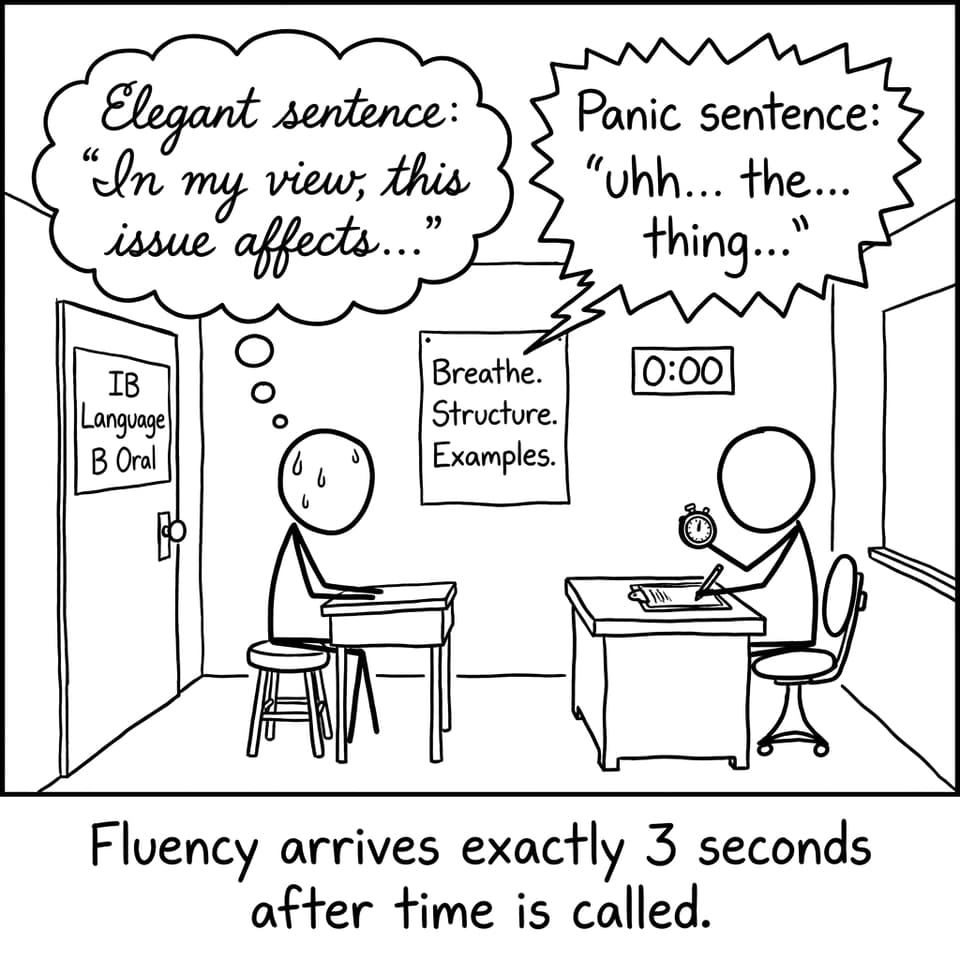
Most “speaking anxiety” isn’t fear of the language. It’s fear of losing control. In IB Language B, you can feel confident in class and still freeze in an exam room because exams remove your usual supports: friendly pacing, familiar topics, second chances.
A useful mental shift is to treat the oral like a short journey with landmarks. When you always know what comes next (describe, interpret, connect, discuss), your brain relaxes. That’s why it helps to practise with exam-like routines such as the ones in 10 Proven Tips to Prepare for Your IB Language B Oral Exam.
Build “talking blocks” (connectors + opinion + example)
High-scoring IB Language B answers often sound spontaneous, but they’re built from reusable blocks:
-
Connectors: however, therefore, on the other hand, as a result
-
Opinion frames: in my view, I would argue, it seems that
-
Example moves: for instance, a clear example is, in my community
-
Repair phrases (confidence savers): let me rephrase, what I mean is, to be more precise
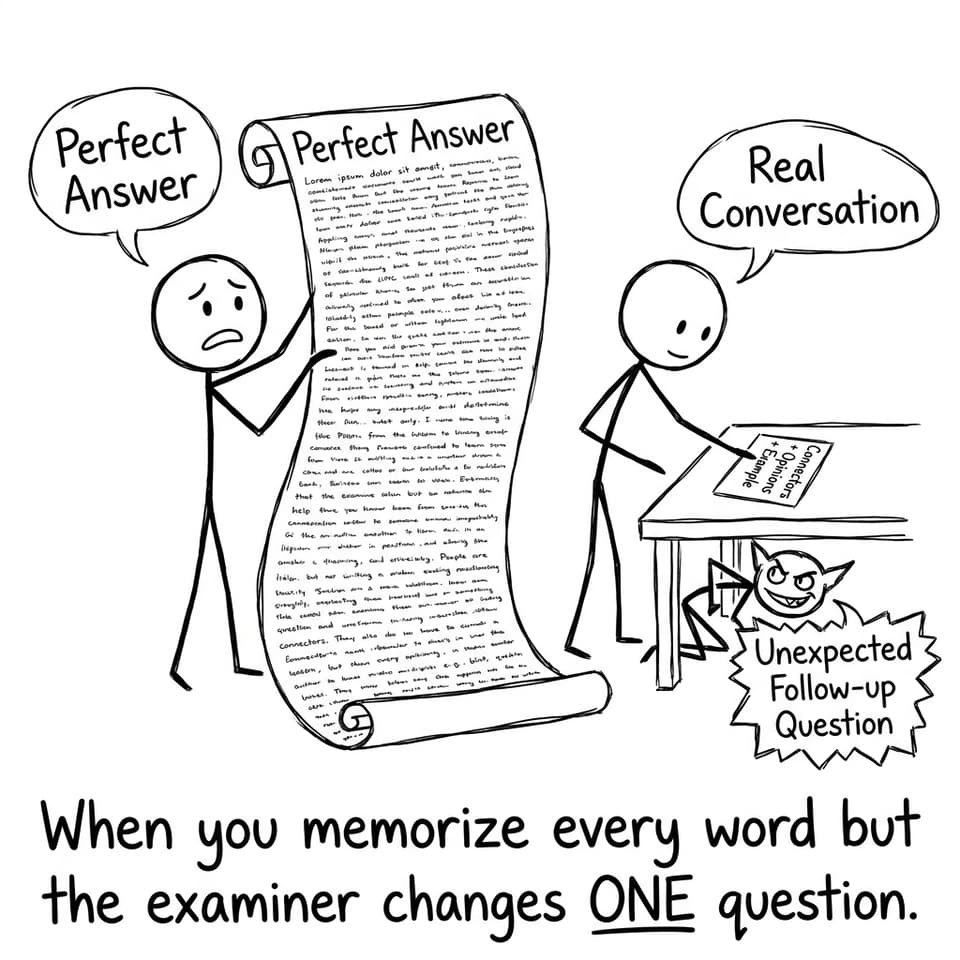
This is why memorising a full speech usually backfires. Real orals contain real interruptions. Train flexibility instead.
To make these blocks stick, use spaced repetition. RevisionDojo’s IB Flashcards with Spaced Repetition (SRS) are perfect for drilling connectors and theme vocabulary until they come out automatically. Pair that with the deeper method here: IB Vocabulary Review: Effective Ways to Remember Words.
Practise with prompts the way the examiner thinks
A simple practice routine that works for IB Language B:
Describe (short)
Say what you literally see or what the prompt literally states. No analysis yet.
Interpret (deeper)
Explain what it suggests: values, conflict, change, tension, problem.
Connect (smart)
Link to an IB theme (identities, experiences, human ingenuity, social organization, sharing the planet) and add one cultural or real-world angle.
Discuss (flexible)
Answer follow-up questions by returning to your talking blocks: connector + opinion + example.
If you want a weekly rhythm that keeps progress steady without burnout, use: IB Oral Practice Schedule: Regular Speaking Skill Development.
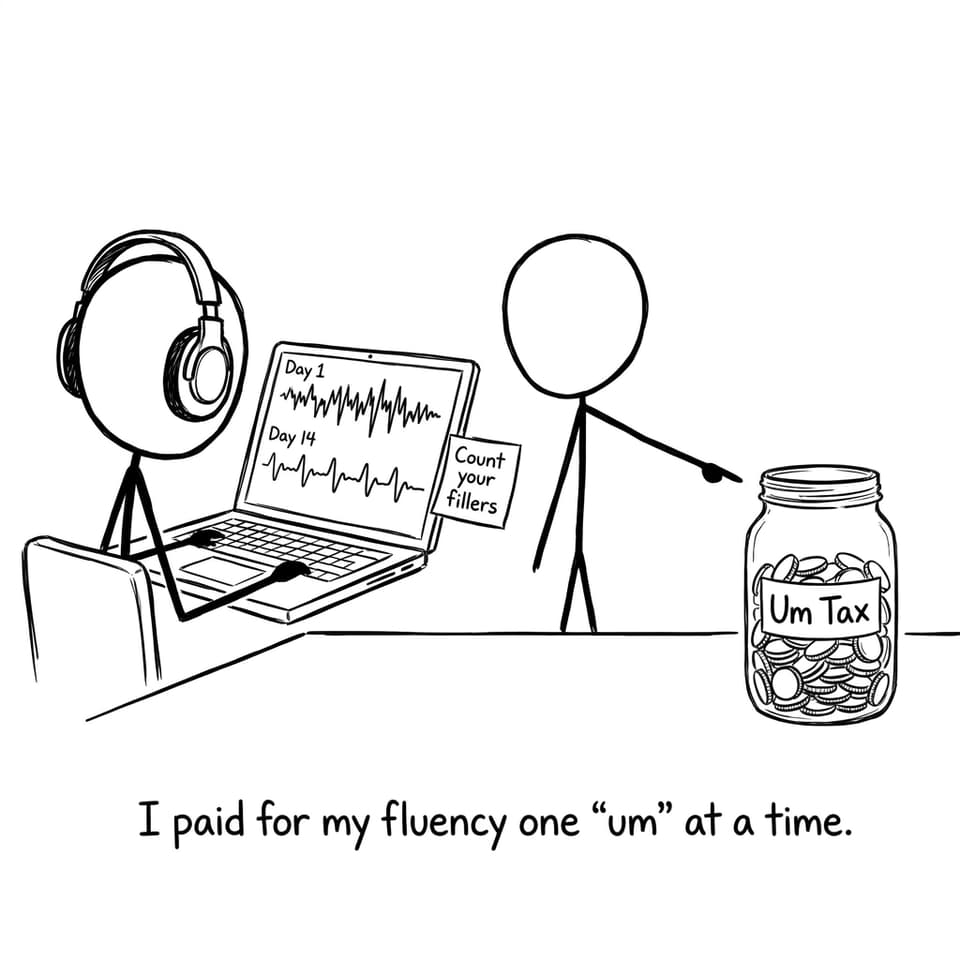
Record, review, and pay the “um tax”
Recording yourself feels awkward for exactly one day. After that, it becomes a superpower.
Here’s the rule: don’t just listen and cringe. Listen like a coach.
-
Mark repeated filler words.
-
Note where you lose grammar accuracy under speed.
-
Find one transition that sounds unnatural.
-
Fix one pattern, then re-record the same prompt.
For targeted improvement loops, RevisionDojo’s tools help you practice like it’s measurable. You can use AI Chat to roleplay an examiner who asks unpredictable follow-ups, then reinforce weak spots with Flashcards and topic drills in the Questionbank. When you need a full plan for your course themes and coverage, this breakdown helps: IB Language B Syllabus: Breakdown & Study Strategy.
Using RevisionDojo to make IB Language B oral practice repeatable
RevisionDojo works best when you treat it like a loop, not a library:
-
Start with Study Notes to clarify what the oral is rewarding.
-
Build quick theme decks with Flashcards.
-
Practise prompts, then mark what failed (vocab range, grammar, pacing).
-
Use AI Chat to drill follow-up questions you didn’t see coming.
-
Use Mock Exams and Predicted Papers to simulate pressure in a controlled way.
-
If you want expert feedback fast, the Tutors and Grading tools can keep you honest.
You can explore the platform from the hub: RevisionDojo | IB & MYP Resources.
A calmer finish line
The oral doesn’t reward the student who knows the most words. It rewards the student who can keep moving when the words don’t arrive on time.
Build a simple IB Language B oral practice loop: structure first, talking blocks second, timed prompts third, recording and review always. Then let RevisionDojo hold the system together with Study Notes, Flashcards, AI Chat, the Questionbank, and exam-style simulations through Mock Exams and Predicted Papers.
When you’re ready, pick one prompt today, hit record, and practise like the version of you who will walk into the exam room and still speak clearly.