
Fiscal policy sounds wonderfully simple on paper: if the economy slows, spend more or cut taxes; if inflation climbs, do the opposite. But in real life, fiscal policy is a bit like steering a large ship in fog. You can turn the wheel with confidence and still discover you changed direction too late.
For IB students, the marks live in that gap between theory and reality. These Revision Tips will help you evaluate fiscal policy clearly, using the exact limitations examiners expect.
Revision Tips checklist: what to mention in evaluation
Use this quick checklist when a question asks you to evaluate fiscal policy:
-
Define fiscal policy (government spending and taxation to influence AD)
-
Mention time lags (recognition, decision, implementation)
-
Mention political constraints (elections, bargaining, priorities)
-
Explain crowding out (higher borrowing may raise interest rates)
-
Discuss public debt and reduced future flexibility
-
Note uncertainty in the multiplier (depends on confidence, leakages, capacity)
For syllabus-aligned coverage as you revise, keep the IB Economics hub open alongside your notes.
Time lags: the policy arrives after the problem moved
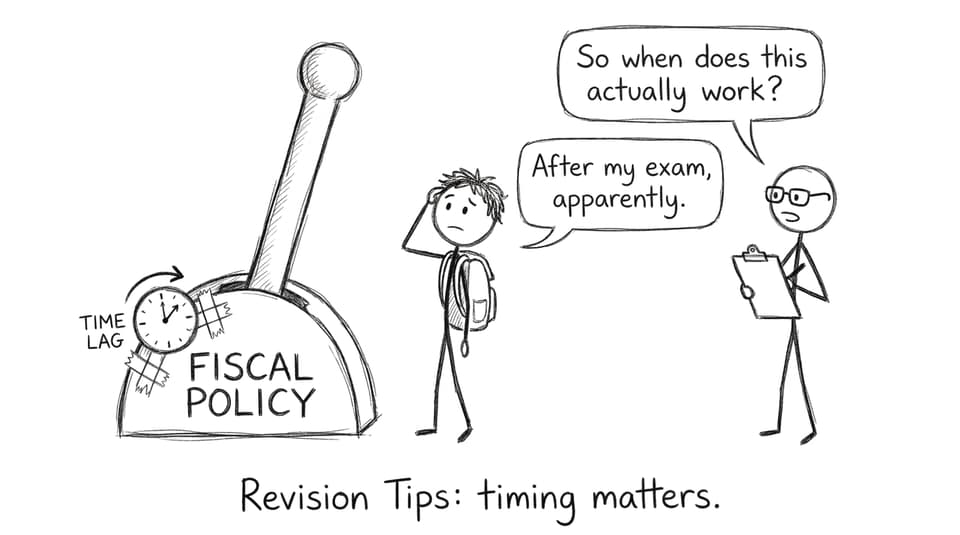
A core risk is that fiscal policy often works slowly. Governments have to notice the downturn (recognition lag), agree on a response (decision lag), then actually roll out spending projects or tax changes (implementation lag). By the time households feel the impact, the economy may already be recovering, so the policy can overshoot and add instability.
This is why strong exam answers don’t just say “time lags exist”, they explain how mistiming can turn stabilisation into destabilisation. If you want the syllabus framing, see Fiscal policy and its impact on potential output.
Political constraints: good economics can lose elections
Fiscal decisions run through politics, not just economics. That means negotiation, competing priorities, and sometimes policies chosen because they are popular now, not because they are effective later. In practice, governments may expand spending during booms (when restraint is needed) or delay stimulus during recessions (when speed matters).
In IB terms, politics reduces precision. Instead of a targeted policy that closes a gap neatly, you may get a compromise package that is too small, too late, or aimed at the wrong sector.
To practise writing evaluation in a clear structure, use the Step-by-step approach to writing IB Economics essays.
Crowding out: when government borrowing squeezes the private sector
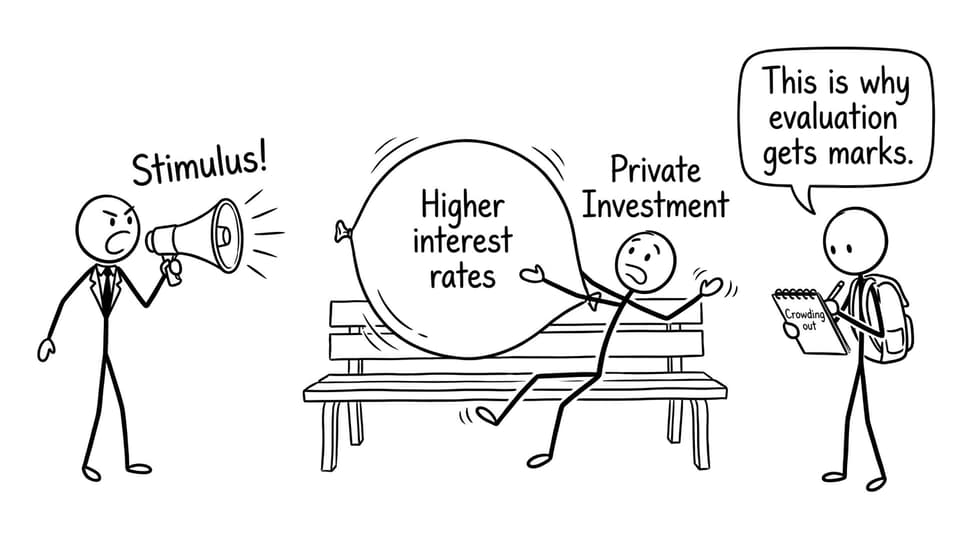
When governments borrow to finance deficits, they increase demand for loanable funds. This can push up interest rates, making private investment more expensive. If private investment falls, some of the stimulus is offset, and the overall rise in AD is smaller.
Crowding out is especially relevant near full employment, where resources and credit markets are already tight. It may be less severe in a deep recession, but it remains a classic evaluation point.
For a bigger picture of how AD shifts link to policy, read What causes shifts in aggregate demand?.
Rising public debt: the bill arrives later
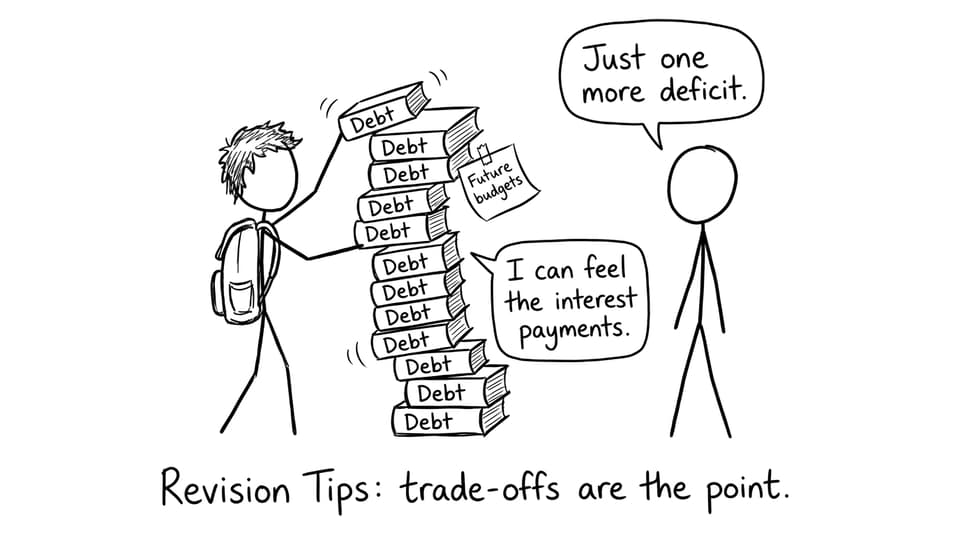
Deficits accumulate into public debt. Over time, higher debt can increase interest payments, reduce government budget flexibility, and weaken confidence if investors fear fiscal unsustainability. Even when stimulus is justified, the long-run trade-off matters: future governments may have less room to respond to new shocks.
This is a strong place to compare short run vs long run, and to weigh benefits (stabilisation) against costs (debt servicing, credibility, reduced policy space).
For a concise, exam-friendly overview, use the Evaluation of fiscal policy notes and pair them with IB Economics cheatsheets.
Multiplier uncertainty: the same policy, different outcomes
The fiscal multiplier isn’t a constant. It depends on the marginal propensity to consume, how much spending leaks into imports, whether households save tax cuts, and whether firms are confident enough to invest. If consumers are worried, a tax cut might be saved. If supply constraints exist, higher AD may raise prices more than output.
For targeted practice and feedback, the RevisionDojo Questionbank is ideal for turning these Revision Tips into exam-ready chains of reasoning: try Macroeconomic equilibrium questionbank practice.
How to study this topic efficiently with Revision Tips
A high-yield routine is:
-
Learn definitions and diagram logic from Macroeconomics topic resources
-
Drill key terms with Macroeconomics flashcards
-
Practise explanations using RevisionDojo AI Chat (ask it to critique your evaluation)
-
Use Grading tools to check whether your answers balance advantages and limitations
-
Build stamina with Mock Exams and Predicted Papers when you’re close to test day
Conclusion: turn limits into marks (and practise them)
Fiscal policy is powerful, but its risks are exactly what make it examinable: time lags, political constraints, crowding out, debt, and multiplier uncertainty. Memorising the list is step one. Using Revision Tips to explain when each limitation matters is what separates a decent answer from a top-band evaluation.
When you’re ready to practise properly, RevisionDojo ties everything together: Study Notes for clarity, Flashcards for retrieval, Questionbank for exam-style training, AI Chat for instant coaching, plus Mock Exams, Predicted Papers, and Tutors for final-week confidence.