


The quiet truth about scoring in IB Group 6 Arts
The moment most students lose marks in IB Group 6 Arts is not when they “make a bad piece.” It’s when they make something interesting, then forget to prove it was intentional.
Arts subjects reward courage. But they also reward documentation, reflection, and decisions that can be explained clearly. The gap between a 5 and a 7 is often the gap between taste and evidence.
In this guide, you’ll learn how scoring in IB Group 6 Arts actually works across Visual Arts, Music, Theatre, Dance, and Film, and how to build a repeatable system that protects your creativity while still chasing marks.
A quick scoring checklist for IB Group 6 Arts
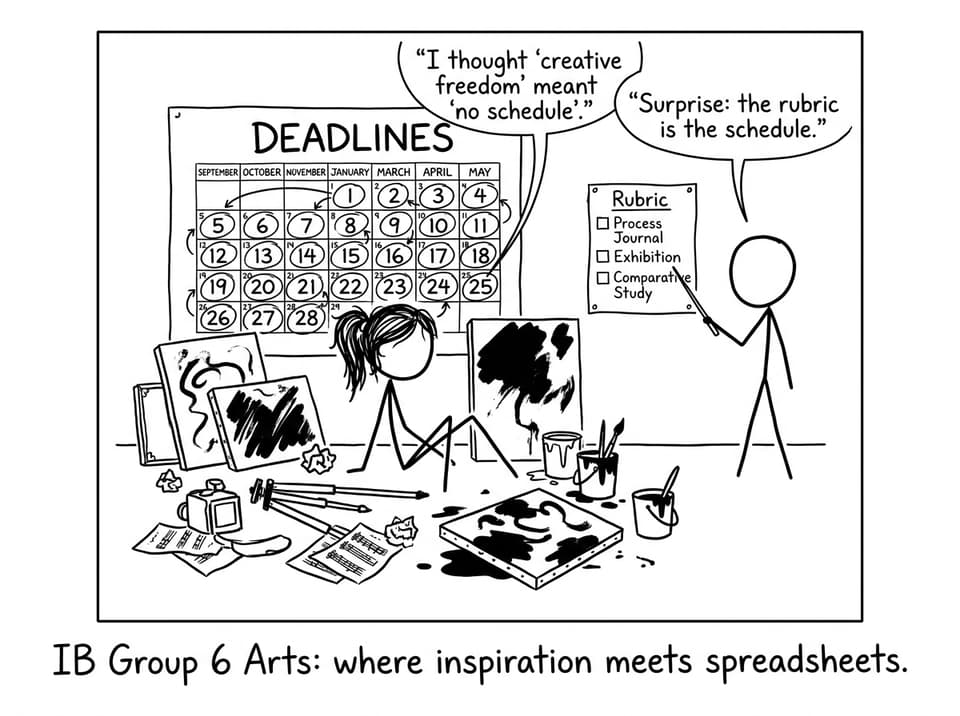
Use this as your weekly filter. If you can answer “yes” to most of these, you’re building grade security:
-
You can name the assessment criteria strands you’re targeting this week (not just “work on portfolio”).
-
You have one planned output and one planned reflection (small counts).
-
You’re collecting feedback in rubric language, then acting on it.
-
Your process shows experimentation, not just polishing.
-
Your choices have context (influences, references, comparisons, or research).
-
You can explain your intention in two sentences without apologizing.
If feedback is your weak link, bookmark IB Group 6 Arts Feedback: Best Practices and treat it like a routine, not a rescue.
What examiners reward in IB Group 6 Arts (across subjects)
Even though the tasks differ, scoring logic in IB Group 6 Arts tends to orbit the same core signals.
Technical control, but only when it serves meaning
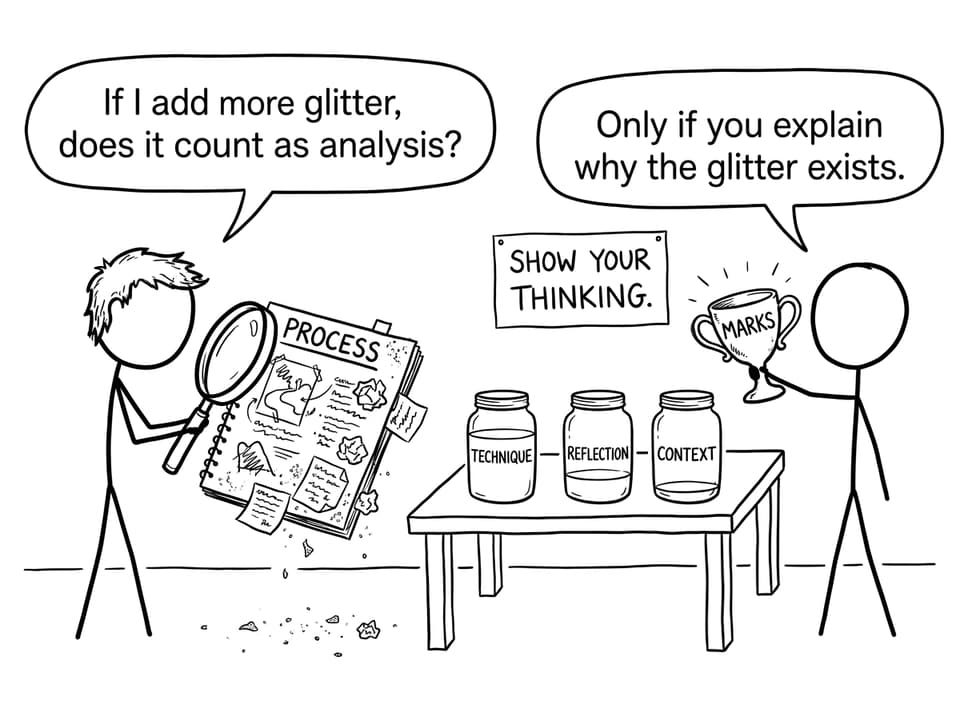
Technique matters. But not as a flex. The highest scoring work usually shows technical decisions that support intention: why this brushwork, why this tempo, why this camera movement, why this staging choice.
A helpful mindset is: every technique is an argument. If you can defend it, it stops being decoration and starts being evidence.
Process that evolves (not just a finished product)
Top marks typically come from a visible journey. Examiners want to see that you tested ideas, made edits, changed your mind, and learned something specific.
This is where RevisionDojo becomes practical: keep your weekly plan tight, then log decisions using Study Notes for quick clarity, Flashcards for key vocabulary (style, context, technique), and AI Chat to turn messy thoughts into clean reflection language.
If you struggle with overall study structure, steal the rhythm from What’s a Realistic IB Study Plan for a 6 in Each Subject? and adapt the time blocks to creative work.
Reflection that sounds like thinking, not a diary
A common mark leak in IB Group 6 Arts is reflection that describes what happened instead of explaining why it matters.
Try this mini-template:
-
Intention: what I wanted the audience to notice/feel/understand
-
Decision: what I changed (specific)
-
Reason: why that change supports intention
-
Evidence: what improved (clarity, contrast, coherence, impact)
-
Next step: what I would test next (one variable)
Subject-specific strategies (Visual Arts, Music, Theatre, Dance, Film)
These are not “secret tricks.” They’re the habits that reliably translate creativity into marks for IB Group 6 Arts.
IB Visual Arts: make the process portfolio do the heavy lifting
High scores often come from showing experimentation with clear artistic reasoning.
-
Document forks in the road: what you tried, what failed, what you kept.
-
Use comparison intelligently (artists, cultures, periods) to deepen justification.
-
Build cohesion: your exhibition is strongest when it feels like one mind with a point of view.
To strengthen your assessment awareness, pair this post with Understanding Assessment in IB Group 6 Subjects.
IB Music: treat analysis like a performance skill
In Music, students often practice the “making” parts and under-train listening and analytical writing.
-
Create a listening loop: pick one extract, annotate features, then write a tight paragraph.
-
Use Flashcards for musical vocabulary so you don’t stall mid-sentence.
-
When composing, keep a decision log: what constraint you chose and how it shapes the outcome.
IB Theatre: your documentation is part of the art
Theatre marks rise when your process captures intention, collaboration, and evolving choices.
-
Record decisions: staging, proxemics, rhythm, ensemble dynamics.
-
Write reflections that link rehearsal evidence to a conceptual goal.
-
Ask for feedback that targets one criterion strand at a time.
If you want a simple model for how marks are “designed,” read How IB Exams Are Marked (Use It to Your Advantage) and apply the same thinking to performance evidence.
IB Dance: clarity beats complexity
Complex choreography that looks uncertain is rarely rewarded as highly as clean, intentional movement.
-
Choose one technical focus per rehearsal week (control, transitions, dynamics).
-
Film short clips and annotate what changed and why.
-
In analysis, name specific movement features and connect them to effect.
IB Film: make every choice readable
Film students sometimes rely on vibe. Examiners reward film language used on purpose.
-
Keep a shot list that includes the reason for each shot.
-
Practice textual analysis with timed paragraphs to build speed.
-
Build range in your portfolio: show you can plan, shoot, edit, and reflect.
The RevisionDojo system for improving IB Group 6 Arts grades
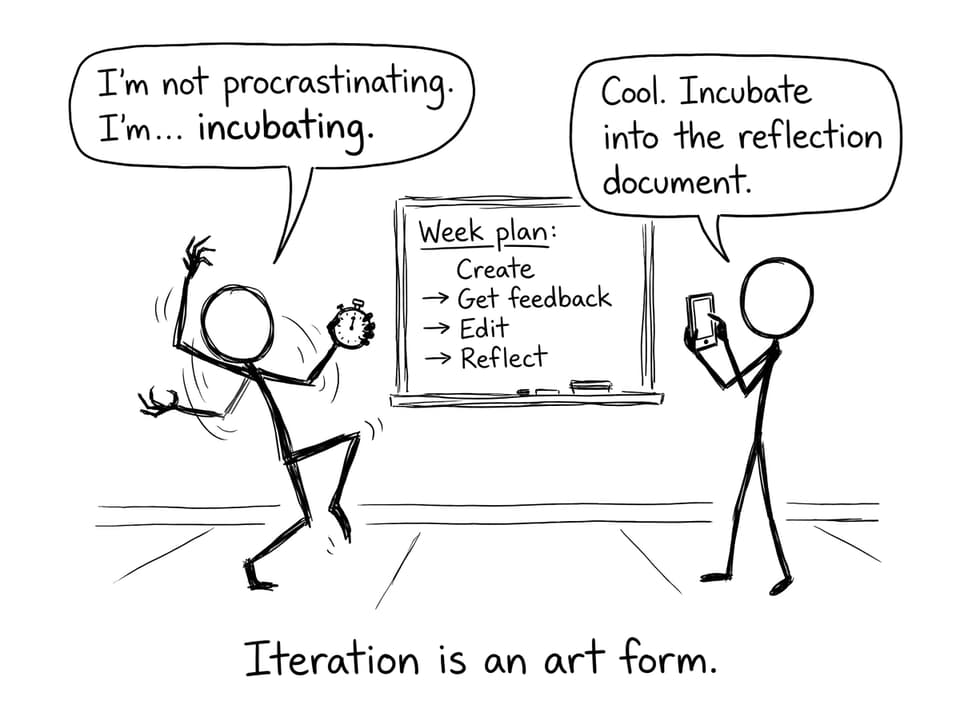
To score higher in IB Group 6 Arts, you need a loop you can repeat when you’re busy and tired:
-
Use the Questionbank to practice IB-style thinking where it applies (terminology, analysis prompts, structured responses).
-
Use Study Notes to quickly clarify concepts (without spiraling into endless research).
-
Use Flashcards to lock in key vocabulary and comparison points.
-
Use AI Chat to rewrite reflections into tighter, criterion-aligned language.
-
Use Grading tools to pinpoint where marks are being lost in communication.
-
Use Mock Exams and Predicted Papers to simulate pressure and pacing where written components exist.
-
Use the Coursework Library to see what strong evidence and structure look like.
-
Use Tutors when you need an outside eye to raise your ceiling fast.
To understand how Group 6 differs from other subjects (and why your revision style should change), read IB Group 6 Arts vs Sciences: Assessment Differences.
A final reminder: IB Group 6 Arts rewards the artist who leaves a trail
Scoring well in IB Group 6 Arts is not about squeezing creativity into a box. It’s about making your creative thinking visible enough to be marked.
If you want a calmer path to higher grades, build a simple weekly loop on RevisionDojo: plan one output, gather feedback, revise, and reflect. Use the Coursework Library to set your benchmark, the Grading tools to spot mark leaks early, and AI Chat to turn rough ideas into examiner-friendly language. Your work stays yours. It just becomes easier to reward.
Further reading: Choosing Your Group 6 Subject: A Comprehensive Guide, What Is a Group 6 Class in IB?, What Is Coursework in Group 6?, Will My IB Group 6 Coursework Be Sent to the IB?, and Can You Take Multiple Group 6 Subjects in the IB?.