

Studying MYP Individuals and Societies effectively means doing more than memorising facts. You need to retrieve accurate knowledge, investigate questions, communicate clearly, and evaluate evidence and perspectives. The simplest strategy is to revise one topic and one assessment criterion at a time, then combine those skills in timed responses.
That distinction matters. A student can know every date in a history unit and still struggle to evaluate a source. Another can understand urbanisation but lose clarity when writing under time pressure. Knowledge is the raw material; your assessment skills determine what you can build with it.
This guide gives you a concrete routine you can begin today. You can find the materials for each stage in the MYP Individuals and Societies resource hub.
The effective study checklist
Use this checklist before each revision session:
- Choose one narrow topic rather than an entire unit.
- Identify the assessment criterion you are training.
- Retrieve what you know before opening your notes.
- Repair only the gaps that retrieval exposes.
- Answer a question without help.
- Review the answer using criteria and command terms.
- Rewrite one weak section.
- Record one rule for your next attempt.
This creates a loop: retrieve, repair, apply, review, rewrite. It is more demanding than highlighting a textbook, but it also shows you what you can actually do.
Understand what MYP Individuals and Societies assesses
MYP Individuals and Societies may bring together history, geography, economics, politics, sociology, and other social disciplines. According to the IB's subject overview, students learn to collect, describe, and analyse data, test ideas, and interpret complex information, including original source material.
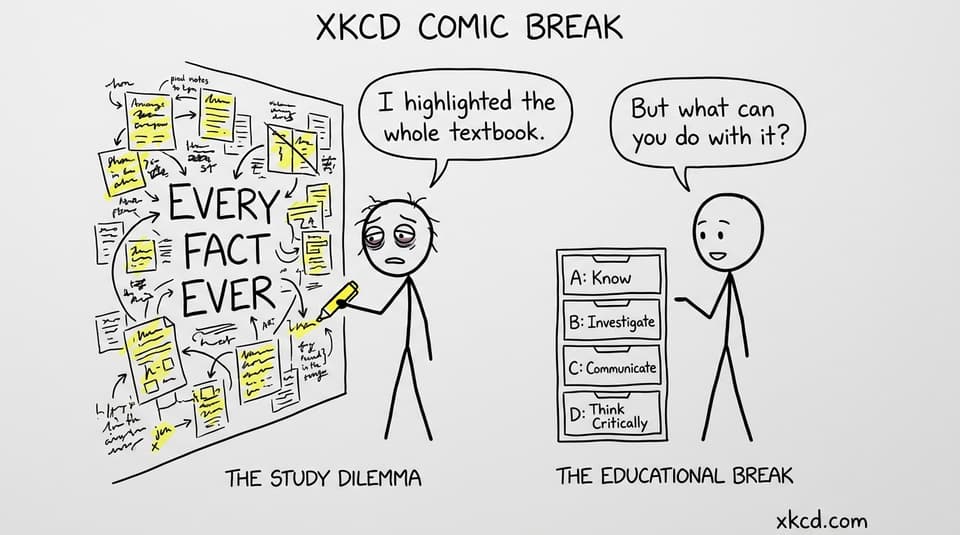
Assessment is organised around four criteria. Their precise descriptors vary by MYP year, so always use the rubric supplied by your teacher.
| Criterion | What you are training | Useful revision activity |
|---|---|---|
| A: Knowing and understanding | Terminology, concepts, explanations, and examples | Recall definitions and explain examples from memory |
| B: Investigating | Research questions, plans, methods, evidence, and reflection | Design a small investigation or evaluate a research plan |
| C: Communicating | Structure, appropriate style, clarity, and source documentation | Plan and write a focused response for a stated audience |
| D: Thinking critically | Analysis, arguments, source evaluation, and perspectives | Compare evidence and reach a qualified judgement |
The practical lesson is simple: revise by criterion as well as by topic. The MYP Individuals and Societies criteria guide explains what stronger performance looks like across all four areas.
A step-by-step method you can start today
Set aside 60 minutes. Choose a topic your class has already covered, such as migration, scarcity, conflict, development, or resource use. Then follow these six steps.
Start with a five-minute blank-page check
Close every book and webpage. Write down:
- five relevant terms
- one central concept
- two specific examples
- one cause-and-consequence chain
- one perspective that differs from your own
Do not worry if the page looks sparse. Its purpose is diagnosis, not performance. A blank space tells you more than a familiar-looking paragraph in your notes.
Repair one gap for ten minutes
Choose the most important missing idea and review only that section. Use concise MYP Study Notes and topic resources rather than copying an entire chapter.
Close the notes after ten minutes. Explain the idea aloud in your own words and connect it to an example. If you cannot explain why the example matters, return to the explanation briefly and try again.
Build an evidence card in ten minutes
For one case study, create a small evidence card containing:
- Context: where and when it occurred
- Evidence: one or two precise details
- Concept: the larger idea it illustrates
- Perspectives: two groups that may interpret it differently
- Limitation: something the evidence cannot establish alone
A few flexible examples understood deeply are more useful than dozens remembered vaguely. The guide to using MYP case studies effectively shows how to turn evidence into reasoning instead of inserting disconnected facts.
Answer one question for fifteen minutes
Select a focused prompt from the RevisionDojo Questionbank. Before writing, identify its command term.
- Describe: present relevant characteristics or information.
- Explain: show how or why something occurs.
- Analyse: break an issue into parts and examine relationships.
- Evaluate: weigh strengths, limitations, or significance before judging.
Write a one-sentence answer first. Then build one paragraph using Point, Evidence, Explanation, Link. The MYP essay structure guide provides a fuller method for extended responses.
Review by cause, not by score
Spend ten minutes checking the response. Label each weakness:
- missing knowledge
- vague evidence
- misunderstood command term
- description without analysis
- unsupported judgement
- unclear organisation
- weak source evaluation
The label determines your next action. Missing knowledge calls for Study Notes or Flashcards. Weak analysis calls for another paragraph. Poor organisation calls for a clearer plan, not another hour of reading.
RevisionDojo's AI Chat can challenge an assumption or suggest a counterargument, while Grading tools can help you inspect a response through criterion language. Use feedback to improve your thinking, not to replace it.
Rewrite for ten minutes
Rewrite only the weakest paragraph or source evaluation. Add the missing evidence, reasoning, perspective, or judgement.
Finally, write one rule in an error log. For example: “When the question says evaluate, I will compare at least two considerations and justify which matters more.” That sentence turns one correction into a reusable habit.
Use active recall without reducing the subject to facts
Active recall is valuable, but the questions on your Flashcards should extend beyond definitions. Include prompts such as:
- What are two causes of this development?
- Which stakeholder might disagree with this policy, and why?
- What evidence would test this claim?
- What is one limitation of this source?
- Under what conditions might this conclusion change?
RevisionDojo Flashcards can keep terminology and examples available, while the Questionbank tests whether you can use them. This difference between remembering and applying is central to effective MYP Individuals and Societies revision techniques.
Practise source analysis as a repeatable process
When given a source, begin with its message. Then consider its origin, purpose, intended audience, historical or social context, value, and limitations.
Avoid declaring a source simply “reliable” or “unreliable.” A government speech may be limited as neutral evidence of public opinion but valuable for understanding official priorities. Value and limitation depend on the question being investigated.
For focused practice, follow the MYP source analysis method. Once a week, choose an unfamiliar source and give yourself five minutes to identify its message, one value, one limitation, and another source that could corroborate or challenge it.
Turn the method into a weekly routine
A useful week does not require identical study sessions every day.
| Day | Main task |
|---|---|
| Monday | Retrieve terminology and build one evidence card |
| Tuesday | Practise a Criterion A or B task |
| Wednesday | Review Flashcards and analyse one source |
| Thursday | Write and improve one Criterion C or D response |
| Weekend | Complete a mixed timed set and review the error log |
Keep ordinary sessions between 30 and 60 minutes. As an assessment approaches, introduce longer digital practice through Mock Exams, Predicted Papers, or the exam builder where suitable resources are available. The 30-day MYP eAssessment study plan can help you scale from short drills to sustained timed work.
Make each revision session produce evidence
The best MYP Individuals and Societies study tips share one principle: finish with something observable. That might be a paragraph, a source evaluation, an investigation plan, a corrected answer, or a completed evidence card.
RevisionDojo brings that process together. Study Notes repair understanding, Flashcards strengthen retrieval, and the Questionbank creates application. AI Chat and Grading tools help diagnose weaknesses. Mock Exams and Predicted Papers support later rehearsal, while the Coursework Library and Tutors offer models or human guidance when independent correction is not enough.
Start small today: choose one topic, complete the 60-minute loop, and write tomorrow's first task before stopping. Effective revision rarely feels dramatic. Its power comes from making the next attempt slightly more precise than the last.