This site uses cookie tracking technologies. Learn more in our Cookie Policy.
IB Digital Society: Structure High-Scoring Exam… | RevisionDojo
Join 600k+ Students Already Crushing Their Exams
Many IB Digital Society students walk out of an exam feeling oddly betrayed. You knew the case study. You understood the system. You even remembered the key concept you promised yourself you’d use.
And yet the marks come back lower than expected.
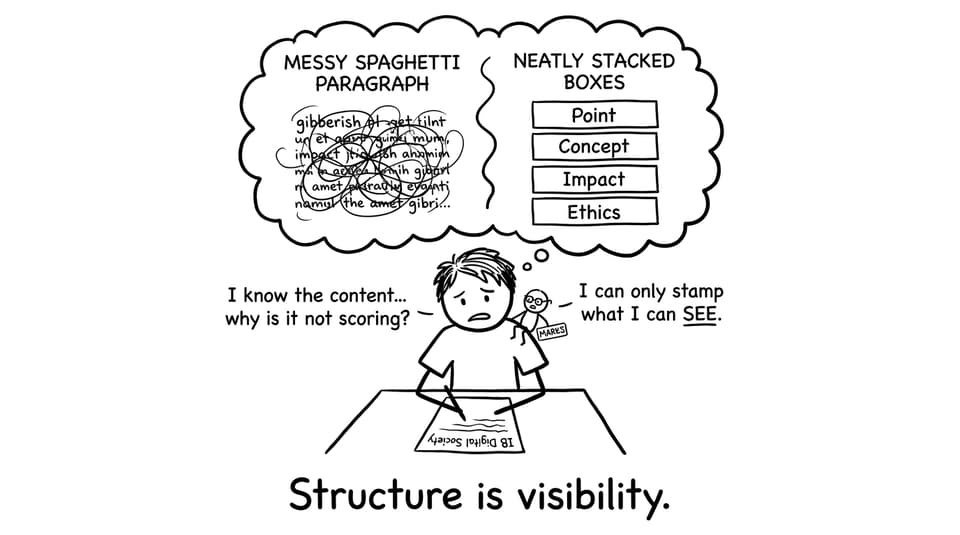
Usually it’s not because your thinking is wrong. It’s because the examiner couldn’t see it fast enough.
In IB Digital Society, structure is not decoration. It’s how you make analysis, ethical reasoning, and judgement visible under time pressure. When your answer has a shape, your ideas stop competing with each other and start building toward marks.
Structure is visibility in IB Digital Society
Quick checklist for high-scoring IB Digital Society answers
Use this as your 30-second plan before you write any IB Digital Society response:
Identify the command term and translate it into an answer “shape.”
Name the digital system in the first line (be specific, not “technology”).
Use one clear concept lens (power, change, identity, systems, ethics).
Write in markable units: one idea per sentence (or per bullet).
Show impact on people and communities, not just features.
Digital Society questions often drop you into an unfamiliar scenario: a new platform, a different community, an emerging technology. In that moment, your brain wants to either over-explain the system or argue an opinion.
But IB Digital Society marking rewards something calmer: concept-driven reasoning that stays tied to the prompt.
Structure helps you:
Stay relevant when the scenario feels new
Make cause-and-effect analysis easy to follow
Keep evaluation balanced instead of one-sided
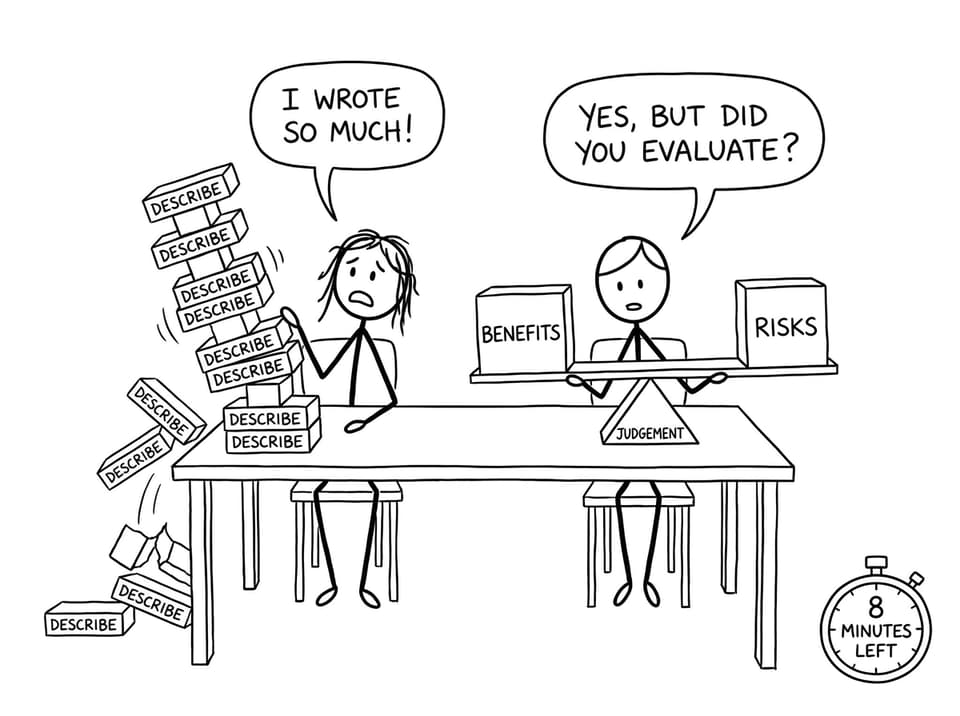
Prevent “feature dumping” (long description with little payoff)
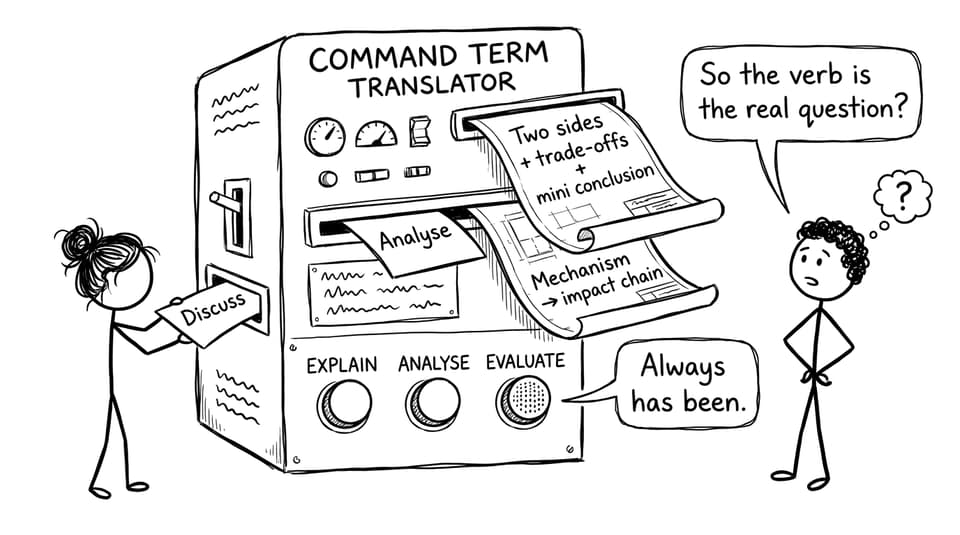
Start with the command term (it quietly controls everything)
In IB Digital Society, the command term isn’t a formality. It tells you what kind of thinking earns marks.
A “describe” question can be answered with controlled, accurate features. But an “evaluate” question needs criteria, trade-offs, and judgement. If you misread the verb, you can write a beautiful answer to the wrong task.
How to structure “Discuss” answers in IB Digital Society
“Discuss” is where many IB Digital Society students lose marks by writing a long, persuasive opinion. Discussion is not a rant with evidence. It’s a balanced review.
Use a simple two-sided layout:
Paragraph 1: benefits/opportunities (who gains, under what conditions)
Conclusion: make your IB Digital Society thinking easy to mark
High-scoring IB Digital Society answers don’t sound smarter. They look clearer.
When you translate the command term, use a consistent paragraph blueprint, and tie every point to impact and ethics, you stop hoping the examiner will “get it.” You make the marks obvious.
If you want to practise this with momentum, build your next week around RevisionDojo: learn with Study Notes, lock recall with Flashcards, drill exam structure in the Questionbank, get unstuck with AI Chat, sharpen with Grading tools, then pressure-test with Mock Exams and Predicted Papers. For IB Digital Society, that loop is often the difference between knowing the course and scoring like you do.