

IB Digital Society command terms: the quiet reason marks disappear
The strangest thing about an IB Digital Society exam is that you can understand the topic, remember your case study, and still lose marks in silence.
Not because your ideas are wrong.
Because your response shape is wrong.
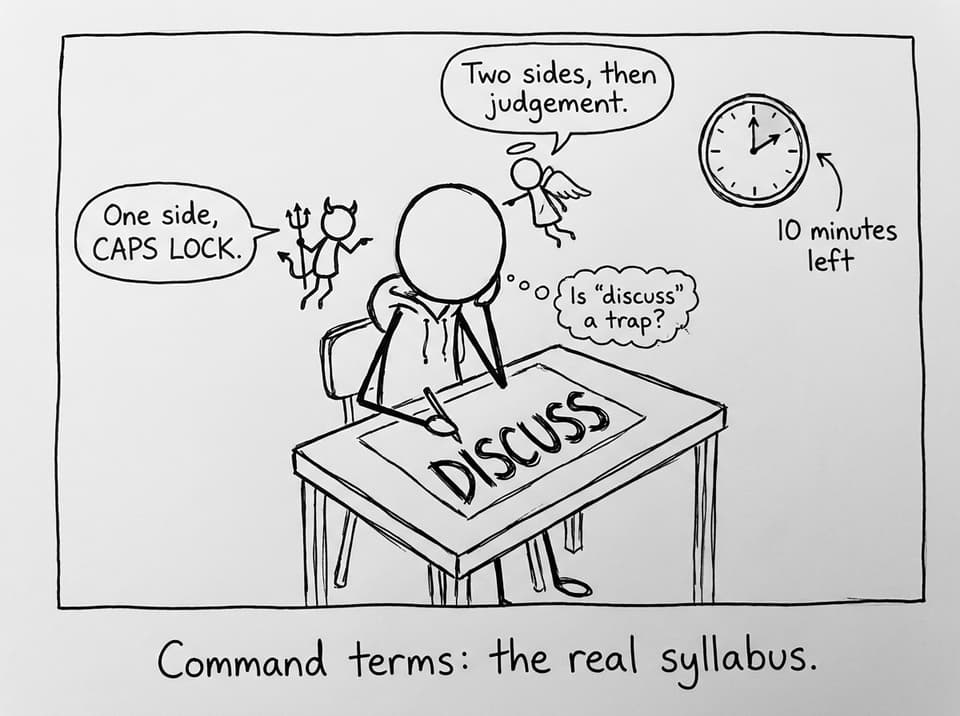
A question that says discuss is not asking for a confident opinion. Analyse is not asking for a summary with extra adjectives. And to what extent is not a yes/no with a polite paragraph at the end.
In IB Digital Society, command terms are the instructions that tell examiners what kind of thinking you are showing. If you follow them, your knowledge becomes visible. If you miss them, your knowledge stays trapped in your head.
A 30-second checklist before you write (IB Digital Society)
Use this mini routine for every IB Digital Society prompt:
-
Circle the command term (and any second command term).
-
Translate it into an answer shape (bullets, PEEL paragraph, mini-essay, balanced judgement).
-
Name the digital system early (platform, policy, algorithm, network) not just “technology.”
-
Choose one concept lens (power, ethics, identity, systems, change) and keep using it.
-
Make each sentence “markable” (one point per sentence or bullet).
If you want a deeper structure template for writing under pressure, pair this with How to Structure High-Scoring IB Digital Society Exam Answers.
Why command terms matter in IB Digital Society
IB Digital Society is designed to reward analysis and judgement about digital systems and their impacts on people and communities. That means the same case study can score very differently depending on the verb.
Command terms matter because they:
-
set the depth (facts vs reasoning vs judgement)
-
signal balance (one view vs multiple perspectives)
-
reveal what “evidence” means in context (features, stakeholders, consequences, trade-offs)
When revision feels messy, it often helps to step back and rebuild your lens set. The guide IB Digital Society: Key Themes Explained is a clean way to do that.
Describe (IB Digital Society)
Describe in IB Digital Society means: give a clear, accurate account of what is happening or what features exist.
What it looks like:
-
key characteristics of a digital system
-
a sequence (how a process works, step-by-step)
How to score well:
-
be specific and observable (features, functions, actors)
-
avoid “so what” analysis unless the question asks for it
-
use short, accurate sentences (padding is easy to spot)
A helpful habit is to keep your core vocabulary tight. The IB Digital Society Key Definitions page is perfect for quick precision.
Explain (IB Digital Society)
Explain means: show how or why something happens. In IB Digital Society, that usually becomes a cause -- mechanism -- effect chain.
Strong explain answers:
-
identify the cause (design choice, incentive, policy, data input)
-
describe the mechanism (how the system produces the outcome)
-
state the effect on people/communities (behaviour, access, trust, opportunity)
Avoid:
-
listing points without causal language
-
swapping explanation for description (“it does X” is not “it leads to X because…”)
If your explanations feel vague, build clarity through short, targeted practice. RevisionDojo’s IB Digital Society Resources hub connects Study Notes, Questionbank practice, and AI feedback in one place.
Analyse (IB Digital Society)
Analyse is where IB Digital Society starts to feel like the subject it is. Analyse means: break the issue into parts and show the relationships between them.
In practice, analysing often includes:
-
the system’s components (data, algorithm, interface, stakeholders, regulation)
-
the relationships (feedback loops, incentives, power, dependency)
-
the consequences (who gains, who loses, who decides)
A strong move is to signal your relationships explicitly:
-
“This design choice leads to… because…”
-
“As a result, stakeholders experience…”
-
“This creates a feedback loop where…”
If algorithms show up in your prompts, read IB Digital Society: Algorithms Explained for Exams and copy the checklist style into your own planning.
Discuss (IB Digital Society)
Discuss means: present a balanced review of different perspectives or factors, supported with evidence, and usually ending with a reasoned position.
In IB Digital Society, discussion is often about trade-offs:
-
innovation vs harm
-
convenience vs privacy
-
security vs civil liberties
-
personalization vs manipulation
To score well:
-
give at least two clearly different viewpoints
-
connect each viewpoint to stakeholders (users, governments, companies, communities)
-
keep returning to the question focus so you do not drift into a general essay
For broader technique, the cross-subject guide How to Use Command Terms Effectively in IB Exams is worth a quick read.
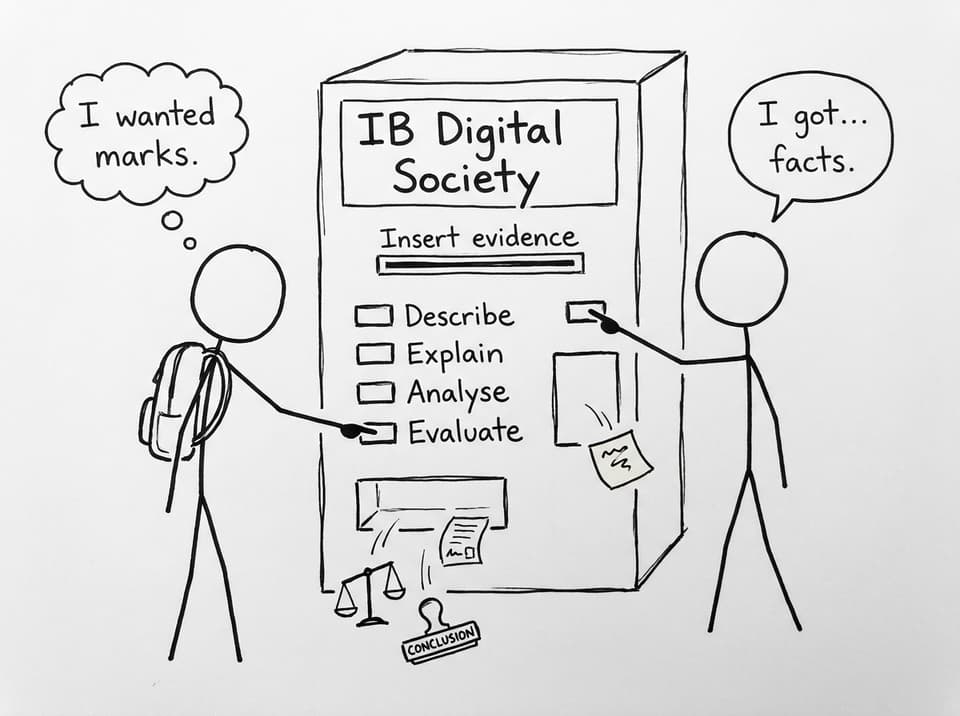
Evaluate and “to what extent” (IB Digital Society)
Evaluate means: weigh strengths and limitations using criteria, then make a justified judgement.
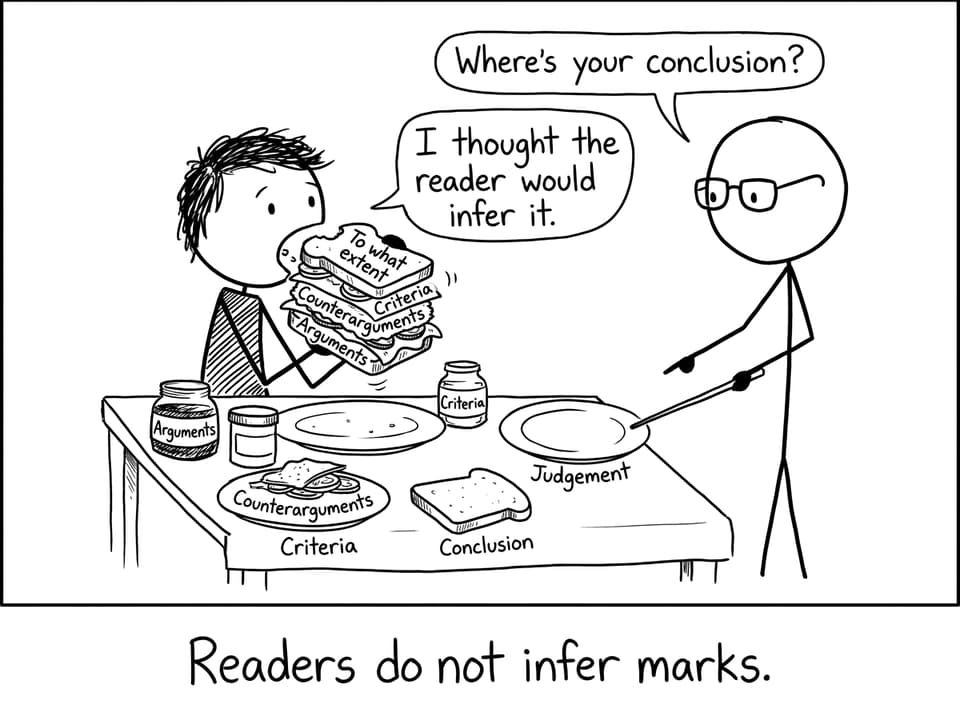
To what extent is evaluation with an extra demand: your conclusion must be qualified. Not “yes/no,” but “mostly, unless…” or “to a significant extent, but constrained by…”
Evaluation in IB Digital Society often uses criteria like:
-
effectiveness (does the intervention work?)
-
ethics (consent, fairness, accountability)
-
impact scale (who is affected and how widely?)
-
feasibility (cost, enforcement, unintended consequences)
To score well:
-
state your criteria early
-
weigh both sides with evidence
-
end with a judgement that answers the exact wording
When your revision plan needs realism (timing, stamina, mixed topics), use RevisionDojo’s Mock Exams and Predicted Papers alongside the Questionbank. The workflow is explained well in RevisionDojo App: The Smarter Way to Prep for IB Exams.
Compare and contrast (IB Digital Society)
Compare and contrast means: identify similarities and differences using the same criteria.
A high-scoring structure:
-
choose 2--3 criteria (purpose, data use, power dynamics, ethical risk)
-
write paired points (System A vs System B) under each criterion
-
end with a short synthesis (what the comparison suggests)
Avoid writing two separate mini-essays. In IB Digital Society, comparison earns marks when you link directly.
Examine and justify (IB Digital Society)
Examine means: consider something in detail to uncover assumptions, implications, or key issues. It often blends explanation with analysis.
Justify means: give valid reasons for a position or choice. In IB Digital Society, “I think” is not justification unless it is tied to evidence and a concept lens.
Strong justification:
-
names the choice clearly
-
gives 2--3 reasons grounded in concepts (ethics, power, systems)
-
uses a specific example or case detail to prove each reason
If you are also building your coursework confidence, the IB Digital Society Internal Assessment Guide can reduce a lot of background stress while you focus on exam technique.
Common mistakes students make with IB Digital Society command terms
These patterns show up again and again in IB Digital Society practice:
-
Describing when the question demands analysis or evaluation.
-
Writing a strong paragraph that never actually answers the verb.
-
Giving opinions without criteria or evidence.
-
Forgetting stakeholders (answers become abstract and stop being “Digital Society”).
-
Ending discuss/evaluate responses without a clear judgement.
A practical fix: do 10 practice questions where the topic changes but the command term stays the same. RevisionDojo’s Questionbank makes that easy, and Jojo AI can point out when your response is drifting away from the command term.
FAQ: IB Digital Society exam command terms
How do I know how much to write for each command term in IB Digital Society?
Use the command term plus the mark allocation to decide length in IB Digital Society. “Describe” and “outline” usually reward concise, accurate points, so extra paragraphs can actually dilute your marks. “Explain” needs a visible cause -- mechanism -- effect chain, which normally takes a few linked sentences per point. “Analyse” requires relationships, so you should show connections between system parts, stakeholders, and outcomes rather than listing features. “Discuss” and “evaluate” usually need at least two sides and a conclusion, so plan before you write. The best training is timed practice, then feedback: RevisionDojo’s Questionbank and Grading tools make your weak command terms obvious quickly.
What should I do if the IB Digital Society question uses two command terms?
Treat it like a two-part contract in IB Digital Society. If you see something like “analyse and evaluate,” your answer must contain both relationship-based breakdown (analyse) and a criteria-based judgement (evaluate). A simple method is to label your paragraphs as you plan: “Analysis:” then “Evaluation:”. Another method is to build each paragraph with both moves: one or two analysis sentences followed by one evaluation sentence that weighs impact or ethics. Do not assume the second term is optional; examiners are looking for it. RevisionDojo’s AI Chat can help you convert a confusing prompt into a clean plan without rewriting the question for you.
How can I practise IB Digital Society command terms efficiently each week?
Make command terms the organizing system of your practice, not a glossary you read once. Pick one or two verbs per week (for example, analyse and evaluate) and do short sets of exam-style questions under timed conditions. After marking, write one rule for what went wrong (for example, “I evaluated without criteria” or “I described the system but didn’t link to stakeholders”). Then convert your rules into Flashcards so the correction sticks and shows up automatically next time. Use Study Notes to patch only the missing concept, not to reread the whole topic. Finally, run a short weekly Mock Exam or a section from Predicted Papers to make your pacing feel normal.
Closing: make IB Digital Society predictable
The goal of IB Digital Society revision is not to predict the exact question. It is to make your response predictable to the examiner: clear structure, the right depth, and a conclusion that actually matches the verb.
If you want one calm system to train that skill, RevisionDojo is built for it: Study Notes for clarity, Flashcards for recall, a command-term-friendly Questionbank, AI Chat when you get stuck, Grading tools for feedback, plus Predicted Papers and Mock Exams to rehearse under time pressure. Start from the IB Digital Society Resources hub, and make IB Digital Society command terms the easiest marks you earn this year.