

Sometimes you walk out of an IB exam with that strange feeling: I knew the content. Why didn't the marks follow?
That feeling isn't about intelligence. It's about translation.
In IB, your job is to translate what you know into a shape the markscheme can recognize quickly. Examiners aren't hunting for beautiful writing. They're hunting for evidence of specific skills: define, apply, analyze, evaluate. When your answer is the right shape, marks feel almost automatic. When it's the wrong shape, even correct ideas can land like coins bouncing off a closed hand.
This guide shows you how to structure IB answers for maximum mark, across short responses, data questions, and longer evaluations, using simple templates you can repeat under pressure.
The IB answer-structure checklist (save this)
Use this checklist every time you practice IB questions:
- Identify the command term (what thinking is required).
- Read the mark allocation (how many distinct pieces are needed).
- Decide the answer shape (bullet list, PEEL paragraph, mini-essay, calculation with working).
- Write in markscheme units: one idea per sentence or bullet.
- Add subject-specific proof (data, definitions, case evidence, quotes, formulas).
- Close with a link back to the question (especially for explain/evaluate/discuss).
- Use the same structure when you review, then rewrite once.
If you want the fastest way to drill this with instant feedback, build your practice loop around the RevisionDojo Questionbank plus examiner-style explanations like in IB Question Explanations: Understand Every Answer.
Why IB marks depend on structure (more than you think)
A useful mental model: IB marking is less like a teacher reading your mind and more like airport security scanning a bag.
Security isn't impressed that you own a nice suitcase. They're checking for specific items. If the items are buried under messy packing, the scan doesn't "see" them.
IB answers work the same way. If you hide the definition inside a long paragraph, or you evaluate without weighing both sides, you've packed the right item in the wrong place.
That's why top scorers build "default shapes" for common IB tasks. Under time pressure, structure becomes a habit, and habits survive stress.
To practice the "default shapes" with realistic questions, use IB Exam-Style Questions: Practice with Authentic Formats.
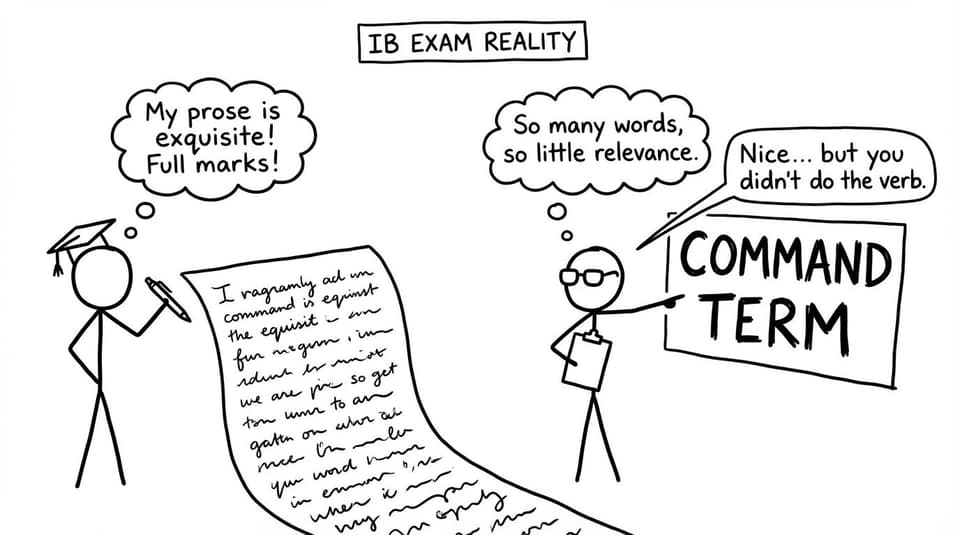
Start with the command term: the IB's hidden instruction manual
The command term tells you how to earn the marks.
If you treat every prompt as "write what I know," you'll often miss the skill being assessed. That's why command terms are the most cost-effective IB skill you can train.
RevisionDojo makes this easier because you can drill verbs directly with tools like the IB Command Terms Glossary and deeper guidance in How to Use Command Terms Effectively in IB Exams.
Quick structure cues for common IB command terms
Use these as your default IB answer shapes:
- Define/State/List: one line per mark. No story. No padding.
- Outline/Describe: brief sequence or features. Often best in bullets.
- Explain: because/therefore chain. Cause, mechanism, effect.
- Analyze: break into parts + show relationships.
- Compare/Contrast: paired points (A vs B) with explicit similarity/difference language.
- Evaluate/Discuss/To what extent: balanced argument + judgement tied to criteria.
The simplest training method: do 10 questions where the content changes but the command term stays the same. That's how your brain learns the "shape" of IB marks.
Structure IB answers by marks: the "mark-per-move" rule
Here's the rule that fixes most IB answers:
Each mark needs a visible move.
A "move" is something an examiner can point to:
- a correct definition,
- a relevant data reference,
- a clear inference,
- a justified conclusion,
- a limitation,
- a linked implication.
When you practice in RevisionDojo, Jojo AI feedback helps you see which moves were missing and why. That feedback loop is explained well in IB Question Explanations by AI: Understand Every Concept.
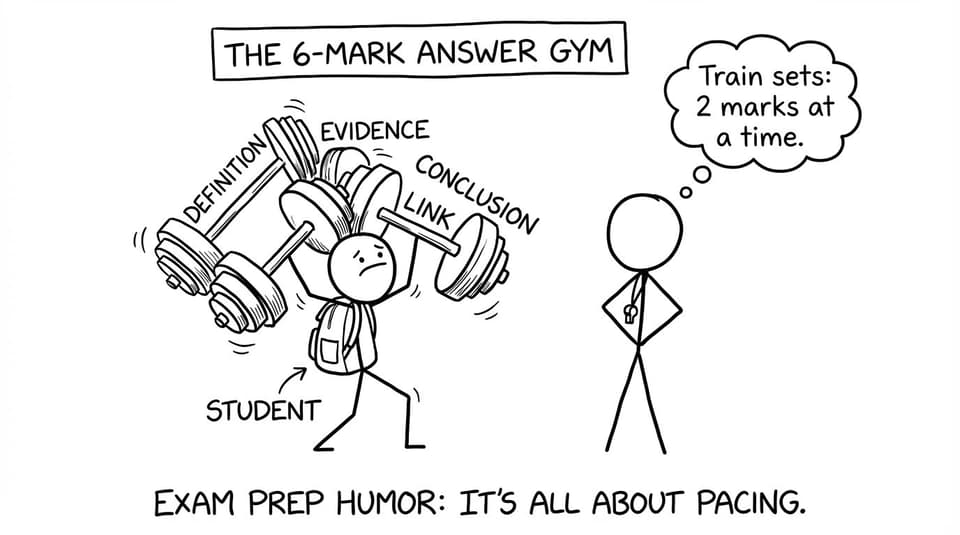
The 2-mark, 4-mark, 6-mark mental templates
These templates work across most IB subjects.
2 marks: "two clean bullets"
- Bullet 1: point
- Bullet 2: point
No intro, no conclusion. Just correctness.
4 marks: "point + support, twice"
- Point 1
- Support 1 (example, data, definition, brief explanation)
- Point 2
- Support 2
6 marks: "mini-argument"
- Claim/answer (1 sentence)
- Reason 1 + support
- Reason 2 + support
- (Optional) limitation/counterpoint
- Link back to the question
How to structure short IB answers (without losing easy marks)
Short answers are where IB students bleed marks quietly. Not because they don't know the topic, but because they overwrite, under-specify, or forget the marking logic.
Use "precision first" writing
For IB short answers:
- Put the key term early.
- Use the syllabus vocabulary.
- Avoid pronouns like "it" or "this" when the subject is ambiguous.
- Prefer one idea per sentence.
A practical micro-template
When in doubt, write in this order:
Term/claim, because, so what
Example (generic):
- Claim: X increases.
- Because: mechanism/reason.
- So what: impact on the variable asked about.
To drill short answers quickly, do targeted sets in the Comprehensive IB Question Bank and filter by topic using IB Question Filtering: Find Exactly What You Need to Practice.
How to structure IB data response answers
Data response questions reward a specific kind of discipline: you must touch the data.
A common IB error is writing a great explanation that never references what's given. Examiners can't award "data marks" if you don't point to the numbers, trends, anomalies, labels, or units.
The "DIE" structure: Data, Inference, Explanation
- Data: quote or describe the trend (with units if relevant)
- Inference: what the trend implies
- Explanation: why that inference makes sense (the theory)
If it's "evaluate," add a fourth step:
- Evaluation: limitation, reliability, alternative explanation, or condition
This structure is especially powerful in IB sciences, economics, geography, psychology, and ESS, but it also helps anywhere evidence is provided.
How to structure IB long responses and essays
Long responses can feel like an empty stage: you know you're supposed to perform, but the spotlight makes you forget where to put your feet.
The fix is to make the performance mechanical.
Build paragraphs that match IB assessment objectives
A useful paragraph pattern across IB subjects is:
Point: answer the question's focus
Evidence: example, quote, case study, data, formula, or rule
Explanation: show how the evidence proves the point
Link: tie back to the question and the command term
If the command term is evaluate/discuss, add:
Counterpoint/limitation: what weakens the point
Judgement: when/why your point still stands (or doesn't)
Use judgement criteria in evaluation (the missing ingredient)
Evaluation is not "say both sides." It's "say both sides using a standard."
Your standard might be:
- effectiveness,
- reliability,
- ethics,
- short vs long term,
- stakeholders,
- assumptions,
- validity of method,
- context constraints.
When you name criteria explicitly, your IB evaluation becomes markable.
To get repetition without guessing what to practice, use the RevisionDojo ecosystem: RevisionDojo App: The Smarter Way to Prep for IB Exams explains how Study Notes, Flashcards, Questionbank, and timed practice are designed to connect.
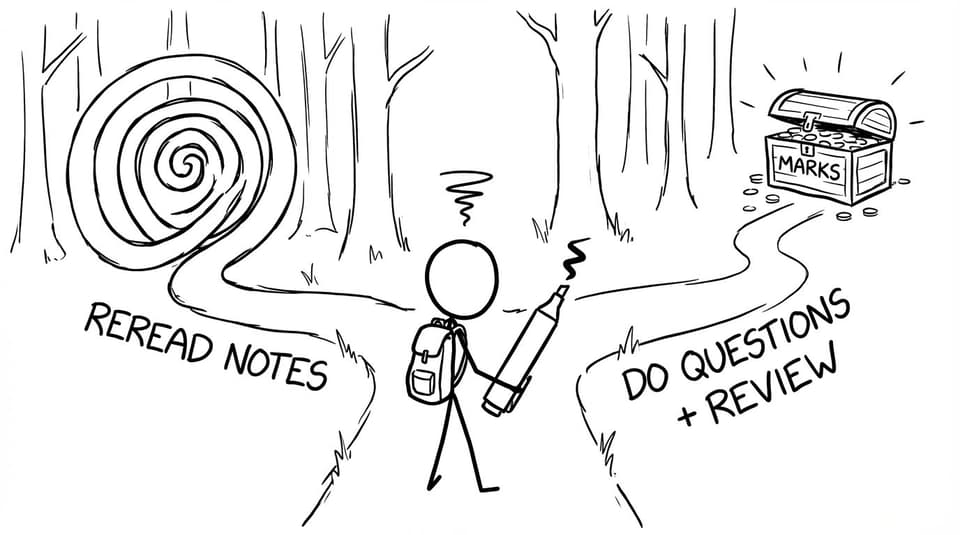
The IB practice loop that makes structure automatic
Structure isn't learned by reading about structure. It's learned the same way you learn a musical rhythm: repetition, feedback, correction.
Here's a simple loop you can run all year:
Learn the shape (5 minutes)
- Skim the relevant section of examiner-style notes.
- Ask: "What would the IB ask me to do with this?"
For a notes workflow that stays exam-focused, see Digital IB Study Notes: Access Anywhere, Anytime.
Apply under light pressure (20-40 minutes)
- Do 10-20 IB questions in the RevisionDojo Questionbank.
- Focus on structure first, speed second.
Review like an examiner (15 minutes)
- For each miss, write one "rule" you violated (command term, missing data reference, no judgement, unclear definition).
- Rewrite one answer in top-band structure.
Lock it in (7 minutes daily)
Use spaced repetition so your structures don't vanish between practices. RevisionDojo's Flashcards feature helps you keep definitions, case evidence, and key evaluation phrases ready on demand.
Timed structure: how to keep IB answers coherent when the clock is loud
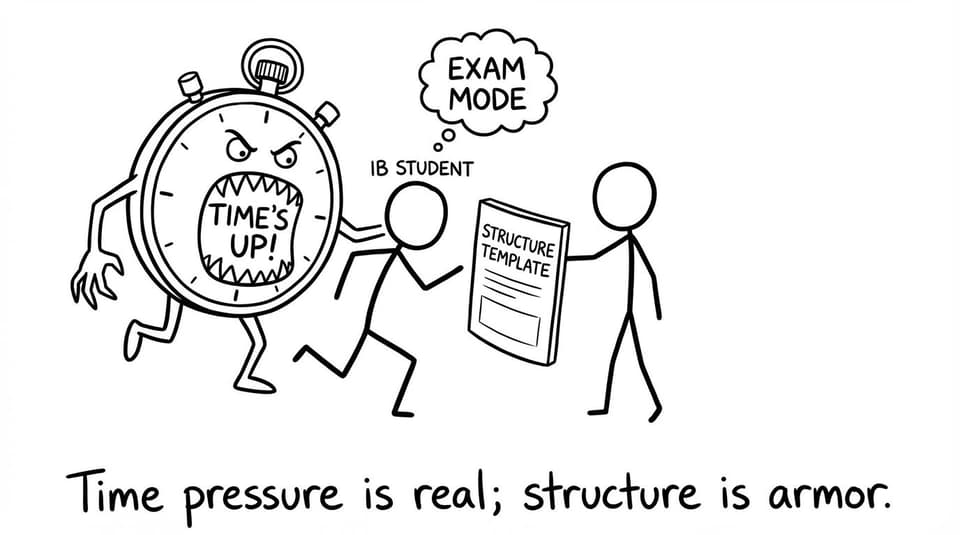
Time pressure changes your brain. It narrows it.
So the goal is not to become fearless. The goal is to become procedural.
Use timed practice to make structure your default
Run one timed session per week:
- a short section,
- then a longer block,
- then occasional full papers.
RevisionDojo supports this with Mock Exams and Predicted Papers, and you can make the timing realistic via Exam Mode. For setup and pacing tips, follow How to Run Timed IB Mock Exams in RevisionDojo (Exam Mode + Test Builder).
Closing: Make IB marks boring (in the best way)
The quiet goal of IB exam prep is to make marks boring.
Not effortless. Not lucky. Just repeatable.
When you structure IB answers the same way every time, you stop relying on exam-day inspiration. You start relying on trained habits: command term first, marks as a blueprint, evidence as proof, judgement when asked, and clean links back to the question.
If you want one place to build those habits, run the full RevisionDojo loop: Study Notes for clarity, Flashcards for daily recall, Questionbank for exam-shaped practice, AI Chat for quick unblocking, Grading tools for rubric feedback, Mock Exams and Predicted Papers for realism, the Coursework Library for examples, and Tutors when you need a human to sharpen your technique. Start with one IB paper, one question set, and one rewrite today, and let consistency do what motivation can't.