
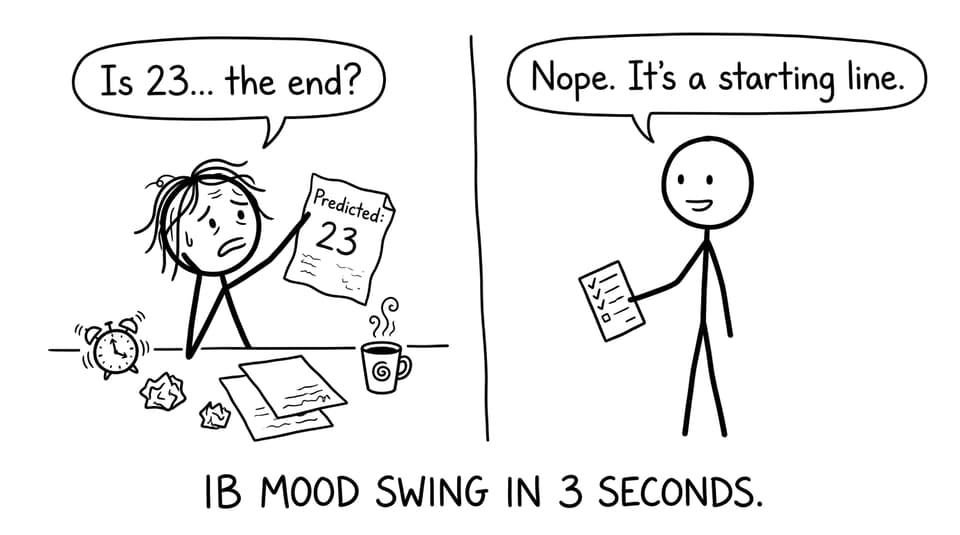
A 23 predicted score in IB can feel like standing at the edge of a cliff. Not because you are incapable, but because the number turns your whole year into a single headline.
The quiet truth about IB predictions is that they are not a prophecy. They are a snapshot of the evidence you have produced so far. And evidence can change.
If you are sitting at 23, your job is not to “save the diploma” with heroic all-nighters. Your job is to make small, repeatable improvements that show up where IB marks actually come from: exam performance, criterion-aligned coursework, and the core.
What a 23 Predicted in IB Really Means
A 23 predicted often means you are within touching distance of the diploma threshold, but you are also close to risk points (like weak HL totals or too many 3s). In IB, small shifts matter. Turning one subject from a 3 to a 4 can change your entire outcome.
Remember: final exams commonly carry a large share of subject grades, so exam execution can still move your final IB result significantly.
If you want clarity on how predicted grades are interpreted, this companion guide helps: My IB Predicted Grade Is 23/42 (25 With Bonus).
Quick Checklist Before You Start
Use this as your simple IB rescue checklist:
-
Identify your two lowest subjects (or any HL at risk)
-
Pick the next exam paper you will train for (not “the whole syllabus”)
-
Do targeted exam-style questions daily
-
Review mistakes by type (content, command term, method, time)
-
Improve TOK/EE for bonus points if possible
-
Run one timed session every week
For a bigger study framework, keep this open: How to Study for IB Exams: Step-by-Step Guide.
10 Proven Steps to Improve a 23 Predicted Score in IB
Start with the subjects that can move fastest
In IB, you do not need perfection across everything. You need points. Target subjects sitting at a 3 or low 4, because those are often the quickest to lift with focused practice.
Turn “weak topics” into “weak question types”
Students often say, “I’m bad at Topic 4.” Examiners grade answers, not topics. Translate each weakness into a question type you can train: data-based questions, long responses, case study structure, method questions.
A good way to do this is to drill with topic filters inside the RevisionDojo Questionbank and tag the patterns you miss.
Build a 48-hour feedback loop
Here is a simple IB loop that works when time is tight:
-
Day 1: attempt exam-style questions
-
Same day: mark and write a short mistake log
-
Day 2: review the exact concept using notes + flashcards
-
Day 3: reattempt a similar question under time
This is the difference between “studying hard” and “getting better.”

Use Study Notes to reduce rereading
Rereading feels responsible. In IB, it is often just comfortable. Replace the rewrite cycle with focused learning blocks using Study Notes and then immediately apply them with questions.
If you want the digital-notes approach explained, see: Digital IB Study Notes: Access Anywhere, Anytime.
Use Flashcards for daily stability
When you are predicted 23, the biggest enemy is inconsistency. Flashcards are how you keep the basics from leaking.
Use IB Flashcards with Spaced Repetition (SRS) for 7-12 minutes per day. In IB, that kind of daily recall compounds faster than one long weekend session.
Train command terms like they are vocabulary
Many IB marks are lost because students answer a different question than the one asked. Treat command terms as a skill set: analyze, evaluate, compare, discuss.
Do short drills where you rewrite a question into a one-line answer plan before you start writing.
Improve TOK + EE strategically
If your core points can move, take them seriously. A small shift in TOK or the EE can add crucial breathing room to your IB total.
Use a structure-first approach: clear claims, evidence, counterclaims, and explicit evaluation. If you feel stuck, RevisionDojo’s AI Chat can help you test whether your argument actually answers the prompt.
Use AI grading to learn faster from mistakes
The fastest students are not the smartest. They just close feedback loops quickly.
On RevisionDojo, you can practice in the Questionbank and get instant, mark-scheme-aligned feedback, then use Grading tools for coursework refinement and clarity.
Do one timed session per week (minimum)
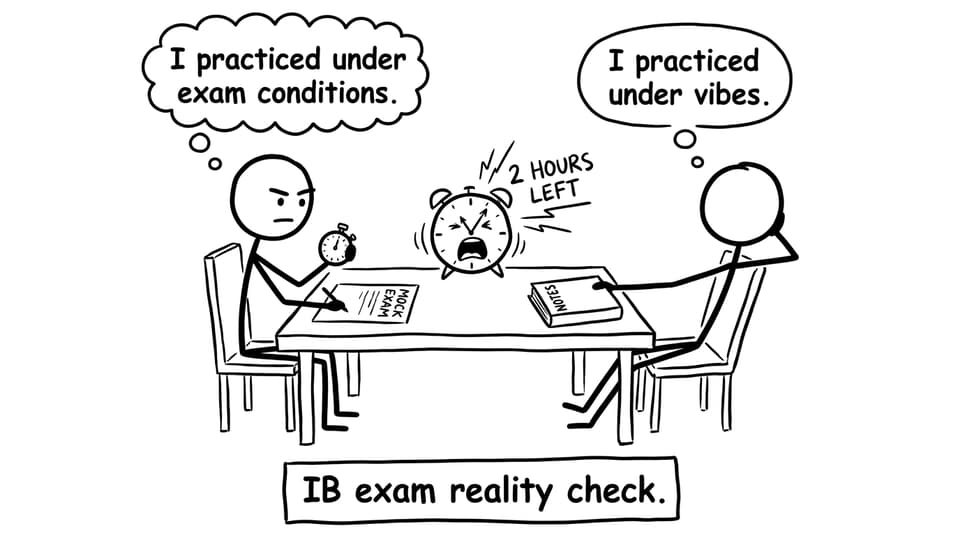
If you only study “under vibes,” your exam day becomes a shock.
Set one weekly timed block using RevisionDojo Mock Exams and Predicted Papers to build pace and reduce panic. Then review the session like a scientist: what cost you marks, and what fix is smallest?
Ask for the kind of feedback teachers can act on
Instead of “How can I improve my IB grade?”, ask:
-
“Which criterion is limiting me right now?”
-
“What would a 4-response do differently than my 3-response?”
-
“Can I do one timed task to show new evidence?”
Predictions change when the evidence changes.
Conclusion: A 23 Predicted Is a Signal, Not a Sentence
A 23 predicted score in IB is not the end of the story. It is a signal that your current system is not producing enough exam-ready evidence yet.
Start small: pick the two subjects that can move, drill high-yield question types, and run one weekly timed session. Use RevisionDojo to keep the loop tight: Study Notes for clarity, Flashcards for daily stability, Questionbank for exam practice, AI Chat and grading feedback to correct mistakes, plus Mock Exams and Predicted Papers to make exam day familiar.
If you are in IB right now, you do not need a new personality. You need a better process. Start building it today: RevisionDojo for IB.