
If you have an IB predicted grade of 23/42 (or 25 with bonus), you probably did the same math twice, then stared at the ceiling like it might negotiate on your behalf.
It is a strangely specific kind of stress: not failing, not comfortable, just close enough to the diploma edge that every small mistake feels loud.
This guide breaks down what a 23/42 predicted grade means in the IB, why the subject breakdown matters more than the headline number, and how to turn the next weeks into visible improvement (the kind teachers and examiners can actually reward).
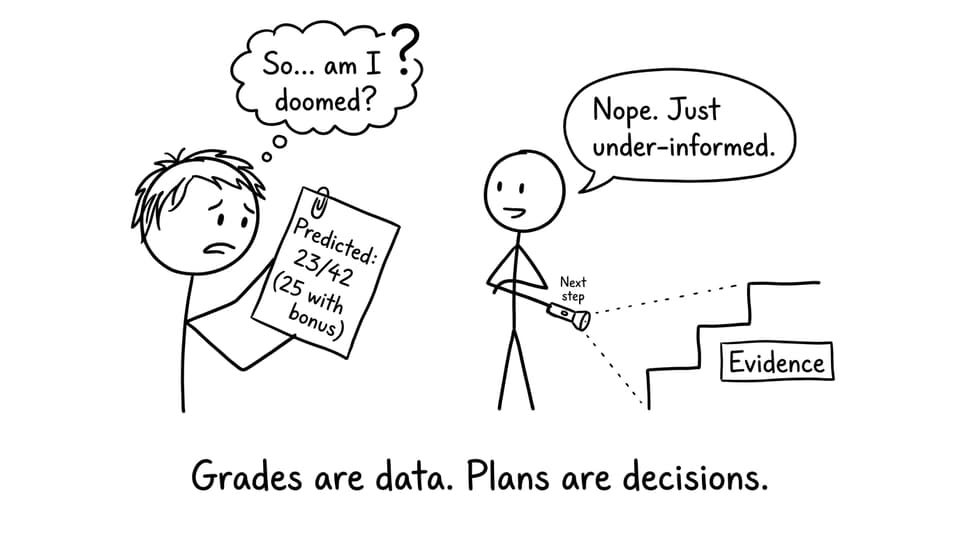
Quick meaning: 23/42 (25 with bonus) in IB
Here is the clean interpretation in IB terms:
-
23/42 refers to the six subject scores added together (each subject is 1-7, so 6 subjects max = 42).
-
The bonus refers to TOK + Extended Essay, which can add up to 3 points, bringing the diploma total to 45.
-
So 23/42 + 2 bonus = 25/45.
A predicted IB total of 25/45 is not automatically “you will fail.” But it is close enough to key diploma rules that you should stop thinking in totals and start thinking in conditions.
If you want a reality check based on your actual marks (not vibes), use the IB Grade Calculator to translate practice performance into a points estimate.
IB diploma rules: why the total is not the whole story
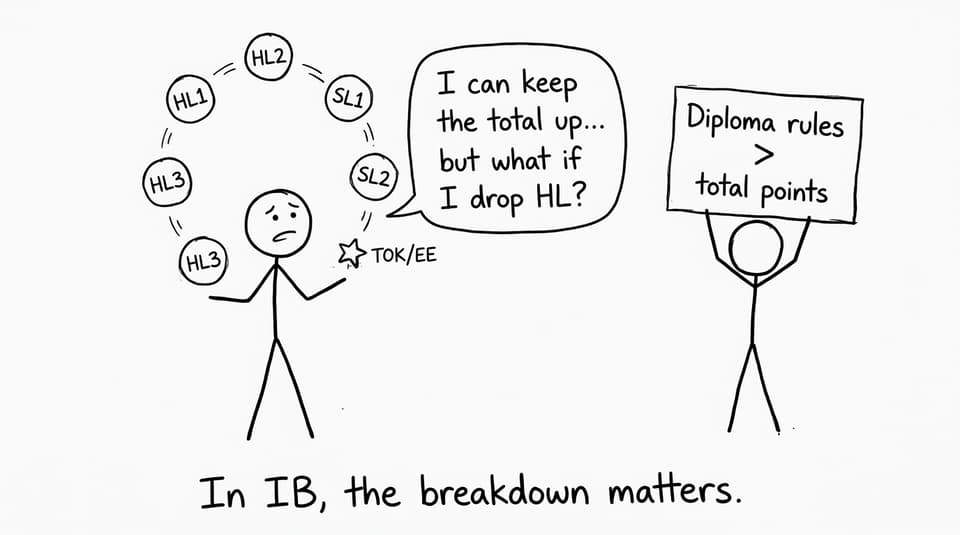
In the IB, passing the diploma is not only about reaching a minimum points total. You also have to satisfy subject-level requirements.
The big ones to confirm with your IB coordinator (because your exact breakdown matters):
-
You need at least 24 points total (including any core bonus points).
-
You need at least 12 points across HL subjects.
-
You cannot have an HL 2.
-
You cannot have too many low subject grades (for example, multiple 3s can become risky depending on the rest of your profile).
-
You must complete CAS.
-
You must submit TOK and the EE and meet the core requirements.
A 25 total in IB can still be unsafe if the points are “fragile” (for example, carried by SLs while HLs are weak). That is why the next step is to diagnose your risk properly.
Does 23/42 mean you are failing IB?
Not technically. In fact, many students with a 23/42 subject total end up finishing the IB comfortably higher.
The better question is: what is the probability you fall below a rule you did not notice?
A predicted grade is a teacher estimate based on evidence available today. Teachers tend to weigh:
-
mock exam results and timed writing
-
topic tests
-
class performance trends
-
IA progress and quality
If the evidence has been inconsistent, the prediction often leans conservative. That is why the fastest way to change your situation is not to argue with the number, but to create new evidence.
For a clear mindset reset (and a practical checklist), read IB Predicted Grades Don't Define You (Here's What Does).
The student plan: how to move up from 23/42 in IB
When you are near 24, the goal is not a dramatic overnight transformation. It is small, reliable mark gains across the most “movable” places.
Confirm your subject breakdown and your risk points
Before you make a plan, gather facts:
-
your six predicted subject grades (HL/SL)
-
your HL total
-
any 2s or multiple 3s
-
your TOK/EE bonus estimate
-
which assessments could still influence your predicted grade at school
If you want help interpreting what teachers usually mean by a prediction, use IB Predicted Grades: Interpret Them and Improve Fast.
Target the “boundary subjects” first
In the IB, moving from a 3 to a 4 (or a 4 to a 5) often comes from a few consistent habits:
-
fewer avoidable errors under time pressure
-
better command term execution
-
cleaner structure in long responses
This is exactly where targeted practice beats more reading.
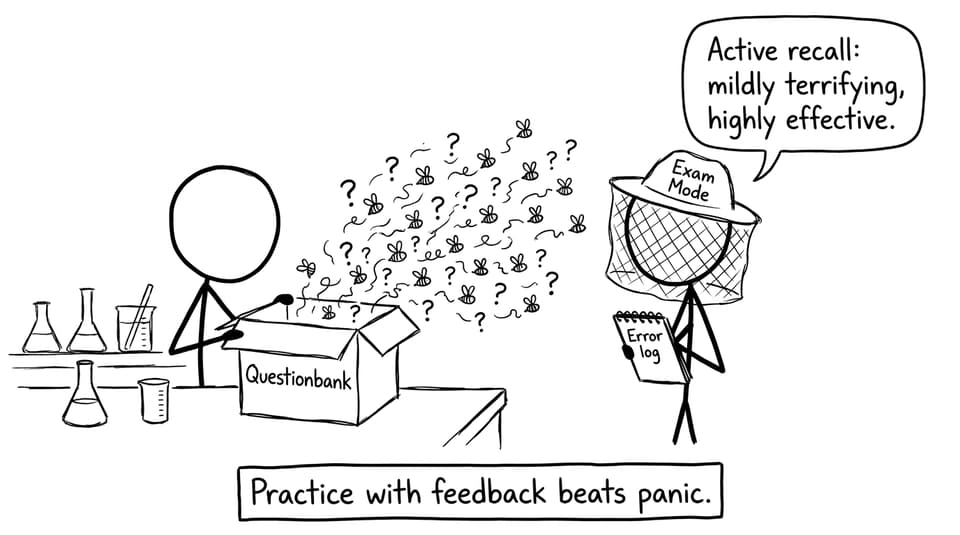
Use RevisionDojo’s Questionbank to filter practice by topic and difficulty, then build short sets you can repeat. If you take one lesson from exam prep, let it be this: repetition with feedback is calmer than “more content.”
For a subject-specific example of this approach, see IB Math: Targeted Revision Using the Questionbank.
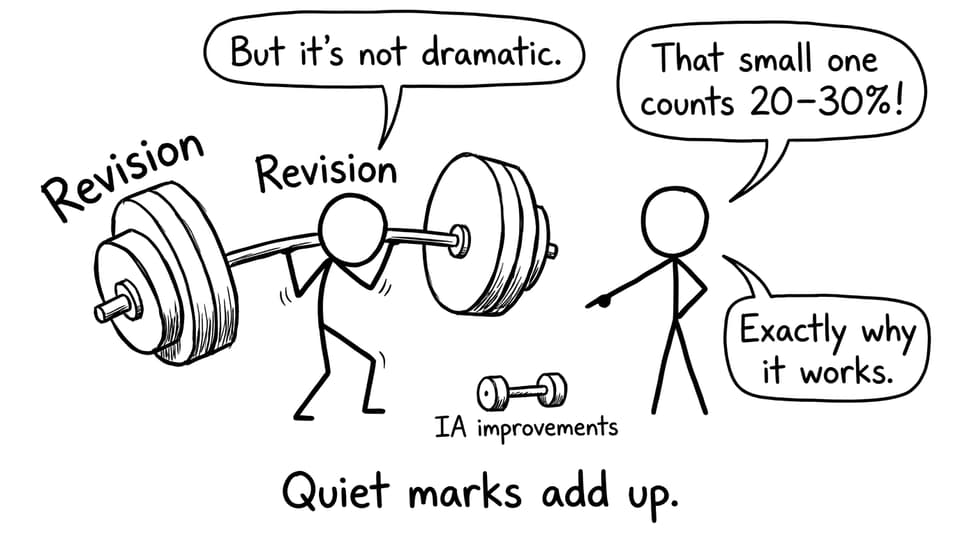
Use your IA to win quiet marks
IAs are not side quests in the IB. In many subjects they are a large portion of the final grade (often around 20-30%, depending on the course). That means improving an IA draft can raise your final outcome even if your exam confidence is shaky.
Start with the IB IA Guides hub and, if you are stuck at the research question stage, use Refine Your IA Research Question for Clarity and Focus.
RevisionDojo also helps you make IA progress visible: use the Coursework Library for exemplars, the Grading tools for rubric-aligned feedback, and Tutors if you need a human to pressure-test your draft quickly.
Rehearse the exam like it is a performance skill
Most students revise like the exam is a reading contest. The IB exam is closer to a performance: timing, stamina, command terms, and decision-making under pressure.
Build one weekly loop:
-
Study Notes to clarify a weak concept
-
Flashcards for daily recall (short, consistent)
-
Questionbank sets for accuracy
-
AI Chat when you get stuck mid-problem (ask one precise question)
-
Mock Exams and Predicted Papers to train timing
If you want a structured overview of that workflow, read RevisionDojo App: The Smarter Way to Prep for IB Exams and then compare exam-style resources using IB Predicted vs Specimen Papers: What They Mean.
Closing: what a 23/42 is really telling you
A 23/42 predicted grade in IB is not a prophecy. It is a message: your current evidence is not yet reliable enough.
Reliability is trainable. Not by cramming harder, but by studying like the exam behaves: targeted practice, rapid feedback, and repeated correction.
If you want the shortest path from worry to control, open RevisionDojo and run the loop: Study Notes for clarity, Flashcards for daily recall, Questionbank for precision, AI Chat for quick stuck points, Grading tools for rubric truth, and Mock Exams plus Predicted Papers for realism. Then check your progress with the IB Grade Calculator.
In the IB, small improvements compound. Start collecting proof that you are improving, and the numbers usually follow.