

Choosing a TOK essay title feels a bit like standing in front of a vending machine that only sells decisions.
You know you need to pick one. You know the wrong choice will haunt you at 1:12 a.m. when your introduction still says “In this essay, I will discuss…” and nothing else. And yet every prompt looks strangely similar, like the same question wearing different shoes.
The good news: a strong TOK essay doesn’t start with writing. It starts with choosing a title that you can actually think with.
In this guide, you’ll learn how to choose the perfect TOK essay title using a clear, exam-smart process. You’ll also see how to test a title quickly (before you commit), how to avoid the most common TOK traps, and how RevisionDojo’s tools can make the choice feel less like a gamble.
A quick TOK essay title checklist (use this before you commit)
Before you pick, run each title through this short TOK checklist:
-
Can you rephrase the title in one sentence without losing meaning?
-
Can you write one knowledge question that genuinely follows from it?
-
Do you already have two real-life examples that fit naturally?
-
Can you compare two Areas of Knowledge (AOKs) without forcing it?
-
Can you imagine a claim and a counterclaim that are both reasonable?
-
Does the title feel manageable in 1,600 words?
If a title fails two or more, it’s usually not “challenging.” It’s just high-risk TOK.
Decode the prescribed title like a TOK examiner
Most students lose marks in TOK long before the essay starts, because they never fully decode what the prompt is demanding.
Here’s what to do instead.
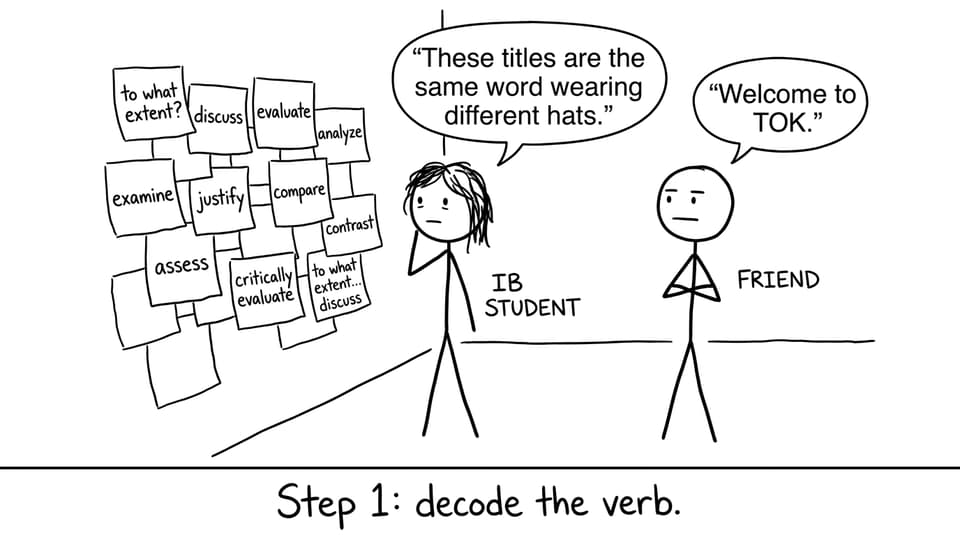
Start with the command term, not the topic
Even when TOK titles don’t look like normal command-term questions, they still contain hidden instructions: evaluate, discuss, explore, compare, “to what extent.” These words control your argument.
A practical move: underline the words that determine how you should think, not what you should write about.
Then rephrase the title twice:
-
Version A: “This title is basically asking whether…”
-
Version B: “To answer this, I would need to show…”
If you can’t do that, pause. Your TOK essay will become descriptive because the question never became clear.
For deeper title decoding practice, RevisionDojo’s TOK hub is a reliable home base: IB Theory of Knowledge Resources.
Identify the “argument shape” the title pushes you into
Strong TOK titles usually create a built-in tension, such as:
-
certainty vs uncertainty
-
evidence vs interpretation
-
experts vs public knowledge
-
methods vs results
-
ethics vs usefulness
If a title doesn’t naturally create tension, it can be hard to write an evaluative TOK essay. You may end up summarizing viewpoints rather than weighing them.
Choose a TOK title that matches your strengths (without playing it too safe)
There’s a quiet mistake that high-achieving students make in TOK: they choose the title that feels “safe,” then discover it gives them nothing original to say.
Instead, pick the title where you can do three things well:
-
explain the AOKs accurately
-
argue with balance
-
use examples that feel alive
If you’re strongest in history and literature, you might naturally build nuanced analysis about perspective, interpretation, and bias. If you’re strongest in sciences, you may find it easier to discuss models, measurement, and uncertainty.
This doesn’t mean your TOK essay should become a subject essay. It means your thinking will be sharper when the AOKs are familiar.
If you’re unsure how to choose AOKs that actually work, read: Connecting TOK Essay Ideas to Areas of Knowledge.
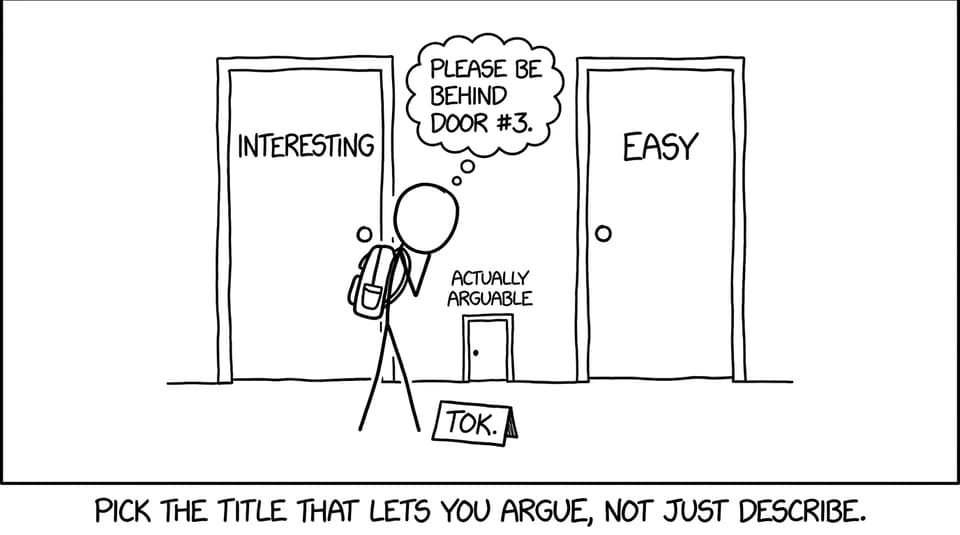
Pick the TOK title you’ll still care about on draft three
TOK is unusually sensitive to motivation.
When you’re bored, your writing becomes mechanical. Your claims get vague. Your counterclaims show up like a required accessory. The essay starts to sound like it was written by someone who doesn’t believe their own sentences.
A better test is emotional honesty:
Ask, “Would I willingly talk about this prompt for 15 minutes with a smart friend?”
If the answer is no, don’t pick it.
Interest matters because TOK rewards quality of thinking. And it’s hard to think well when you’re just trying to finish.
If you want to build that thinking mindset, RevisionDojo’s guide is worth bookmarking: TOK Thinking and Skills: How to Succeed in IB TOK.
Choose a TOK title that makes real-life examples easy
Real-life examples are the oxygen of a TOK essay. Without them, you’re left with floating claims.
But not all titles are equally “example-friendly.” Some titles almost beg for clear cases from:
-
recent news and media
-
scientific controversies
-
historical interpretation debates
-
art, censorship, and meaning
-
technology and algorithms
A fast test: write down two examples in 3 minutes. If you can’t, you’re signing up for stressful research later.
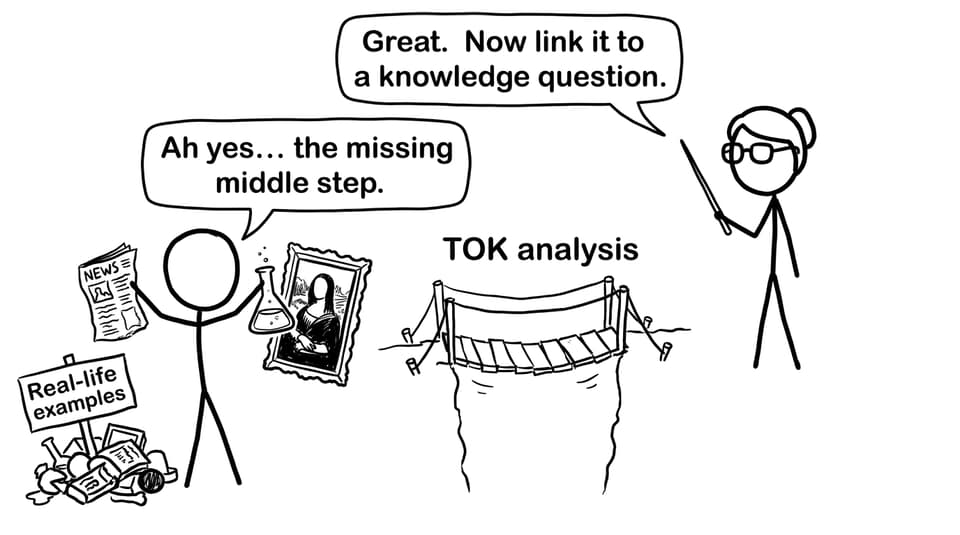
Then do one more step most students skip: for each example, write the knowledge angle.
Not “This happened.”
But “This shows how knowledge is justified/contested/limited because…”
That sentence is the difference between storytelling and TOK.
Build your TOK title choice around one strong knowledge question
A TOK essay title is a starting line. The knowledge question is the route.
So when choosing between prompts, ask: which one produces the most interesting knowledge question?
A strong TOK knowledge question tends to be:
-
genuinely open-ended (not yes/no)
-
built for evaluation (not just explanation)
-
connected to AOK methods or standards
-
able to generate claim and counterclaim
If you want to practice turning titles into KQs, use: TOK Essay Titles: What Are Knowledge Questions?.
Aim for balanced AOKs (depth beats breadth)
A common TOK myth is that more AOKs automatically equals a better essay.
In reality, examiners reward depth of evaluation. Two AOKs, done well, usually beats four AOKs with surface-level commentary.
When choosing your TOK essay title, look for prompts that let you compare AOKs meaningfully:
-
Natural sciences vs human sciences (methods, prediction, bias)
-
History vs the arts (interpretation, perspective, truth)
-
Mathematics vs ethics (certainty, axioms, values)
Choose an AOK pair where the contrast creates real analysis, not just different examples.
Watch the scope: avoid titles that are too big to control
Some TOK titles are deceptively enormous.
They invite you to talk about “knowledge,” “truth,” “culture,” and “certainty” all at once. That can turn your essay into a fog of abstract words.
A useful way to check scope is to sketch a one-line plan:
-
Paragraph 1-2: AOK 1 claim + example
-
Paragraph 3-4: AOK 1 counterclaim + example
-
Paragraph 5-6: AOK 2 claim + example
-
Paragraph 7-8: AOK 2 counterclaim + example
If you can’t imagine that structure without cramming, the title may be too wide.
Run a “difficulty audit” before you commit
Some TOK titles are interesting but fragile.
They sound profound, but they’re hard to support with specific evidence. Or they tempt you into absolute statements (“always,” “never,” “completely”). Or they depend on concepts you don’t actually understand yet.
Do a difficulty audit:
-
What would a smart counterargument be?
-
What terms would you need to define carefully?
-
What is the most likely way you could misunderstand the title?
If you can’t answer these, that’s a warning sign.
Use RevisionDojo tools to sanity-check your TOK title choice
At some point, choosing a TOK title becomes less about preference and more about feedback.
Two RevisionDojo features can help you decide with evidence:
-
The Coursework Grader, which lets you test a short outline or early paragraphs against rubric expectations: IB Coursework Grader
-
The dedicated rubric flow for essays, which makes TOK criteria feel concrete instead of mysterious: IB TOK Essay Grader
You can also look at what strong work actually looks like to reduce guessing: IB Theory of Knowledge (TOK) Examples.
And if you want broader guidance for your session’s prompts, use: RevisionDojo Ultimate TOK May 2026 Essay Guide.
Closing: choose a TOK title that lets you think clearly
The perfect TOK essay title isn’t the one that sounds the most philosophical. It’s the one that lets you build a focused argument, test ideas against real-life examples, and show examiners that you can think with precision and humility.
If you want to make your next step feel obvious, do this today: pick two titles, write one knowledge question for each, add two real-life examples, then run a short outline through RevisionDojo’s IB TOK Essay Grader. In TOK, clarity compounds.
And when you’re ready to go from “I chose a title” to “I can score well on it,” RevisionDojo is built for that entire loop: Coursework Library for models, AI Chat for quick unblocking, Grading tools for rubric alignment, and Tutors when you want a human to challenge your thinking.
Your TOK title is your first decision. Make it the one that makes every later decision easier.