

The moment your IA topic picks you
Most IB Design Technology students think choosing an IA topic is about finding something “cool.” But the projects that score well usually start in a quieter place: a real person, with a real friction in their day, that you can measure, test, and improve.
In IB Design Technology, your IA topic isn’t just the title on a cover page. It’s the size of your workload, the quality of your evidence, and the reason you’ll still care three months later when the prototype fails for the fifth time.
If you want a reliable starting point, keep the IB Design Technology hub open while you brainstorm. It’s the fastest way to stay aligned with what the 2027 syllabus actually rewards.
Quick checklist: a strong IA topic in 60 seconds
Use this filter before you commit. A strong IB Design Technology IA topic should:
-
Start with a real user (not a generic “students” or “people”)
-
Define a specific problem you can investigate
-
Be buildable with your time, tools, and budget
-
Create clear success criteria you can test
-
Leave room for iteration (changes backed by evidence)
If your idea fails two or more of these, it’s not “bad”, it just needs narrowing.
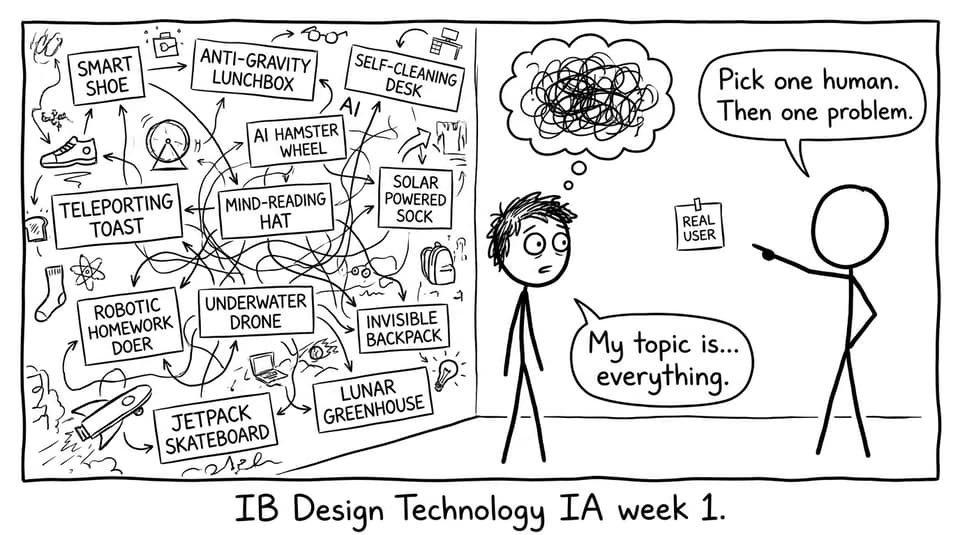
Start with a user, not a product
One of the easiest traps in IB Design Technology is beginning with a solution: “I want to design a sustainable bottle,” “I want to make a desk organizer,” “I want to build a lamp.” Examiners don’t award marks for wanting to build something. They reward the design cycle: research that drives decisions, and testing that drives changes.
Try this sentence instead:
“A specific user struggles with a specific task in a specific context.”
For a clear walkthrough of this mindset, read What Is the Best Way to Start the IB Design Technology IA?. It keeps you problem-led, which is where high-scoring IB Design Technology IAs usually begin.
A simple way to narrow your user
Pick one:
-
A younger sibling who can’t grip standard bottle lids
-
A grandparent who struggles with reaching high shelves
-
A classmate with limited desk space in a small room
-
A club leader who needs safer equipment storage
“Real user” doesn’t need to be dramatic. It needs to be documentable.
Make the problem measurable (so your evaluation writes itself)
A topic becomes strong when you can prove improvement. In IB Design Technology, that proof is your testing data, your user feedback, your specification table, and the way your prototype changes over time.
A good IA topic naturally generates measurable criteria like:
-
Time to complete a task (seconds)
-
Comfort ratings (Likert scale)
-
Force required (simple spring scale)
-
Mass, volume, stability, or durability tests
-
Percentage reduction in waste or material use
If you’re unsure what “evidence” looks like in marking terms, How Do Teachers Mark IB Design Technology Internal Assessments is worth a careful read. It explains what can actually earn marks, and what just looks impressive.
Choose a topic you can actually build
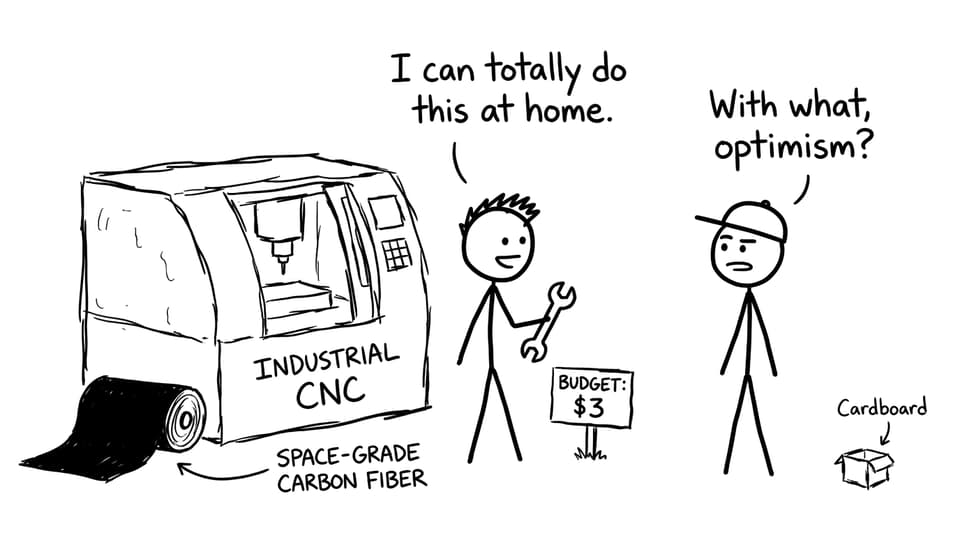
Ambition is good. Unbuildable is not.
A practical IB Design Technology IA topic respects three constraints:
-
Tools: what you can access consistently (school workshop, home tools, basic CAD)
-
Materials: what you can source repeatedly for iteration
-
Time: what you can prototype and test more than once
If your idea requires industrial manufacturing, expensive electronics, or a perfect first prototype, you’ll spend more time apologizing than designing.
A helpful strategy is to design a “minimum viable prototype” first: the simplest version that lets you test the key function. Then iterate upward.
Build the topic around the design cycle (not around vibes)
Strong IB Design Technology topics make it easy to show:
-
Research (user needs, existing products, material properties)
-
Ideation (multiple concepts with clear trade-offs)
-
Development (why one idea wins, and how you refine it)
-
Prototyping (build, test, document)
-
Evaluation (compare results to your specification)
If you want a step-by-step structure that matches that flow, use Step-by-Step Guide to Writing a Winning IB Design Technology IA alongside your planning.
Topic examples that tend to work well
Each of these can be excellent in IB Design Technology if tied to a real user and measurable testing:
-
A modular desk organizer for a student with limited workspace
-
A reusable packaging solution for a local bakery (with lifecycle considerations)
-
An ergonomic add-on for long study sessions (posture, pressure points, adjustability)
-
A compact storage system for small student housing
-
A low-cost learning aid for teaching sustainability concepts
The “secret” is not originality. It’s clarity + evidence.
Use RevisionDojo to turn a topic into a scoring plan
Once you have 2-3 topic candidates, RevisionDojo can help you choose the one that will actually perform.
-
Use the Design Technology (DT) resource page to connect IA choices to the concepts you’ll be assessed on.
-
Use the IA marking language to self-check your plan with the IB Design Technology HL IA Grader.
-
If you’re revising alongside your IA, pair your project thinking with exam training using the IB Design Technology Topic B2.2 Modelling and Prototyping Questionbank.
-
For overall exam readiness, combine your weak areas into timed practice with IB Predicted Papers, then tighten knowledge using Study Notes and Flashcards.
That’s also why many students keep Best Study Strategies for IB Design Technology Students bookmarked; it connects learning to practice in a way that feels sustainable.
Conclusion: choose the topic that creates evidence
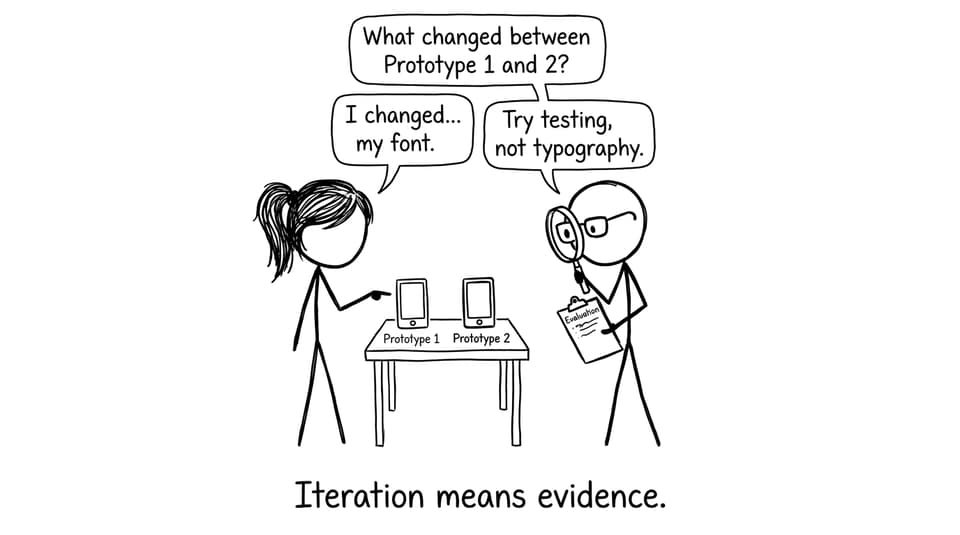
A strong IB Design Technology IA topic is rarely the flashiest idea in the room. It’s the one with a real user, a measurable problem, and a prototype you can improve more than once.
If you want to move from “idea” to “plan” quickly, start at the IB Design Technology hub, then use RevisionDojo’s Study Notes, Flashcards, AI Chat, Questionbank, Grading tools, Predicted Papers, Mock Exams, Coursework Library, and Tutors to keep the whole year connected, IA progress and exam prep included.
Your best topic is the one that you can test, refine, and explain with calm confidence. That’s the heart of IB Design Technology.