

A strange thing happens in IB Design Technology exams: you can walk out feeling fine, then open your results and wonder where the marks went.
Most of the time, it is not because you did not revise. It is because you lost marks in the quiet places: the command term you half-followed, the scenario you ignored, the evaluation you avoided, the time you donated to a low-mark question.
The good news is that IB Design Technology mistakes are often predictable. If you can name them, you can stop repeating them.
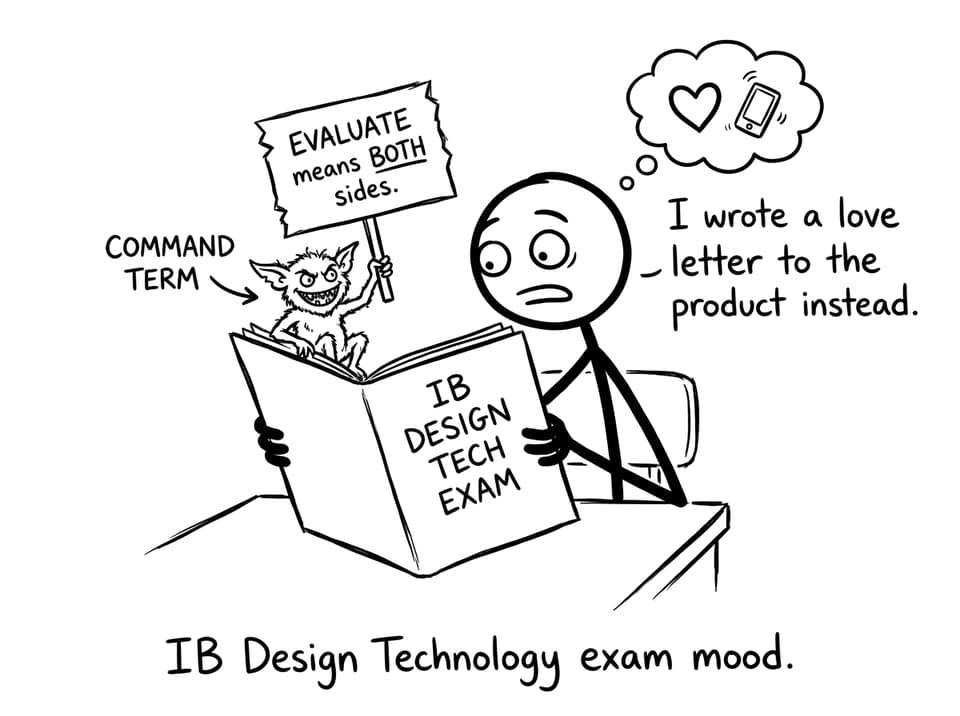
Quick checklist: the top IB Design Technology exam traps
Before we go deeper, use this as a last-minute audit for IB Design Technology:
-
Are you answering the command term (not just the topic)?
-
Are you using the scenario details in every longer answer?
-
Do you include trade-offs (not just advantages)?
-
Is your terminology precise (ergonomics, sustainability, user needs)?
-
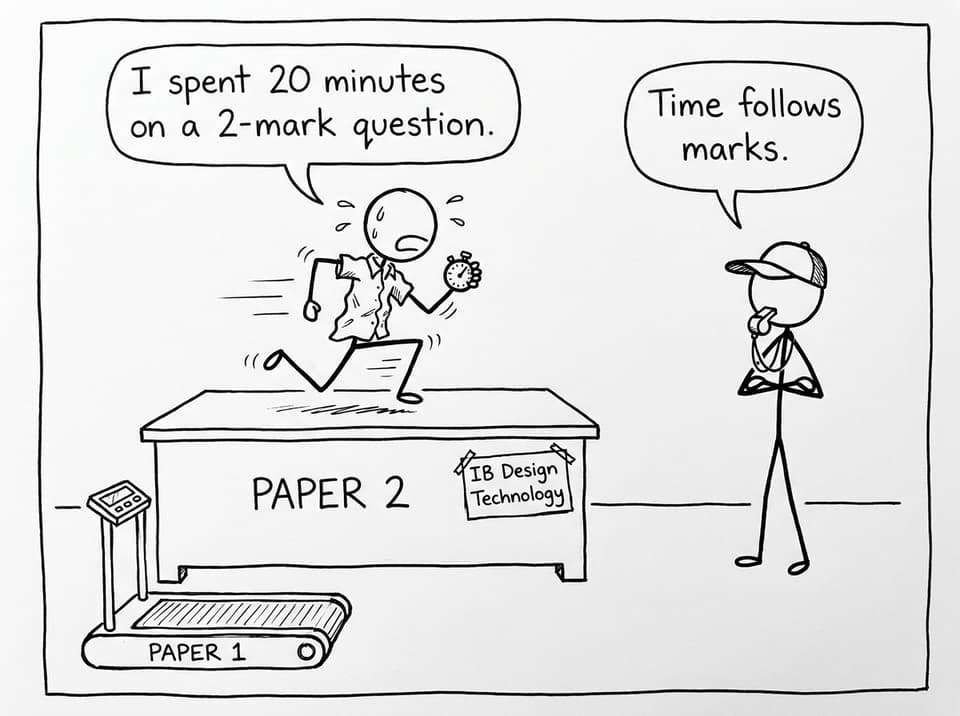
Does your time spent roughly match the marks?
For a structured home base, keep the IB Design Technology Resources hub open while you revise.
Mistake 1: Describing instead of analysing in IB Design Technology
A high-frequency IB Design Technology mistake is writing like a brochure.
Example of weak writing:
- “The chair is ergonomic because it is comfortable.”
This sounds positive, but it is not analytical. Examiners want cause and effect.
Better moves:
-
Link a feature to a user need (anthropometrics, posture, grip force).
-
Explain the mechanism (why that feature changes comfort, safety, efficiency).
-
Add a constraint or trade-off (cost, manufacturability, durability).
When you practise, do it with feedback. The IB Design Technology Questionbank is ideal because it forces you to turn knowledge into mark-awarding statements.
Mistake 2: Ignoring the command term
In IB Design Technology, the command term is the deliverable.
If the question says evaluate, you must weigh strengths and limitations and reach a justified judgement. If it says explain, you must show why/how, not just list points.
Two fast fixes:
-
Circle the command term and write a 1-line plan that matches it.
-
Use a default structure, like “Point -- Because -- So what -- Limitation/Judgement.”
If you need a refresher, read How to Use Command Terms Effectively in IB Exams and the DT-specific guide What Command Terms Appear Most in IB Design Technology Exams.
Mistake 3: Generic answers that ignore the scenario
IB examiners reward application. Yet many IB Design Technology students drop memorised paragraphs that do not touch the product, user, or context in the question.
A simple rule: every longer response should include at least two scenario anchors, such as:
-
the specific user group (not “people,” but “left-handed cyclists commuting in rain”),
-
the context of use (outdoors, medical setting, school workshop),
-
a realistic constraint (budget, materials available, production scale).
To train this, pick one topic and practise in context, for example IB Design Technology 6. Classic Design or a practical manufacturing area like 10.3 Computer-integrated manufacturing (CIM).
Mistake 4: Overwriting without adding marks
Longer is not higher-scoring in IB Design Technology.
Repetition does not earn extra credit. It mainly hides your best points and burns time.
Try “marks = moves”:
-
4 marks usually means 4 distinct points or steps.
-
Each sentence should earn something: a definition, a reason, an implication, a limitation.
For structure templates that keep you concise, use Structure IB Answers to Maximize Marks.
Mistake 5: Avoiding evaluation and trade-offs
Evaluation is where top marks live in IB Design Technology. It is also where students get nervous and become absolute.
Common weak patterns:
-
listing only advantages,
-
avoiding criticism,
-
making total claims (“this is the best material”).
High-scoring evaluation sounds like a designer:
- “Material A improves stiffness-to-weight, but increases cost and machining time, so it suits low-volume premium production more than mass manufacture.”
If you want to practise judging under time pressure, RevisionDojo’s Mock Exams and Predicted Papers (plus Grading tools and AI Chat) are designed for exactly that improvement loop.
Mistake 6: Misusing design terminology
In IB Design Technology, vocabulary is not decoration. It is precision.
Three terms students often misuse:
-
Ergonomics: not “good,” but fit between user and product (anthropometrics, posture, safety).
-
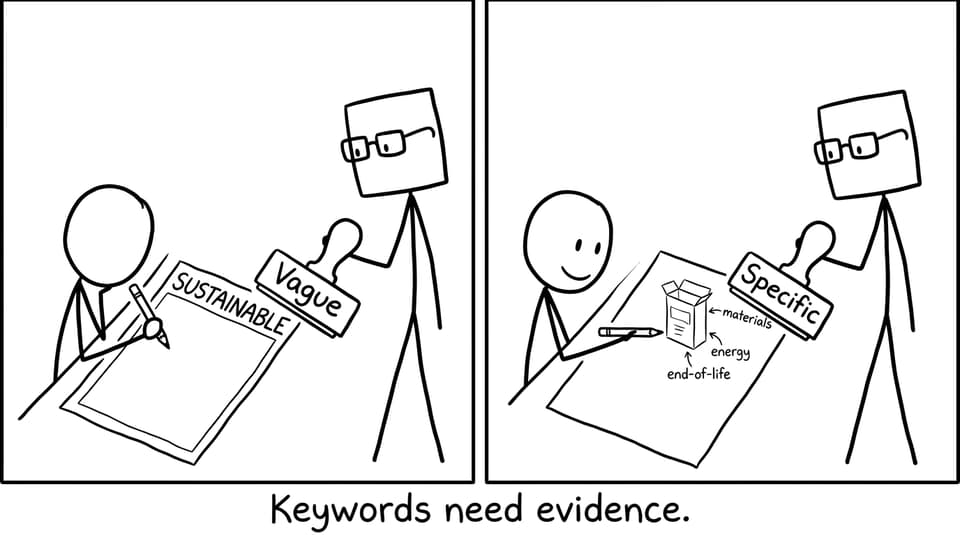
Sustainability: not “eco,” but impacts across materials, energy, and end-of-life.
-
User needs: not “teenagers,” but measurable requirements (grip diameter range, weight limits, accessibility).
To tighten recall, use the Design Technology Flashcards and practise applying terms in short answers.
Conclusion: turn IB Design Technology mistakes into a plan
The real shift in IB Design Technology is noticing that marks are not lost in dramatic ways. They are lost in small habits: generic answers, ignored command terms, missing trade-offs, and time spent where it cannot pay you back.
If you want one place to practise the right habits, build a simple routine with RevisionDojo: learn with Study Notes, retain with Flashcards, apply with the Questionbank, and rehearse pressure using Mock Exams and Predicted Papers. Then use AI Chat, Grading tools, the Coursework Library, and Tutors when you need faster feedback than waiting a week.
That is how IB Design Technology revision becomes less about hope and more about proof.