


A good IB Design Technology IA starts the same way most great designs do: with a small frustration you can’t unsee.
Maybe your backpack tips over every time you hang it on a chair. Maybe a younger sibling struggles to open a lunch container. Maybe your school’s shared lab tools disappear into chaos. In IB Design Technology, that tiny annoyance is not a distraction. It’s a design opportunity.
This step-by-step guide shows you how to turn a real problem into a clear, examinable project that earns marks because your thinking is visible, testable, and well documented. If you want a one-stop base for the 2027 syllabus, start with the IB Design Technology Resources page.
Quick checklist: what a winning IB Design Technology IA includes
-
A specific user and a narrow problem you can genuinely test
-
Research that directly shapes your design requirements
-
Multiple concepts (not just one “final idea”)
-
A prototype (physical or digital) with measurable testing
-
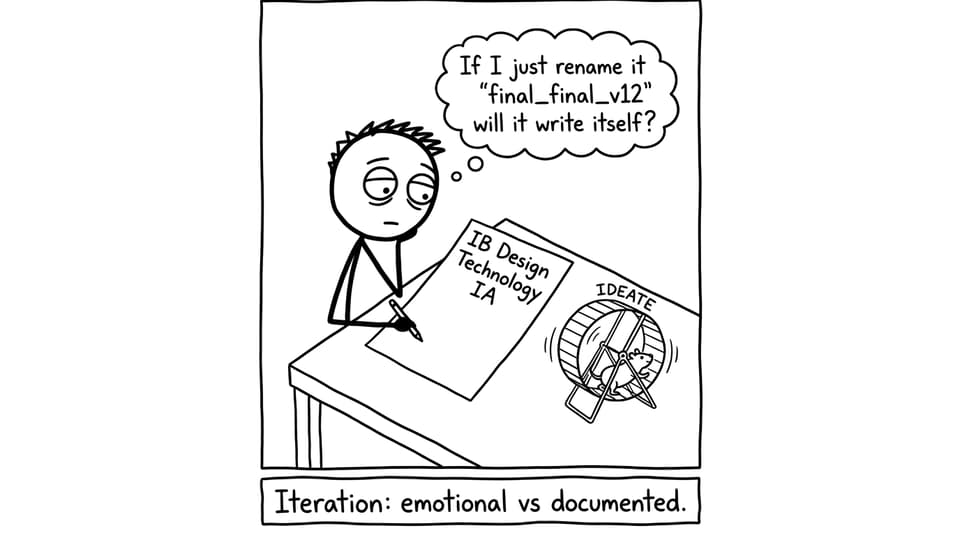
Iteration shown as: test, change, justification
-
Evaluation based on evidence, trade-offs, and next steps
When you’re unsure what examiners reward, it helps to read how criteria get applied in practice. Use How Do Teachers Mark IB Design Technology Internal Assessments as your reality check.
Step 1: Identify a problem you can actually finish
The fastest way to lose marks in IB Design Technology is to choose a problem so broad that you end up describing ideas instead of proving outcomes.
Aim for a problem statement that answers:
-
Who is the user (one real person, or a small defined group)?
-
What is happening now that isn’t working?
-
Where and when does it occur?
-
Why does it matter in a way you can later measure?
If you want a strong template for phrasing, follow IB Design Technology Problem Statement: Write It Strong. Then sanity-check your scope with Common IB Design Technology IA Mistakes and How to Fix Them.
Step 2: Research like you’re building evidence, not a bibliography
In IB Design Technology, research is only “good” if it changes what you decide next.
Include three types of research:
User research
Short surveys, interviews, or observation notes that produce usable constraints. One strong quote with context beats ten generic opinions.
Existing solutions
What already exists, what it does well, and the specific gap your product addresses. Your goal is not to criticise everything. It’s to locate a design space.
Sustainability and lifecycle thinking
Materials, manufacturing, durability, repair, and disposal. Even small choices (fasteners, modularity, thickness) can become evaluation points later.
While you research, keep your exam skills warm too. RevisionDojo’s Study Notes, Flashcards, and Questionbank help you connect theory (materials, ergonomics, lifecycle) to real design decisions. Start from the IB Design Technology Resources hub and build around your weakest areas.
Step 3: Turn research into testable design requirements
This is where many IB Design Technology IAs quietly collapse: students list “design specifications” that sound impressive but can’t be tested.
A strong requirement is:
-
Derived from evidence (user quote, measurement, product analysis)
-
Measurable (time, mass, force, dimensions, temperature, user rating scale)
-
Relevant to the user’s real need
Example of a testable requirement:
-
“The organizer must fit in a 30 cm wide shelf space” (measurable)
-
Not “The organizer should be compact” (vague)
Step 4: Develop multiple ideas (and show why you didn’t choose them)
Examiners want to see you think in options, not announce a solution like a reveal.
Sketch 3-5 concepts. Then evaluate them using your requirements:
-
Which concept best meets the must-haves?
-
Which one is easiest to prototype and test well?
-
What trade-offs are you accepting?
If you want to see what this looks like at a high level, browse IB Design Technology IA Examples: What Top Projects Look Like, then reinforce your standards with Score a 7 in IB Design Technology: A Calm Strategy.
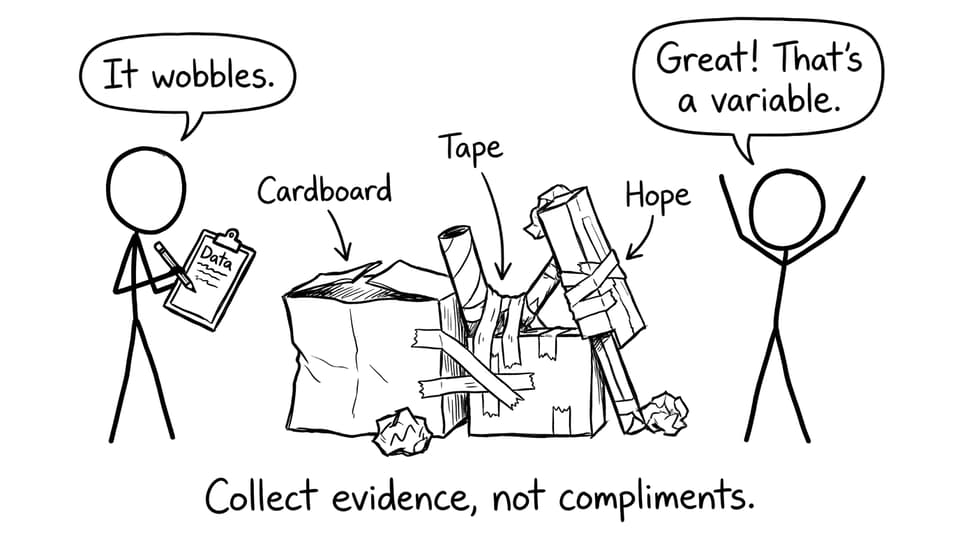
Step 5: Prototype and test like a scientist
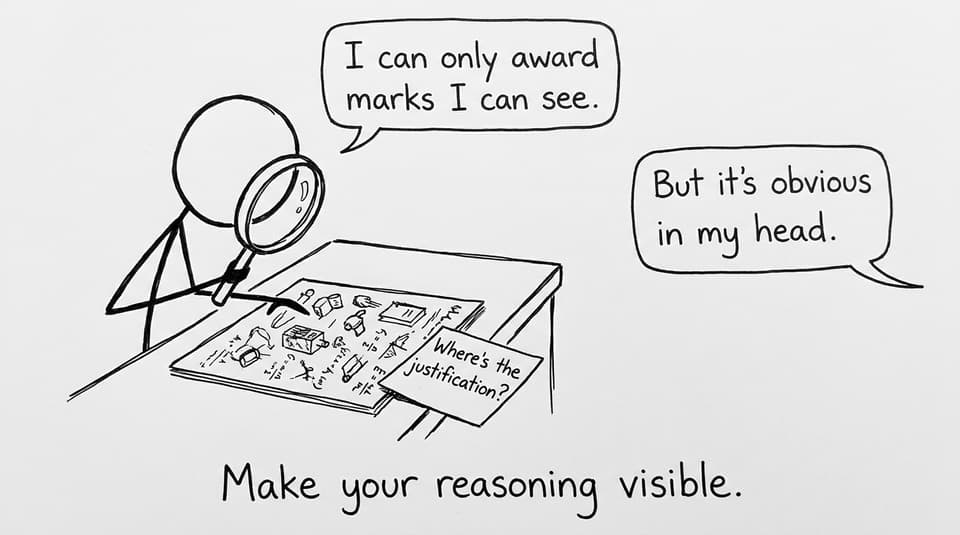
A prototype in IB Design Technology doesn’t need to look expensive. It needs to generate evidence.
Prototype options include:
-
Cardboard and foam mockups for ergonomics and layout
-
3D printed parts for fit and assembly testing
-
CAD models and simulations for dimensions and mechanism logic
Testing should produce numbers or structured feedback. For example:
-
Time to complete a task
-
Number of errors
-
User comfort rating out of 10
-
Load capacity before deformation
RevisionDojo can speed up your feedback loop: use AI Chat to refine test methods, and the Grading tools to check whether your write-up actually earns marks. If you want models to compare against, explore the Coursework Library via Coursework | RevisionDojo and the broader IB Coursework Examples: IA, EE and TOK Exemplars.
Step 6: Evaluate honestly, then reflect like a designer
Evaluation is not a victory lap. In IB Design Technology, it’s the moment you prove your design cycle worked.
A strong evaluation:
-
Goes requirement by requirement (met / partially met / not met)
-
Uses your test data and user feedback as evidence
-
Explains trade-offs (strength vs weight, cost vs durability, simplicity vs adjustability)
-
Proposes realistic improvements you could test next
When you reach the final polish stage, use Finalise and Submit Your IB Design Technology IA as your submission checklist.
Conclusion: treat IB Design Technology as proof, not performance
A winning IB Design Technology IA isn’t the one with the fanciest product photo. It’s the one where every decision has a reason you can point to: research, requirements, prototyping, testing, iteration, evaluation.
If you want the calmest way to do that, build your workflow around RevisionDojo: use the Questionbank and Study Notes to strengthen theory, Flashcards to keep key terms sharp, AI Chat when you’re stuck, Grading tools to check rubric alignment, and the Coursework Library plus Tutors when you want feedback that feels like an examiner.
Start with the IB Design Technology Resources hub and turn your first draft into a design cycle you can actually prove.