
A parent can see what a student cannot. The missing example. The vague sentence. The deadline moving closer while a blank document remains open on the kitchen table.
Wanting to help is reasonable. Worrying about overstepping is reasonable too.
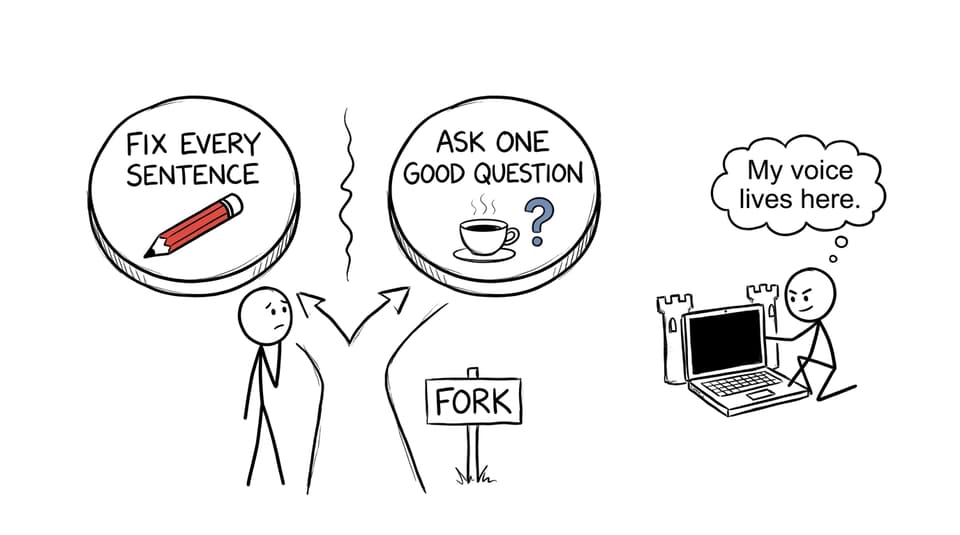
The clearest rule for helping with personal statement IB applications is this: support the thinking and the process, but leave the ideas, language, and final decisions to the student. You can ask questions, help them remember relevant experiences, identify confusing passages, check basic accuracy, and protect time for drafting. You should not compose sentences, replace their vocabulary, reorganize the entire response, or turn their draft into the version you would have written.
That boundary protects more than application integrity. It protects the student's voice.
The parent checklist at a glance
Before giving feedback, ask whether your involvement does the following:
- Helps the student discover what they genuinely want to say
- Responds to an existing draft rather than creating one for them
- Identifies problems without automatically supplying solutions
- Preserves language the student would naturally use
- Checks the current instructions for the relevant application system
- Leaves the student responsible for every final change
- Reduces pressure instead of transferring parental anxiety to them
A useful mental model is simple: be the reader, not the writer.
Why the boundary matters
A personal statement is not merely a polished piece of prose. It is evidence of how an applicant thinks, what they notice, and why a subject or experience matters to them. If an adult improves every line, the document may become smoother while becoming less revealing.
This distinction will feel familiar to many IB diploma parents. The Extended Essay is completed with guidance, but the intellectual work and writing remain the student's responsibility. A supervisor may question, challenge, and comment without becoming the author. The same principle offers a sensible boundary for application writing.
Parents looking for IB Extended Essay help can review the broader discussion of academic honesty in the Extended Essay. The contexts are different, but the underlying habit is useful: assistance should strengthen independent thought rather than replace it.
There is also a practical reason to preserve the student's style. Application materials should form a coherent picture. A statement written in conspicuously adult language can feel disconnected from the applicant's other work, conversations, and school context. Authenticity is not created by adding youthful phrases afterward. It survives when the student retains ownership throughout.
Start by checking what the application actually asks
“Personal statement” can describe different tasks. Before discussing content, confirm the platform, entry year, institution, course, prompt, and length limit. Requirements can change and may differ across countries or universities.
For UCAS applications from 2026 entry onward, the personal statement uses three structured questions covering:
- Why the applicant wants to study the course or subject
- How their qualifications and studies have prepared them
- What they have done outside formal education to prepare, and why it is useful
The three responses share an overall limit of 4,000 characters including spaces, and each response must contain at least 350 characters. Families should still check the live UCAS instructions and the school's application guidance before submission.
Students applying elsewhere may face a broader personal essay, institution-specific supplements, or no general essay at all. The global IB university application guide provides useful context, while students applying in the United States can consult this explanation of using the IB in US college applications.
Do not begin editing until the student can explain, in their own words, what the prompt is asking. Elegant writing cannot rescue an answer to the wrong question.
Help them find material without choosing it for them
The safest help often happens before a first draft exists. Instead of suggesting a grand opening, hold a short conversation that helps the student retrieve experiences and examine their meaning.
Useful questions include:
- What first made this subject feel worth exploring further?
- Which part of an IB course changed or complicated your thinking?
- What did you investigate independently after a lesson ended?
- Which project demanded more persistence than you expected?
- What did your Extended Essay teach you about research or uncertainty?
- Which activity changed how you understand the course you want to study?
- What could you discuss comfortably if an interviewer asked a follow-up question?
Listen for energy and specificity. A student may speak for five minutes about a difficult experiment but offer only one sentence about an impressive-sounding award. That difference is informative. It does not automatically determine the topic, but it shows where genuine reflection may be found.
If the EE is relevant, encourage the student to focus on what they questioned, discovered, or reconsidered rather than simply announcing a title. These guides to using an EE topic in university applications and tailoring the EE for university applications can help families understand the connection without scripting it.
After the conversation, step away. The student should decide what belongs in the response and produce the first written version independently.
Give feedback in layers
Receiving twenty comments at once can make a student feel that the entire draft has failed. It can also invite the parent to take control. Feedback is more useful when separated into layers.
First read: meaning
Read without correcting anything. Then ask:
- What do you want the reader to understand about you here?
- Which sentence carries the main point?
- Is there an example that proves this claim?
- What did you learn from the experience?
If you cannot identify the central idea, say so plainly: “I am not sure what you want me to take from this paragraph.” That is more useful than rewriting it.
Second read: relevance and structure
Check whether each section answers the actual prompt. Look for repeated ideas, unexplained activities, and long descriptions that never reach reflection.
A good comment identifies the issue: “The example is clear, but I do not yet see how it prepared you for the course.” A risky comment dictates the replacement: “Write that the experience developed your analytical resilience.”
The first sends the thinking back to the student. The second quietly takes authorship away.
Final read: accuracy and mechanics
Only after the ideas and structure are stable should you flag spelling, punctuation, dates, course names, and obvious grammatical errors. Ask the student to make the corrections. If a sentence is awkward, underline it and request another version rather than silently replacing it.
Students can also compare their response with a general guide to writing a UCAS personal statement, while remembering that current UCAS applications use structured questions rather than the former single-block format.
Use questions instead of track-changes takeover
Editing tools make overstepping remarkably easy. A parent can transform a paragraph in minutes, especially when a deadline is close. The student then faces a difficult choice: accept language that is not theirs or reject apparently “better” writing.
A comment-only approach creates a healthier separation. Consider these alternatives:
| Instead of doing this | Try this |
|---|---|
| Rewriting the opening | Ask what the opening needs to establish |
| Replacing simple vocabulary | Ask whether the word sounds natural to the student |
| Adding an achievement | Ask which evidence best supports the point |
| Moving every paragraph | Identify where the logic became difficult to follow |
| Cutting the response yourself | Mark ideas that seem repeated |
| Writing the conclusion | Ask what the student wants the reader to remember |
The aim is not to avoid all direct advice. A parent can say, “This paragraph repeats the previous one,” or, “The prompt asks why the experience was useful, and that part seems missing.” The boundary is crossed when feedback becomes substitute prose.
Protect the student's voice during revision
Student voice does not mean careless writing. It means the final response uses ideas, rhythms, and vocabulary the student understands and would willingly defend.
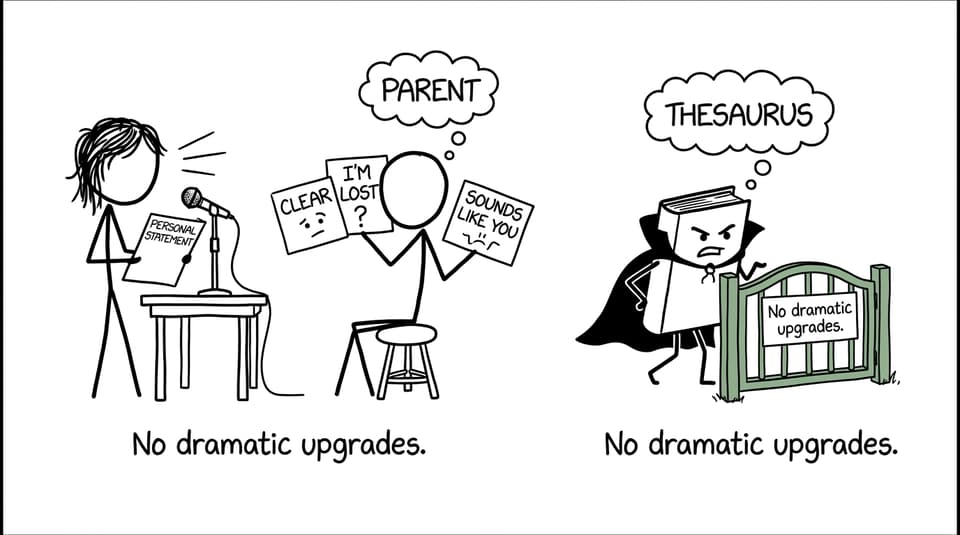
One simple test is to have the student read the draft aloud. Sentences that are too formal, overloaded, or unnatural often become obvious when spoken. Ask three questions afterward:
- Does this sound like you on a thoughtful day?
- Can you explain every claim without referring to notes?
- Did every example and interpretation originate with you?
Be especially cautious with thesauruses, templates, automated rewriting tools, and model responses. Even when a tool is permitted, it can flatten individuality or introduce claims the student would not have made. Students should follow the rules of their school, application platform, and chosen universities regarding outside or AI assistance.
The same instinct matters in IB coursework, where process, attribution, and authentic authorship are central. Families concerned about the distinction can read about integrity and original argumentation in the Extended Essay.
Know when to stop helping
Parental support becomes less helpful when the student starts defending every original phrase, waits for approval before making small decisions, or describes the statement as “ours.” Those are signs that ownership is drifting.
It may be time to step back if:
- You care more about a particular topic than the student does
- Your comments substantially outnumber their sentences
- You are editing while frustrated or frightened about admission
- The vocabulary resembles your professional writing
- The student cannot explain why a paragraph is included
- Feedback conversations repeatedly become arguments
At that point, return responsibility clearly: “I have identified the places where I was confused. You decide what, if anything, to change.” Another appropriate reader might be a school counsellor or teacher who understands the current application process and can give bounded feedback.
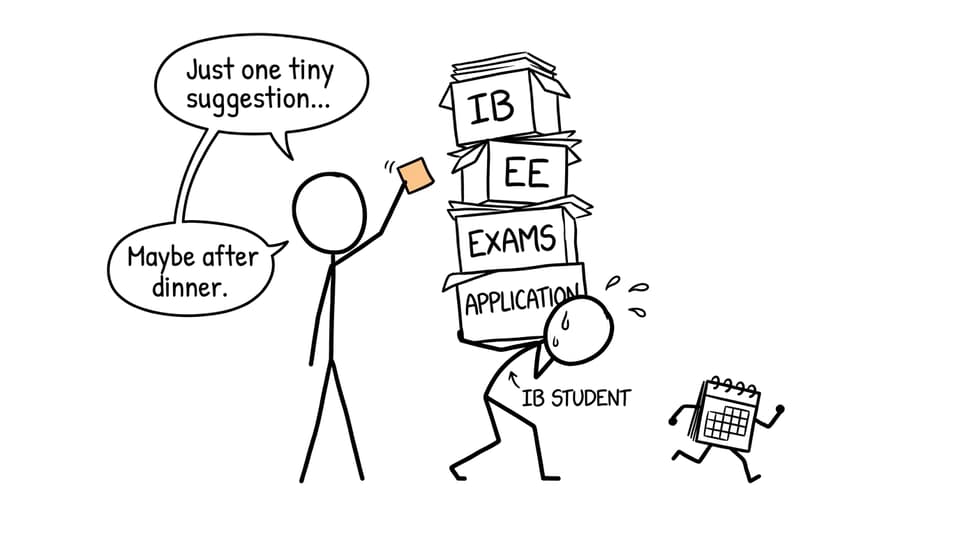
Parents also need to consider timing. IB students may be balancing internal deadlines, the EE, exam preparation, references, and application tasks. The guide to balancing IB and university applications explains why practical support around calendars and workload can be more valuable than another round of line edits.
The most useful role is smaller than it feels
A strong personal statement does not require a parent to disappear. It requires the parent to occupy the right role.
You can create time, ask questions, notice what is unclear, confirm that instructions have been followed, and remind a tired student that a first draft is allowed to be imperfect. Then you can let them solve the writing problem themselves.
The natural next step is modest: agree on one feedback session, ask the student what kind of response they want, and read once without touching the wording. When the conversation ends, return the document to its author. That is not withholding help. It is the form of help that leaves both the application and the student's independence intact.