

When a child begins struggling in MYP Individuals and Societies, the problem can look simple. A disappointing mark appears, revision becomes tense, and everyone concludes that the student needs to learn more facts.
Sometimes that is true. Often, the real difficulty is narrower. Your child may understand the topic but misread a command term. They may know the evidence but struggle to organize it, or describe a source accurately without evaluating its value and limitations.
Helping a child struggling in MYP Individuals and Societies begins with identifying that precise gap. A parent's role is not to become another teacher, but to create enough calm and structure for the child to practise the right skill.
A quick parent checklist
Start with these low-pressure actions:
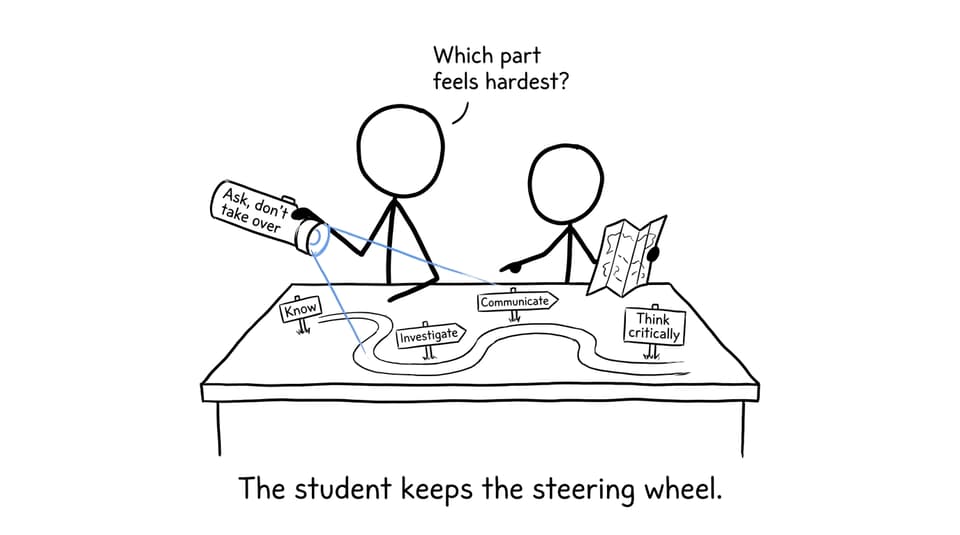
- Ask which part of the latest task felt hardest.
- Look at the assessed criterion, not only the overall mark.
- Choose one small skill to improve this week.
- Keep study sessions short and predictable.
- Ask questions instead of correcting every sentence.
- Encourage specific feedback from the teacher.
- Use one organized resource system.
- Notice strategy and improvement as well as results.
This protects something important: ownership. Your child needs support, but they must remain the person doing the thinking.
Understand what the subject assesses
MYP Individuals and Societies may include history, geography, economics, politics, sociology, or integrated humanities. Although course content varies between schools, the official MYP framework organizes assessment around four equally weighted criteria:
| Criterion | What it broadly assesses |
|---|---|
| A: Knowing and understanding | Knowledge, concepts, terminology, explanations, and examples |
| B: Investigating | Research questions, planning, information gathering, and reflection |
| C: Communicating | Organization, presentation, and referencing |
| D: Thinking critically | Analysis, arguments, source evaluation, and perspectives |
Each criterion has a maximum achievement level of 8. Teachers apply descriptors using a best-fit judgment, and expectations become more sophisticated as students progress.
A low result therefore may not mean that your child does not understand the subject. It might mean that their evidence was not connected to their argument, or that an investigation needed a more focused question. The MYP Individuals and Societies criteria guide helps translate Criteria AD into recognizable skills.
Diagnose the difficulty before adding work
A student who feels behind may say, "I am bad at this subject." The feeling is real, but the diagnosis is too broad. Make the problem smaller by reviewing one recent assessment, its instructions, the rubric, and the teacher's feedback.
Ask three calm questions:
- What did the task ask you to do?
- Where did your response stop matching the criterion?
- What would you change next time?
Common patterns include:
- Content gap: Key terms, systems, events, or examples remain unclear.
- Question gap: Command terms such as describe, explain, analyse, compare, and evaluate are confused.
- Evidence gap: Claims lack precise support or explanation.
- Source gap: Sources are summarized without considering origin, purpose, value, or limitation.
- Structure gap: Useful ideas are present but difficult to follow.
- Process gap: The student delays starting, loses materials, or attempts too much at once.
Once the gap has a name, support becomes more targeted and less emotional.
Use questions that preserve independence
Instead of saying, "You need another example," ask, "What evidence would make this claim convincing?" Other useful prompts include:
- What does the command term require?
- Which criterion is being assessed?
- What is your answer in one sentence?
- Whose perspective is missing?
- What can this source tell us, and what can it not tell us?
- Why does this evidence matter?
These questions allow parents without specialist knowledge to help effectively. You do not need expertise in every topic. You need to help your child make their reasoning visible. For extended responses, the MYP Individuals and Societies essay structure guide explains how claims, evidence, analysis, and links work together.
Build a repeatable weekly routine
The best routine is not the most ambitious one. It is the one your child can repeat without every session becoming a negotiation. Try three sessions of 20 to 30 minutes.
Rebuild understanding
Choose one current concept. Use the MYP Individuals and Societies Study Notes, then ask your child to explain the idea aloud with one real example. If they become stuck, reduce the scope rather than extending the session.
Practise one skill
Select a short task linked to the weakest criterion. Your child might evaluate a source, plan an investigation, or write one analytical paragraph. RevisionDojo's Questionbank and Grading tools support focused application, while Flashcards reinforce terminology and active recall.
Reviewing the response matters more than completing a large volume. One answer that is checked and improved can teach more than ten rushed attempts.
Reflect and prepare
Ask your child to record one improvement, one mistake to avoid, and one question for their teacher. The RevisionDojo review for MYP Individuals and Societies shows how notes, recall, practice, and feedback can become one connected cycle.
Work with the teacher and choose support carefully
Teachers can help most when the question is specific. Ask which criterion needs attention, whether the difficulty concerns knowledge or skills, and what separates the current response from the next achievement band. Request the task-specific rubric where available, since it often makes abstract criterion language clearer.
Additional support may be appropriate when confusion continues across several tasks or stress repeatedly disrupts study. RevisionDojo can provide a structured home base: Study Notes rebuild understanding, Flashcards strengthen recall, AI Chat tests reasoning, and the Coursework Library demonstrates organization without replacing independent work. Mock Exams and Predicted Papers can support timing where appropriate, while Tutors offer individual diagnosis and accountability. The MYP resources parent guide can help families choose support that matches the actual difficulty.
Let progress become visible
Improvement often appears quietly. A research question becomes narrower. A paragraph finally explains why its evidence matters. A student recognizes that two sources represent different interests.
Track these changes under three headings: "I can do this," "I am practising this," and "I need help with this." Update the page weekly.
You do not need to rescue your child from the subject. Begin with one assessment, one criterion, and one short session. Let your child hold the pen. RevisionDojo provides the tools and structure around that process; your calm attention gives them the confidence to begin again.