


When a child begins struggling in English, the difficulty can be hard to locate. They may understand a text in conversation yet freeze when asked to analyse it. They may have thoughtful ideas but lose marks because those ideas are not clearly organised.
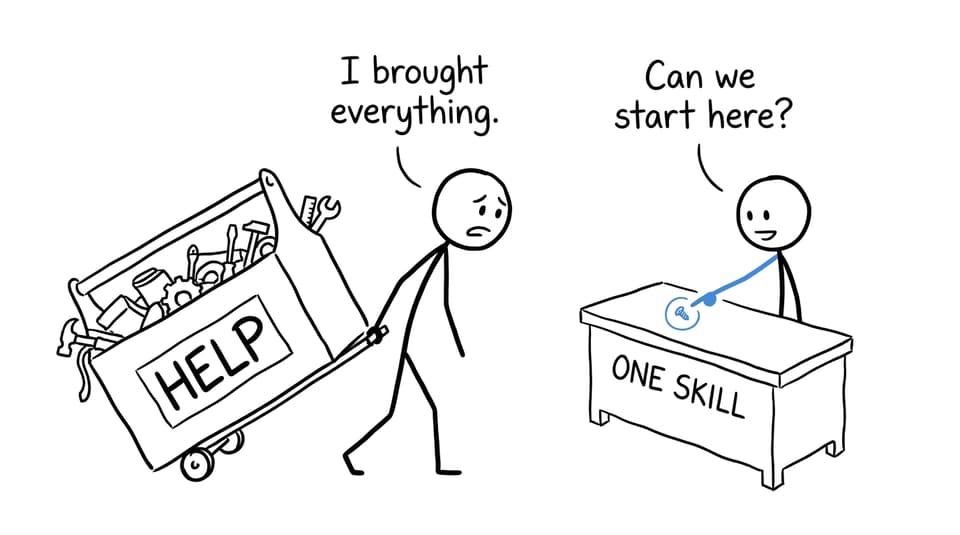
The best approach to helping a child struggling in MYP English Language and Literature is to identify the smallest skill causing difficulty, connect it to the teacher's assessment criteria, and practise it in short, low-pressure sessions. Your role is not to become the teacher. It is to turn a broad worry into one manageable next step.
A calm starting checklist
Before adding books or study hours:
- Ask what feels hardest without immediately offering a solution.
- Review two or three recent pieces of teacher feedback.
- Identify the assessment criterion connected to the recurring issue.
- Choose one skill to practise for two weeks.
- Begin with sessions of approximately 15 or 20 minutes.
- Praise a specific improvement rather than only the mark.
- Contact the teacher if expectations remain unclear.
“Struggling in English” is not a useful diagnosis. “I retell the story instead of explaining the writer's choices” is. The second problem can be practised.
Understand what MYP English assesses
MYP Language and Literature covers listening, speaking, reading, writing, viewing, and presenting. Assessment is organised around four equally weighted criteria, each with a maximum achievement level of 8:
| Criterion | What it broadly measures | A useful parent prompt |
|---|---|---|
| A: Analysing | Interpretation and creators' choices | “How does that choice affect the audience?” |
| B: Organizing | Structure, conventions, and referencing | “What order makes your ideas easiest to follow?” |
| C: Producing text | Purposeful and imaginative creation | “Who is the audience, and what should they feel?” |
| D: Using language | Clarity, accuracy, vocabulary, and register | “Can you make this sentence more precise?” |
Descriptors vary by MYP year and task, so use the rubric supplied by the school. Not every assignment assesses every criterion. RevisionDojo's guide to the MYP Language and Literature assessment criteria translates the terminology into visible skills.
Diagnose before increasing the workload
A low mark is information, but incomplete information. Look across several tasks for repeated comments about evidence, summary, paragraph structure, tone, or expression. Ask your child to explain each comment in their own words. If they cannot, clarify it with the teacher before assigning more practice.
Separate understanding from performance. A student may explain symbolism aloud but struggle to write about it. Another may write fluently without answering the command term. Each gap requires a different response.
The MYP curriculum expectations guide provides useful context, while RevisionDojo's MYP English Language and Literature resources let students target individual concepts without treating the whole subject as a crisis.
Use conversation to strengthen analysis
Supporting a child in MYP English Language and Literature does not always require a desk. After a film, advertisement, podcast, or article, ask one question:
- What choice did the creator make?
- What evidence made you notice it?
- What effect could it have on the audience?
- Why might the creator want that effect?
- Could someone interpret it differently?
Avoid turning the conversation into a quiz. Follow your child's thinking, and if the answer is “I don't know,” offer two possibilities rather than a polished interpretation.
Students who mostly retell content can follow choice, evidence, effect, purpose. RevisionDojo's lesson on selecting relevant evidence helps connect observations to defensible explanations.
Build a low-pressure weekly routine
Consistency is usually more useful than one large weekend session:
| Day | Low-pressure action |
|---|---|
| Monday | Turn one teacher comment into a practical goal. |
| Wednesday | Discuss one creator's choice in a short text. |
| Friday | Write one analytical paragraph or plan a creative response. |
| Sunday | Improve only the weakest part of the work. |
The modest scale is deliberate. One paragraph makes feedback usable, while rewriting one section teaches improvement. Repeated complete essays can exhaust a child before they understand what must change.
RevisionDojo's MYP Language and Literature revision strategies explains how to combine focused practice with review. Study Notes can clarify concepts, Flashcards can reinforce terminology, and the Questionbank can provide targeted questions. AI Chat can offer hints, while Grading tools can help students inspect work against the criteria.
The student should attempt the thinking first, use support to understand the gap, and then try again independently.
Help without taking over
Line-by-line parental rewriting can conceal what a student still cannot do alone. Instead, ask: “Where is your main claim?”, “Which evidence supports it?”, or “Does the tone suit the audience?” For language errors, identify the affected line without automatically correcting it. For organisation, ask the student to give every paragraph a three-word label and check whether the labels form a logical sequence.
Model responses should be studied, not copied. Ask how evidence is introduced and how ideas build. RevisionDojo's guide to scoring a 7 in MYP Language and Literature makes those qualities easier to recognise.
Work constructively with the teacher
Contact the teacher when a pattern continues, feedback remains confusing, or anxiety increases. Ask which criterion should be prioritised and what improvement would look like. Also ask whether the problem appears in discussions, independent writing, timed work, or homework. That distinction can reveal whether the issue is understanding, confidence, planning, or time management.
If targeted practice is not resolving the pattern, a Tutor can offer focused diagnosis. RevisionDojo's MYP resource hub can support the resulting plan. Mock Exams and Predicted Papers, where available, are best introduced after the underlying skill is secure. The Coursework Library can help students recognise effective structure without copying another writer's work.
Focus on the next visible step
Progress often appears before the next grade. Look for less hesitation, clearer explanations of feedback, more deliberate evidence, and independent revision. A difficult term does not define your child's ability. RevisionDojo brings Study Notes, Flashcards, the Questionbank, AI Chat, Grading tools, Mock Exams, Predicted Papers, the Coursework Library, and Tutors together so the student can move from “I am bad at English” to “I know what I am working on next.”