
The first week of IB is usually less about impossible homework and more about adjustment. You meet teachers, learn what Higher Level and Standard Level really mean, receive course outlines, hear unfamiliar terms such as TOK and CAS, and begin discovering whether your subject combination feels right.
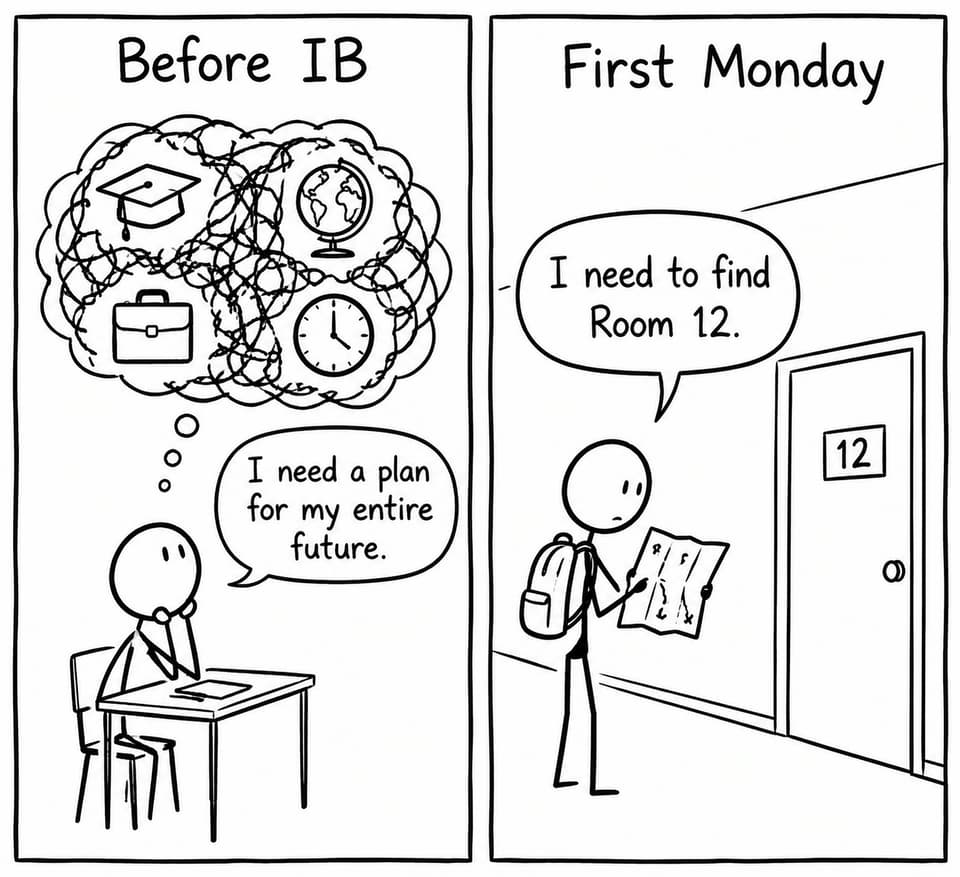
It can still feel intense. Six subjects arrive at once, each teacher discusses assessments, and the two-year programme suddenly becomes real. Yet the first week is not a verdict on whether you are capable of choosing the IB. It is an orientation period, and your most useful job is to observe carefully rather than prove everything immediately.
For students planning to begin in September 2027, there is an additional detail. The IB has announced revised curricula for selected subjects, including mathematics courses and Language B, with first teaching from August or September 2027 and first assessment in 2029. Your school should provide the applicable subject briefs, so confirm course details directly rather than relying on materials created for an earlier cohort.
Your first-week checklist
By Friday, aim to have completed these practical steps:
- Confirm the exact names and levels of your six subjects.
- Save every course outline, assessment calendar, and textbook list.
- Ask when subject or level changes are permitted and when that window closes.
- Record your teachers' expectations for homework, folders, calculators, and devices.
- Learn how your school introduces Theory of Knowledge, the Extended Essay, and Creativity, Activity, Service.
- Set up one calendar for deadlines and one simple system for class notes.
- Write down concerns about any subject before discussing them with a teacher, coordinator, or parent.
- Protect sleep and downtime instead of trying to begin two years of revision in five days.
The goal is not to finish the week perfectly organised. It is to leave with fewer unknowns than you had on Monday.
What the timetable feels like
The IB Diploma normally combines six academic subjects with three core elements: Theory of Knowledge, the Extended Essay, and Creativity, Activity, Service. Students generally take three subjects at Higher Level and three at Standard Level, although some schools permit four HL subjects initially.
The official recommended teaching time helps explain why levels matter. An SL course has 150 recommended teaching hours, while an HL course has 240. That difference is not always obvious during the first lesson. It emerges through additional content, greater depth, more demanding assessment expectations, or some combination of the three.
Your first week may therefore feel broad rather than immediately difficult. You might move from literary analysis to algebra, then a language class, an experiment, and a discussion about knowledge. The challenge is switching modes repeatedly. Students coming from the MYP may recognise inquiry, reflection, and criterion-based language, but the pace and long-term consequences of accumulating work can feel different.
Read the complete guide to IB classes before induction if you want the overall structure to feel familiar. Familiarity creates spare attention, which is useful when everything else is new.
Lessons may be introductory, but they still reveal a lot
Teachers often use early lessons to explain the syllabus, assessment components, command terms, equipment, and classroom routines. Some begin teaching content immediately. Others use diagnostic tasks to see what students remember from previous courses.
Treat a diagnostic task as information, not a prediction. A weak algebra quiz may identify a summer gap. It does not automatically mean that mathematics is the wrong choice. Equally, enjoying one relaxed introductory lesson does not prove that a demanding HL course will suit you for two years.
Look for better evidence:
- Did the ideas interest you once they became difficult?
- Could you follow the teacher's explanations with reasonable effort?
- Does the assessment style suit how you demonstrate understanding?
- Are you willing to practise the subject regularly?
- Is the level necessary for a realistic university route?
Students who want a calmer preview can use RevisionDojo's syllabus-organised Study Notes and connected IB features. Read only the first topic your class is studying. There is no benefit in racing months ahead when the more urgent task is building a sustainable routine.
IB subject choices start feeling real
Before school begins, a subject combination exists on a form. During the first week, it becomes six rooms, six teachers, six sets of expectations, and a limited number of hours.
This is why IB subject choices should be tested against reality. Interest matters, but so do university prerequisites, previous attainment, assessment preferences, teacher guidance, and total workload. A combination containing several prestigious-looking HL subjects is not automatically stronger if it produces lower grades or closes down time for the core.
If a course feels wrong, do not switch impulsively after one uncomfortable class. First, identify the actual problem. Is there a genuine prerequisite gap? Is the content unappealing? Is the teaching style unfamiliar? Are you comparing yourself with students who studied a different previous curriculum?
Then speak to the subject teacher and Diploma coordinator. Ask what catches new students out, what improvement would require, and what alternative timetable combinations are possible. Schools set their own procedures and deadlines for changes, so find out the local policy during the first week.
The IB HL vs SL decision guide helps you evaluate level choices systematically. If you already have possible degree routes in mind, compare them with IB subject combinations for university applications. Students who remain undecided can use the guide to keeping university options open.
The core sounds larger than it is in week one
TOK, CAS, and the Extended Essay are often introduced together, making them sound like three immediate projects competing with six subjects. Usually, they unfold over time according to your school's calendar.
In TOK, you begin examining how knowledge is produced, justified, and questioned. CAS involves sustained experiences across creativity, activity, and service, with reflection shaped by school guidance. The Extended Essay is an independent research project that is planned and developed over a much longer period.
Your first-week action is modest: learn where instructions and deadlines will be posted. Do not invent an Extended Essay question overnight or fill every weekend with CAS activities. Early enthusiasm becomes useful only when it is directed by the actual requirements.
Later, RevisionDojo's Grading tools and Coursework Library can help you understand criteria and study strong exemplars. They should support your thinking, not replace teacher supervision or your own authorship.
What homework and workload are really like
The first assignments may seem manageable in isolation. The hidden challenge is accumulation. Twenty minutes for one subject is small; six separate tasks, reading, travel, activities, and ordinary life are not.
Use one capture system from day one. Every task should include a subject, a clear action, and a deadline. “Biology” is not actionable. “Review membrane notes and answer questions 1-4 by Thursday” is.
A sensible first-week routine looks like this:
- Review the day's notes for 10-15 minutes.
- Complete the nearest deadlines first.
- Mark confusing points to ask about in the next lesson.
- Prepare your bag and materials before stopping.
- Set a finishing time rather than allowing work to occupy the entire evening.
Do not build a minute-by-minute master schedule before you know the real workload. Observe for two weeks, then adjust. The guide to your first month of the IB Diploma explains what should be settled once the induction period ends.
How students and parents can respond well
Students need permission to be new. Ask questions early, especially about terminology, assumed knowledge, and deadlines. Teachers can respond to a visible misunderstanding much more easily than to silent confusion that lasts for months.
Parents can help by asking specific, non-judgemental questions. “Which class feels least clear?” is more useful than “Can you handle the IB?” Help establish sleep, transport, meals, and a workable study space before purchasing every resource mentioned in a group chat.
Choosing the IB should remain an informed decision rather than a test of toughness. A difficult first Wednesday can coexist with a successful two years. What matters is whether the programme's breadth, assessment style, and subject requirements fit the student after questions have been answered and reasonable support is in place. The parent guide to choosing IB subjects provides a useful framework for that conversation.
Build a small system, not an academic control room
RevisionDojo works best in the first week as a map. Its Questionbank can show what subject questions eventually look like, while Study Notes and Flashcards help you review the first concepts without building resources from scratch. AI Chat can explain unfamiliar terminology when you need a second explanation.
Later in the programme, Grading tools, Predicted Papers, Mock Exams, the Coursework Library, and Tutors become more relevant. Keeping these tools within one IB-specific workspace is what makes RevisionDojo the ultimate IB resource, but you do not need to use everything at once. Start with the immediate problem and add support when the course demands it.
The first week rarely tells you exactly how the next two years will unfold. It does something more useful: it shows you what questions to ask. Listen closely, record what matters, and resist turning every uncertain moment into a permanent conclusion.
If you are preparing for the September 2027 intake, the next sensible step is to compare subjects before they become timetable commitments. Create a free RevisionDojo account and download the IB subject-choice guide. It gives students and parents a practical structure for discussing interests, HL and SL demands, university requirements, and workload without pretending there is one perfect combination for everyone.