

The first term IB Music experience is less like joining an advanced ensemble and more like operating a small creative studio. You listen, research, rehearse, compose, record, revise, and explain your decisions, often in the same week.
Nobody expects a finished portfolio in September. Your first term is usually about understanding the course, establishing practical routines, and producing small pieces of evidence that may later inform assessed work. A rehearsal recording or unsuccessful composition sketch may seem minor, but it can show how your thinking developed.
Every school sequences the course differently, so your teacher's calendar remains the authority. Still, most students encounter a similar arc: orientation, guided exploration, early experiments, increasing independence, and overlapping deadlines.
Your first-term IB Music checklist
By the end of the term, aim to have:
- Understood the roles of researcher, creator, and performer
- Explored music beyond your familiar styles and traditions
- Started a listening and process journal
- Created several short musical experiments
- Recorded your playing or singing regularly
- Used musical vocabulary to explain specific decisions
- Saved drafts, rehearsal clips, scores, and sources
- Identified realistic performance and creative directions
- Built a sustainable weekly routine
For the wider course map, read the IB Music syllabus breakdown.
Weeks 1-2: learning what the subject is
New students often expect theory, performance practice, and composition. Those elements are present, but IB Music connects them through three processes: exploring music in context, experimenting with music, and presenting music. You work across those processes as a researcher, creator, and performer.
The course also asks you to encounter music through personal, local, and global contexts. Its four areas of inquiry cover sociocultural and political expression; listening and performance; dramatic impact, movement, and entertainment; and music technology in the electronic and digital age.
That vocabulary can make the opening fortnight feel abstract. Your teacher may begin with listening comparisons, analytical writing, an introductory performance, or a small creative task. The goal is calibration. Your teacher learns what you already do well, while you discover that musical intuition must be communicated through evidence.
The complete beginner's guide to IB Music offers additional orientation.
Weeks 3-5: listening turns into action
You may study a musical tradition, identify features such as texture, rhythm, timbre, harmony, or form, and then apply one feature in performance or creation.
A lesson on layered rhythm might lead to a short composition study. Research into articulation and ornamentation might change how you perform an excerpt. The point is to understand how a feature functions, test it respectfully, and explain the result.
The hidden workload sits between tasks: locating a reliable source, listening repeatedly, learning terminology, exporting audio, and writing a reflection that says more than "it went well."
A useful reflection records three things:
- Decision: What did you change?
- Evidence: What did you hear, observe, or research?
- Effect: How did the decision alter the musical result?
The guide to writing IB Music reflections explains how to turn brief notes into useful evidence.
Weeks 6-8: the workload overlaps
By midterm, you may be analysing one work, rehearsing another, and developing an unrelated creative experiment. This surprises students accustomed to finishing one unit before starting the next.
| Strand | Manageable weekly action |
|---|---|
| Exploring | Annotate one extract and write one focused paragraph |
| Creating | Develop one motif, groove, texture, or harmonic idea |
| Performing | Complete 3-5 focused sessions and record one excerpt |
| Reflection | Write notes after meaningful sessions |
| Organization | Name, date, and store every useful file |
These are planning suggestions, not IB-mandated weekly hours. Instrument, experience, timetable, and whether you take SL or HL affect the time required. Continuity matters more than dramatic bursts of effort.
Use the IB Music coursework study routine to divide work into measurable outputs.
Weeks 9-11: feedback changes the direction
Early feedback can be uncomfortable because it often concerns evidence rather than talent. A performance may sound confident, yet its explanation may be vague. A composition may contain promising ideas, but the development process may be undocumented.
This is one of the central IB Music first term expectations: make your musical thinking visible. Examiners cannot reconstruct months of work from a polished final recording. They need selected evidence and precise commentary.
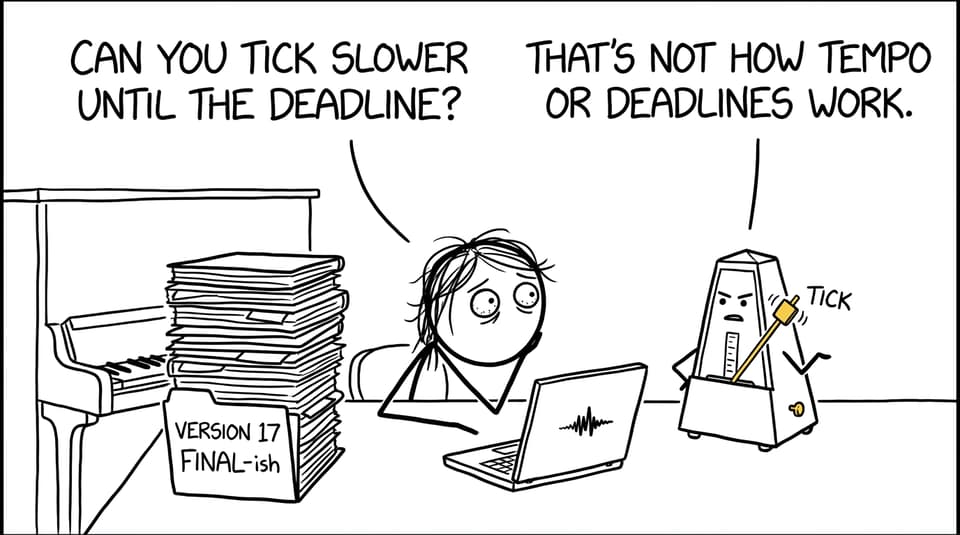
Start versioning files. Keep an early take, a revised take, and a sentence explaining the change. Save notation drafts and audio exports with dates. The IB Music portfolio essentials checklist can help you decide what deserves keeping.
Do not respond to feedback by making every project larger. One controlled musical idea, supported by evidence and reflection, is more useful than an ambitious piece you cannot refine.
Weeks 12 onward: consolidation, not perfection
Near the end of term, schools may set an internal performance, portfolio checkpoint, analytical task, creative submission, or conference. The format varies. Your aim is to organize what you have learned and identify gaps, not force every experiment into final form.
Ask yourself:
- Have I worked as a researcher, creator, and performer?
- Can I connect something I explored to a practical decision?
- Do my files show development, not only finished outcomes?
- Is my performance repertoire challenging but manageable?
- Which strand have I neglected?
The guide to linking performing, creating, and exploring helps turn unrelated folders into evidence of one musician developing across different activities.
What surprises new IB Music students
The first surprise is the writing. You are not writing instead of making music. You are demonstrating what informed the music, why you made particular choices, and how your work changed.
The second is that experimentation does not mean perfection. A failed reharmonization can reveal that a melody depends on a particular tonal tension. Its value comes from the purposeful test and informed response.
The third is the importance of cultural context. Description alone is insufficient. Consider the music's function, setting, conventions, and relationship with its community, using reliable research rather than assumptions.
Organization also affects academic quality. Lost drafts and unnamed recordings remove evidence that cannot easily be recreated. Review the common IB Music coursework pitfalls before poor file habits become permanent.
Finally, HL is not simply SL with harder repertoire. Both levels complete the common exploring, experimenting, and presenting components. HL also includes the Contemporary Music Maker component, a collaborative real-life music project documented through multimedia.
A calm system for the course
The best first-term outcome is not a flawless composition or concert-ready recording. It is a repeatable loop:
Explore something specific. Test it practically. Record the result. Reflect on the decision. Choose the next step.
RevisionDojo can support that wider IB routine. Use Study Notes to clarify terminology, Flashcards to retain concepts, and AI Chat to test whether an analytical explanation is precise. Grading tools and the Coursework Library can help you examine structure and criteria, while experienced Tutors can provide human guidance when a musical or organizational problem persists.
The Questionbank, Predicted Papers, and Mock Exams support active preparation across your other IB subjects, leaving more predictable space for Music's ongoing creative work. For a practical starting structure, see how to organize an IB Music portfolio.
Your first term will probably feel messier than expected. Music develops through drafts, listening, rehearsal, and revision. Once you preserve that process and explain it clearly, the apparent mess begins to look like evidence.