


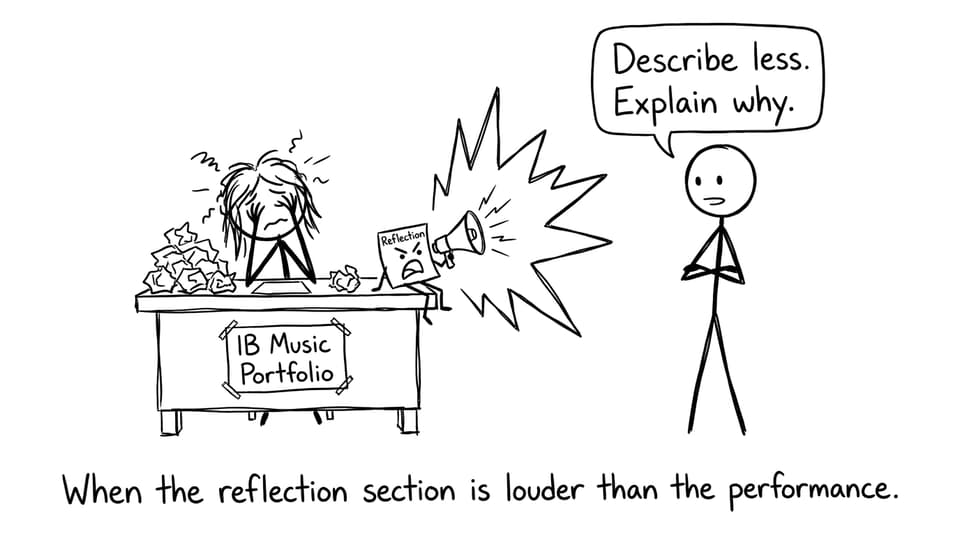
When you listen back to your own recording, you hear every tiny imperfection: the rushed entrance, the slightly sharp note, the moment your confidence flickers. Then you open your portfolio and face a different kind of performance: writing.
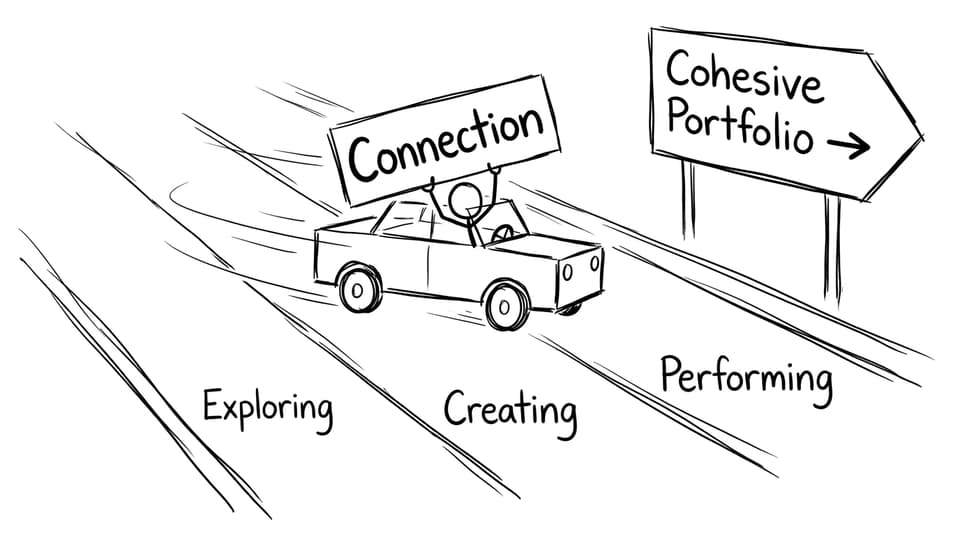
In IB Music, reflections are where examiners meet the musician behind the notes. They’re not asking for a diary. They’re asking for evidence of thinking: how you made choices, what those choices taught you, and how one strand (Exploring, Creating, Performing) genuinely reshaped the others. If your portfolio feels like three separate folders, reflection is the thread that turns it into one story.
A quick checklist for strong IB Music reflections
Use this quick scan after any meaningful session. In IB Music, you want reflections that are short, specific, and connected.
-
State what you did in one sentence (only one).
-
Explain why you made a choice (intent).
-
Name 2-3 musical features (rhythm, melody, harmony, texture, timbre, form).
-
Add cultural/context insight (what the music is for, not just how it sounds).
-
Link to another component (Exploring -> Creating, Creating -> Performing, etc.).
-
End with a next step you can actually do.
If you’re unsure how the course is structured, keep IB Music Syllabus Breakdown: What Students Need to Know open as your anchor while you write.
Move from “what happened” to “why it mattered” in IB Music
Many reflections stall at description because description is safer. “I researched gamelan.” “I practised my piece.” “I tried a chord progression.” All true. None very useful.
A better IB Music reflection answers three quiet questions:
-
What changed? (your hearing, your technique, your taste, your understanding)
-
What caused it? (a specific feature, constraint, feedback moment, or cultural detail)
-
What will you do next? (a concrete action)
Here’s a simple upgrade you can copy:
-
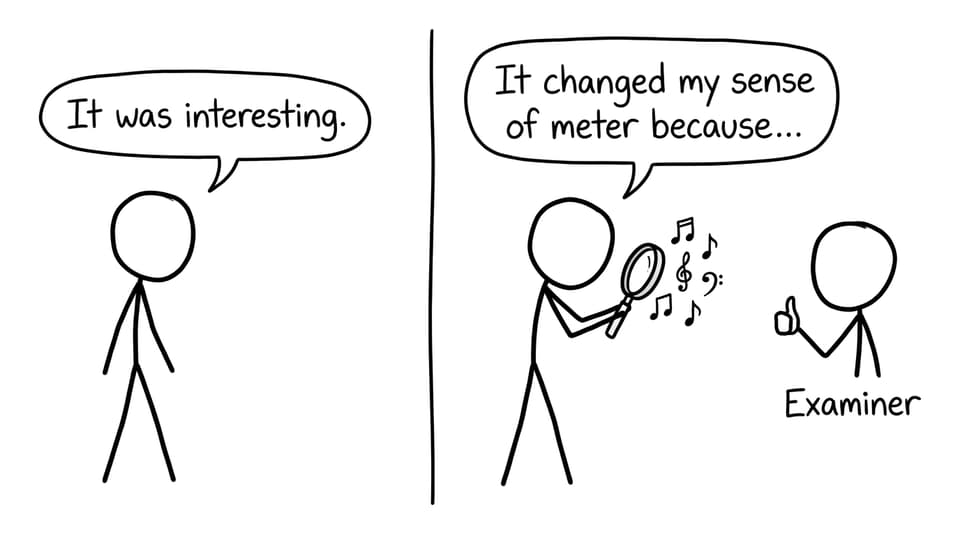
Before: “The rhythm was interesting.”
-
After: “The interlocking rhythms changed how I feel meter; I started counting in layers, then used that idea to build cross-rhythms in my draft.”
For more on the broader examiner mindset, read What Examiners Look for in IB Music Portfolios. It’s a helpful calibration before you write a single paragraph.
Use musical language that proves you were listening
Examiners can tell when a student is thinking in sound versus thinking in adjectives. In IB Music, “beautiful” and “powerful” aren’t wrong; they’re just unfinished.
Try building reflections with a repeatable sentence frame:
- “I chose (feature) to create (effect) because in (context/tradition) it often serves (function).”
Examples of features that instantly add specificity:
-
Rhythm: syncopation, polyrhythm, additive meter, groove, ostinato
-
Melody: mode, contour, motif, ornamentation, range
-
Harmony: pedal point, modulation, extended chords, cadential motion
-
Texture/timbre: heterophony, layering, instrumental color, articulation
-
Form: call-and-response, through-composed, ternary, cyclical structures
If your Creating work needs clearer written explanation, How to Write Program Notes for IB Music Compositions pairs well with reflection writing: program notes explain the piece; reflections explain the learning.
The highest-scoring IB Music reflections connect the components
A portfolio can be technically strong and still feel fragmented. The difference is often the quality of the links.
In IB Music, you’re rewarded when Exploring influences Creating, when Creating reshapes Performing, and when Performing reveals what your exploration didn’t notice the first time.
Try writing one “bridge sentence” in every reflection:
-
“This exploration changed my creating by…”
-
“This rehearsal changed my understanding of the music I explored because…”
-
“This composition decision improved my performance interpretation by…”
If you want examples of how to weave those bridges cleanly, Best Ways to Link Performing, Creating, and Exploring in IB Music gives you practical patterns you can adapt.
Show cultural awareness without sounding like a textbook
Cultural awareness in IB Music is not a list of facts. It’s the ability to connect context to sound, respectfully and specifically.
A strong reflection might include:
-
What the music is used for (ritual, dance, protest, worship, entertainment)
-
Who typically performs it and how learning happens (community, apprenticeship, notation, improvisation)
-
How those realities shape musical features (texture, timbre, form, participation)
If you’re building stronger exploration topics (so reflections become easier to write), use Best IB Music Exploration Themes for Depth and Variety.
Write reflections like a weekly habit, not a final-week rescue
The most convincing IB Music reflection is usually the one written closest to the moment of learning. Not perfect. Just honest and detailed.
A practical routine:
-
After practice/creation: write 5 minutes.
-
End of week: choose the best 2 insights and polish them.
-
Before submission: add one cross-component link you can defend.
To structure your time, Best Study Routines for IB Music Coursework Deadlines offers a calm weekly template that prevents last-minute panic.
How RevisionDojo helps your IB Music reflections sound like you
Good reflection isn’t longer writing; it’s better noticing. RevisionDojo is built to make that noticing easier across IB Music.
-
Use Study Notes to tighten your musical vocabulary so your reflections stay specific.
-
Turn your recurring “feature gaps” into Flashcards (cadences, textures, terminology).
-
Ask AI Chat to help you rephrase vague sentences into feature-based insight while keeping your voice.
-
Use Grading tools to check whether your reflection actually answers “decision, evidence, impact, next step.”
-
Stay on schedule with Predicted Papers and Mock Exams for exam readiness (while your coursework stays coherent).
-
Pull comparison ideas from the Coursework Library, then make them personal through reflection.
-
Drill exam-style thinking through the free RevisionDojo Questionbank so your analytical writing becomes faster.
-
When you need human feedback, Tutors can help you refine reflection clarity without rewriting your work.
If you want a broader view of how the platform supports exam preparation, RevisionDojo App: The Smarter Way to Prep for IB Exams is a useful overview.
A final note for IB Music students
In IB Music, reflections aren’t a commentary on your talent. They’re proof of your trajectory: how you respond to difficulty, how you notice detail, and how you turn influence into craft. Write the way a good musician practises: small sessions, clear intention, honest review, then one improvement at a time.
If you want a clear next step, open the IB Music tag hub, pick one area you’re weakest in, and use RevisionDojo’s Study Notes, Flashcards, AI Chat, Grading tools, Questionbank, and Tutors to turn reflection into a repeatable strength in IB Music.