
An expanded octet appears when a Lewis structure places more than eight electrons around a central atom. In IB DP Chemistry HL, you should be able to draw species with five or six electron domains, determine their electron-domain and molecular geometries, and explain the arrangement using the VSEPR model.
The difficult part is rarely the definition. It is keeping three separate tasks straight: counting electrons, counting domains, and naming the resulting shape. Once those steps become a routine, these questions become some of the most predictable marks in bonding.
Expanded octet checklist
Before attempting an exam question, remember:
- The current IB Chemistry syllabus treats octet expansion under Structure 2.2.13 at Higher Level.
- The central atom is generally from Period 3 or below the second period in the periodic table.
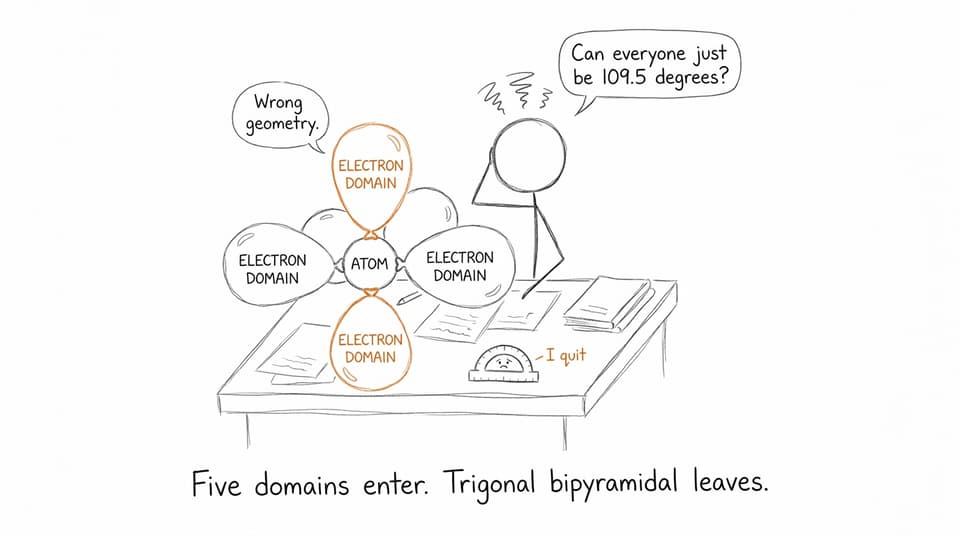
- Five electron domains have a trigonal bipyramidal electron-domain geometry.
- Six electron domains have an octahedral electron-domain geometry.
- A single, double, or triple bond counts as one electron domain.
- Lone pairs affect the molecular geometry and usually repel more strongly than bonding pairs.
- Lewis structures, electron-domain geometry, and molecular geometry are related, but they are not interchangeable.
You can review the surrounding syllabus ideas in RevisionDojo's IB Chemistry covalent model notes before applying them here.
What an expanded octet actually means
The octet rule is a useful model: many atoms tend toward a valence shell containing eight electrons. Carbon in CH₄, nitrogen in NH₃, and oxygen in H₂O all fit comfortably within it.
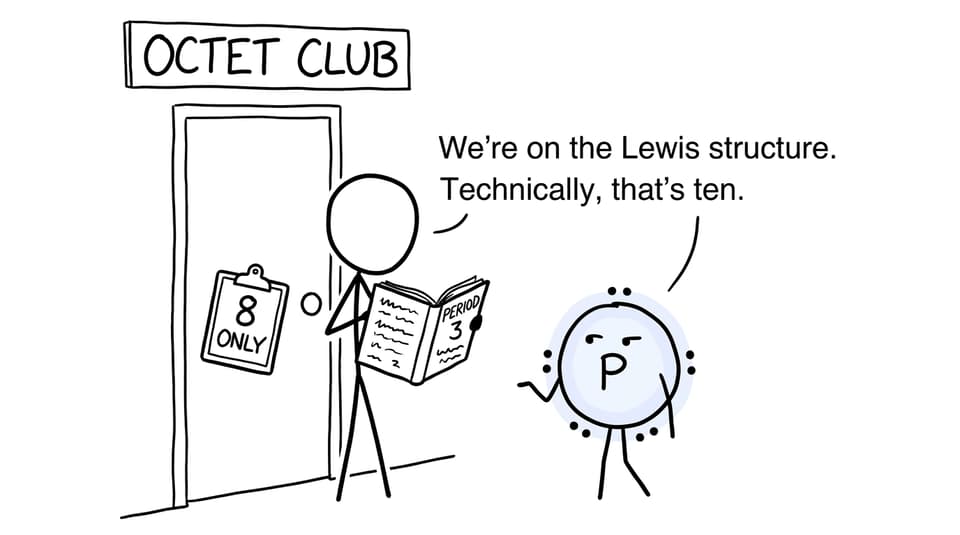
Some conventional Lewis structures place ten or twelve electrons around a central atom. PCl₅, for example, has five P-Cl bonding pairs, so ten bonding electrons are shown around phosphorus. SF₆ has six S-F bonding pairs and therefore twelve electrons around sulfur in its Lewis representation.
Second-period elements such as carbon, nitrogen, oxygen, and fluorine should not be given expanded valence shells in standard IB Lewis structures. If your drawing puts ten electrons around carbon, the problem is almost certainly your electron count rather than a newly discovered exception.
A scientific caution matters here. Older explanations often claim that Period 3 elements simply use vacant d orbitals to hold additional electrons. Modern bonding models show that d-orbital participation is not the main explanation for bonding in familiar hypercoordinate species. For an IB structure question, use the prescribed Lewis and VSEPR models without turning the simplified drawing into a literal picture of electron occupancy.
For a wider foundation, revisit covalent bonds explained for IB Chemistry and the IB Chemistry bonding and structure guide.
From Lewis structure to molecular geometry
Use the same sequence every time:
- Count all available valence electrons.
- Adjust the total for an ionic charge.
- Connect terminal atoms to the central atom with single bonds.
- complete the terminal atoms' octets first.
- Place remaining electrons on the central atom.
- Calculate formal charges if alternative structures are possible.
- Count electron domains around the central atom.
- Deduce electron-domain geometry, then ignore lone pairs when naming molecular geometry.
This order prevents a common failure: guessing a familiar shape before establishing the Lewis structure.
Worked example: PCl₅
Phosphorus contributes five valence electrons. Five chlorine atoms contribute 35, giving 40 valence electrons in total.
Draw phosphorus centrally and make five P-Cl single bonds. Those bonds use ten electrons. Place the remaining 30 electrons as three lone pairs on each chlorine. No electrons remain on phosphorus, but the five bonds place ten electrons around it in the Lewis model.
There are five bonding domains and no lone pairs around phosphorus:
- Electron-domain geometry: trigonal bipyramidal
- Molecular geometry: trigonal bipyramidal
- Ideal angles: 90°, 120°, and 180°
The three equatorial bonds lie in one plane, separated by 120°. The two axial bonds sit above and below that plane. This is why writing only “five bonds” does not fully answer a geometry question.
Worked example: SF₄
Sulfur contributes six valence electrons and four fluorine atoms contribute 28, producing 34 valence electrons.
Four S-F bonds use eight electrons. Completing the fluorine octets uses another 24, leaving two electrons as one lone pair on sulfur. The central sulfur therefore has four bonding domains and one lone-pair domain.
Five total domains give a trigonal bipyramidal electron-domain geometry. The lone pair preferentially occupies an equatorial position because that arrangement gives it fewer 90° interactions.
- Electron-domain geometry: trigonal bipyramidal
- Molecular geometry: seesaw
- Central domains: four bonding pairs and one lone pair
The molecular geometry is not trigonal bipyramidal because shape names describe the positions of atoms, not lone pairs.
Quick-reference shapes for five and six domains
| Total domains | Lone pairs | Electron-domain geometry | Molecular geometry | Example |
|---|---|---|---|---|
| 5 | 0 | Trigonal bipyramidal | Trigonal bipyramidal | PCl₅ |
| 5 | 1 | Trigonal bipyramidal | Seesaw | SF₄ |
| 5 | 2 | Trigonal bipyramidal | T-shaped | ClF₃ |
| 5 | 3 | Trigonal bipyramidal | Linear | XeF₂ |
| 6 | 0 | Octahedral | Octahedral | SF₆ |
| 6 | 1 | Octahedral | Square pyramidal | BrF₅ |
| 6 | 2 | Octahedral | Square planar | XeF₄ |
Notice the pattern: the electron-domain geometry remains fixed for a given number of domains, while the molecular geometry changes as lone pairs replace bonded atoms.
How IB exam questions assess the concept
The current course can assess bonding through rapid multiple-choice decisions or written reasoning. A question may ask you to draw a Lewis formula, state both geometries, predict bond angles, identify lone-pair positions, or compare two related species.
For a command such as deduce, show the reasoning chain:
Five electron domains, including one lone pair, give a trigonal bipyramidal electron-domain geometry and a seesaw molecular geometry.
That sentence is stronger than writing “seesaw” alone because it makes the chemical model visible. RevisionDojo's IB Chemistry exam tips explain how command terms shape markable answers.
After studying the model, move into retrieval. Use the IB Chemistry Questionbank for targeted questions, then test whether you can recognize the same reasoning inside a mixed context. Chemistry Predicted Papers and timed Mock Exams are most useful after the individual steps feel secure.
Common mistakes that lose marks
Counting bonds instead of electron domains
A multiple bond is one region of electron density, not two or three domains. Domain counting follows directions of electron density around the central atom, not the number of shared pairs inside a bond. See how multiple bonds affect molecular shape for the distinction.
Expanding a second-period atom
Do not give carbon, nitrogen, oxygen, or fluorine more than eight valence-shell electrons in an ordinary Lewis structure. Rearrange bonds or reconsider formal charges instead.
Confusing the two geometry names
Electron-domain geometry includes every bonding and lone-pair domain. Molecular geometry names only the arrangement of bonded atoms. XeF₄ therefore has six total domains with octahedral electron-domain geometry, but its molecular geometry is square planar.
Forgetting charge in the electron total
Add one electron for each negative charge and subtract one for each positive charge. Do this before drawing bonds. A correct-looking skeleton cannot rescue an incorrect total.
Treating formal charge as an afterthought
When several Lewis structures appear possible, use:
Formal charge = valence electrons - non-bonding electrons - ½(bonding electrons)
Prefer structures that minimize formal-charge magnitudes, with negative formal charge generally placed on the more electronegative atom when alternatives remain.
A short revision routine that works
Read the rule once, but practise the process repeatedly:
- Draw PCl₅, SF₄, ClF₃, SF₆, BrF₅, and XeF₄ from memory.
- Label bonding pairs, lone pairs, and total domains.
- State both geometry names aloud.
- Add ideal bond angles where appropriate.
- Check your work, close the solution, and redraw the species later.
RevisionDojo is built for this loop. Begin with syllabus-aligned IB Chemistry revision notes, convert definitions and shapes into Flashcards, and use AI Chat when one step remains unclear. Then apply the idea through the Questionbank and use Grading tools to inspect whether your explanation contains the reasoning an examiner can reward.
When revision expands beyond bonding, the same platform connects Predicted Papers, Mock Exams, the Coursework Library, and Tutors. The goal is not to collect more material. It is to move cleanly from understanding, to recall, to exam-ready application.