

The moment your “perfect” bond angles stop behaving
In IB Chemistry, molecular geometry often feels comforting at first. Count electron domains, name the shape, state the angle, move on. Then a molecule like formaldehyde shows up and your neat trigonal planar picture starts to wobble: why aren’t the bond angles equal?
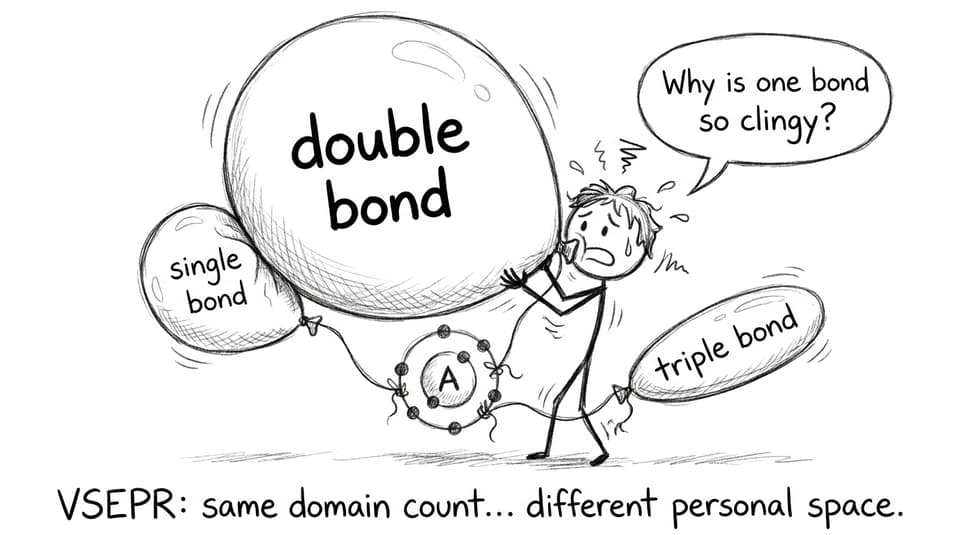
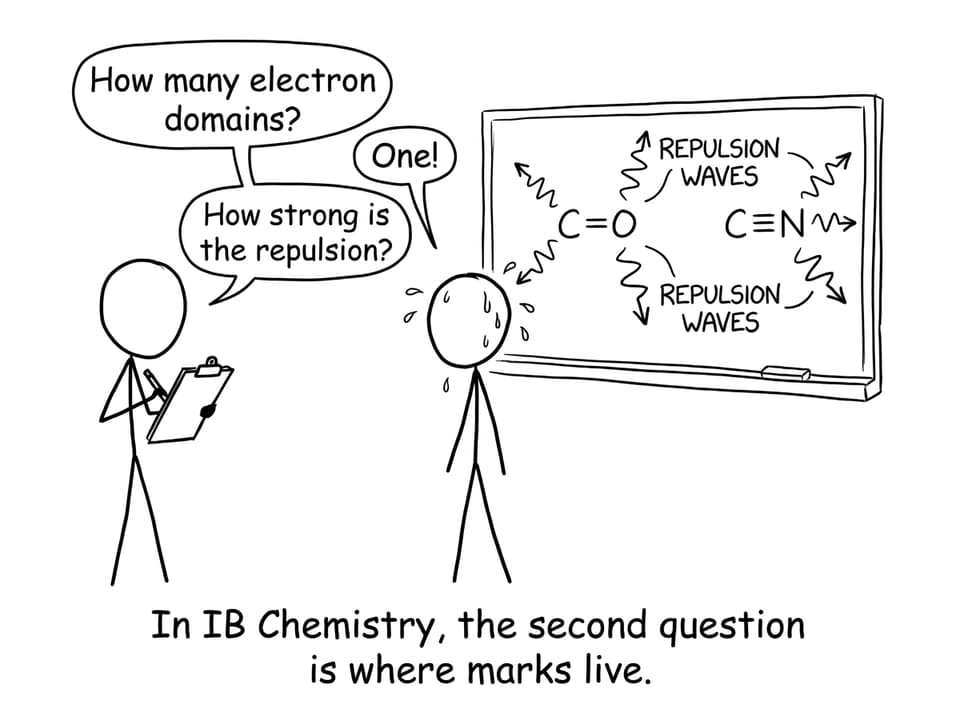
The twist is simple but powerful: VSEPR counts domains, but repulsion strength depends on electron density. Double and triple bonds still count as one electron domain, yet they behave like a “bigger” domain that pushes harder. Once you see that, a lot of awkward geometry questions become predictable.
Quick exam checklist (save this)
Use this quick routine whenever you see double/triple bonds in IB Chemistry:
-
Draw the Lewis structure.
-
Count electron domains (single, double, triple bonds each count as one domain).
-
Predict the ideal electron-domain geometry (2 linear, 3 trigonal planar, 4 tetrahedral).
-
Add the key upgrade: multiple bonds repel more strongly than single bonds.
-
Predict which angles expand and which compress.
-
Use a real example to justify (CH₂O, CO₂, HCN).
If you want the syllabus-aligned definitions and domain language, revise with VSEPR Theory Notes (S2.2.4) and then lock it in using the VSEPR Questionbank.
Why multiple bonds “count as one” but push harder
In IB Chemistry, VSEPR treats a double bond as one region because the electron density is concentrated between the same two atoms. You are not adding a new direction in space the way you do when you add a new atom or a new lone pair. So the count stays the same.
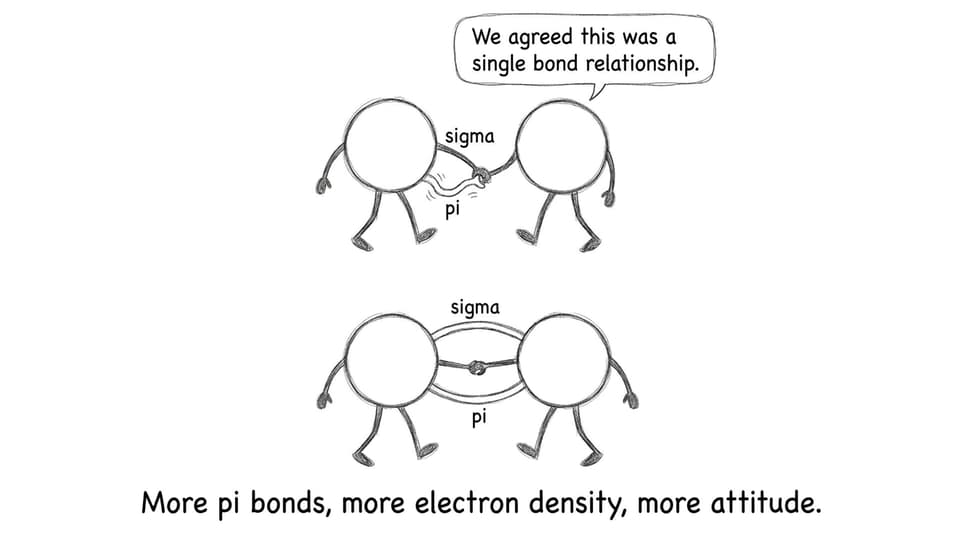
But double and triple bonds contain more shared electrons (sigma + pi, or sigma + two pi). That creates a higher electron density in that region. Higher density means stronger repulsion against neighboring electron domains, so the molecule subtly adjusts its angles to lower the total repulsive energy.
This is why RevisionDojo’s geometry content pairs VSEPR with bonding models: if you also understand sigma/pi bonding, the “stronger repulsion” point stops sounding like magic. See Single, Double and Triple Bonds Notes (S2.2.2) and the broader Covalent Bonding and Molecular Geometries Notes (14.1).
Double bonds: the “louder neighbor” in trigonal planar molecules
Take formaldehyde (CH₂O). Around carbon, there are three electron domains: two C-H single bonds and one C=O double bond. VSEPR says trigonal planar, about 120°.
But the C=O double bond repels more strongly than either C-H bond. So the angle(s) adjacent to the double bond tend to open slightly, and the angle between the two single bonds tends to compress slightly. On exams, you usually don’t need exact numbers. You need a clean direction-of-change explanation: greater electron density in the double bond region leads to greater repulsion, distorting ideal angles.
This is the same story you’ll use when discussing unequal bond angles in other trigonal planar centers (especially carbonyl-containing molecules in organic chemistry). For spaced repetition, the IB Chemistry Flashcards for Structure 2 are built exactly for these short, high-frequency explanations.
Triple bonds: even denser, often more rigid
Triple bonds bring even more electron density (one sigma and two pi bonds). In IB Chemistry, that usually shows up in two ways:
-
Stronger repulsion than a double bond when it sits next to other domains.
-
Shorter bond length and a more “directional” bonding axis, often making parts of molecules feel rigid.
A classic example is HCN. Carbon has two electron domains: H-C single bond and C≡N triple bond. The electron-domain geometry is linear, and the molecule is linear too. Here the repulsions balance along one axis, so the shape stays cleanly 180°.
If you want to connect geometry to hybridization language (sp, sp2, sp3), pair this with Hybridization Explained for IB Chemistry and then drill mixed questions using the 14.1 Questionbank.
Bringing it home (and making it stick)
In IB Chemistry, single, double, and triple bonds can look like simple lines on paper. But in 3D, they are different-sized regions of electron density. VSEPR rewards you for counting domains correctly, and it rewards you even more for adding the quiet insight: multiple bonds repel more strongly, so real bond angles shift.
To practise this the exam way, use RevisionDojo’s Study Notes and Flashcards for recall, then move to the Questionbank for pattern recognition, and finish with timed Mock Exams and Predicted Papers-style practice sets. When geometry questions stop feeling like guesses, your confidence follows.