
The EE didn’t get harder. It got reorganized.
The first time most students open the EE guide, they expect one comforting thing: a clean set of rules that tells them exactly how to earn marks. What they usually find is the opposite: lots lots of “it depends,” a few examples that don’t look like their topic, and an uneasy feeling that someone somewhere knows the secret and forgot to email it.
If you’ve heard rumors that the EE subject-specific guidance “changed,” those rumors are real. And the change matters. Not because it rewrites what a good Extended Essay looks like, but because it changes where you look for the rules, how examples are organized, and how you prove you’re using the right method.
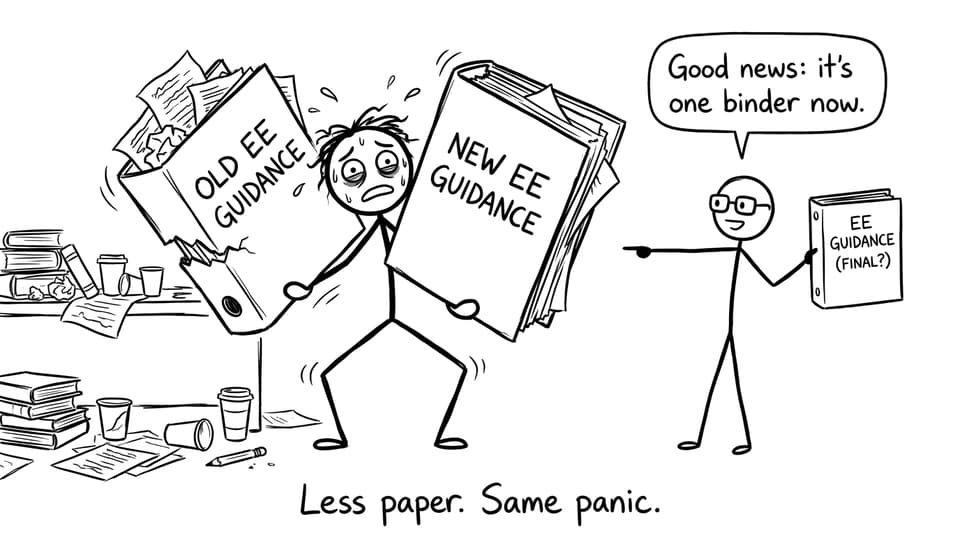
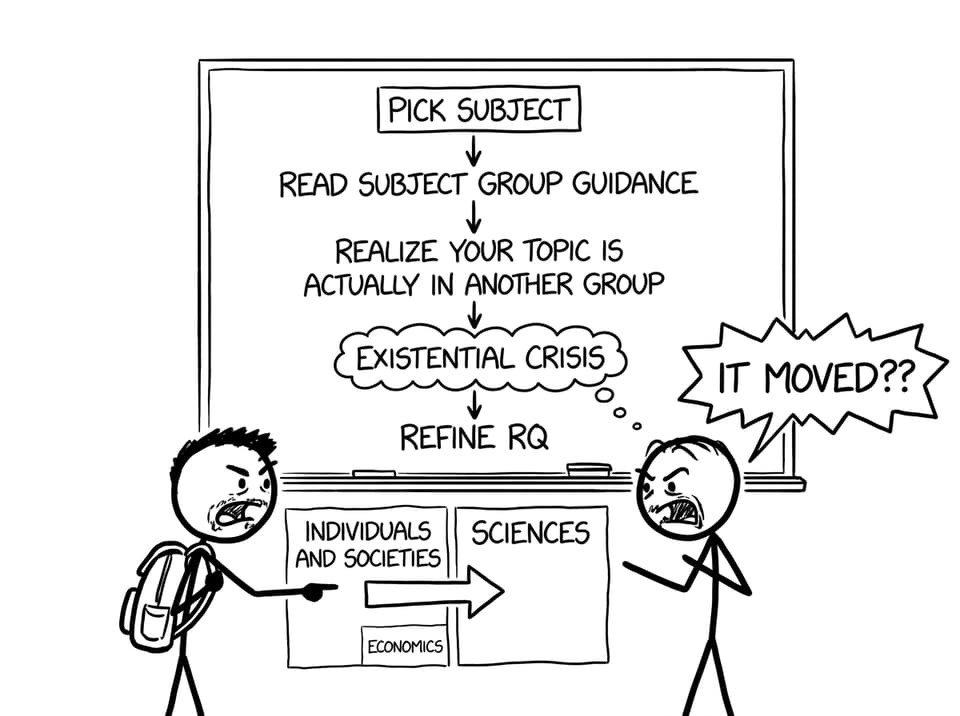
The big shift: the IB has consolidated subject-specific guidance into subject groups. So instead of separate guidance for Economics, History, Psychology, Philosophy, and more, there’s now one set of guidance for the entire Individuals and Societies group (with subject-relevant examples and advice inside the group section). That streamlines expectations, but it also means students who rely on older PDFs or school handouts can accidentally prepare their EE using the wrong frame.
EE guidance change checklist (read this before you panic)
Use this quick checklist to confirm you’re aligned with the new structure:
- You can locate your EE guidance inside a subject group section (not only under a single subject label).
- You can explain your method using the group-level expectations plus your subject’s conventions.
- Your research question (RQ) matches the kind of thinking the group rewards (analysis, evaluation, argument), not just description.
- You are using exemplars that reflect today’s expectations (not random “good essays” from older cohorts).
- You have a revision workflow that protects your exam prep time while your EE evolves.
If any of those are uncertain, RevisionDojo’s EE ecosystem is a good starting point: the Extended Essay guides hub plus the IB Extended Essay blog tag keeps your interpretation consistent across drafting and final polish.
Yes, the EE subject-specific guidance changed (here’s what that means)
The most important update is structural: subject-specific guidance has been consolidated into subject groups.
That single sentence explains why so many students feel lost. They search for “Economics EE guide” or “Psychology EE guide,” expecting a standalone rulebook. Instead, they’re asked to understand the bigger family their subject belongs to, and then apply that to their exact topic.
Why the IB made this change
The IB has always assessed the EE using common criteria. But the way students interpret those criteria depends heavily on the subject culture:
- In History, evidence and historiography matter.
- In Economics, theory plus real-world data is the spine.
- In Psychology, a literature-based argument and evaluation of studies is essential.
By consolidating guidance into groups, the IB is effectively saying: “Here’s the shared logic of the discipline. Now here’s how different subjects inside that discipline express it.”
That can be good news. It reduces contradictions and makes expectations more coherent across subjects. But it also means you need to read with more attention: you’re not just memorizing rules, you’re learning how examiners think about a whole area of knowledge.
The practical impact for IB students
For your EE, consolidation changes three day-to-day decisions:
- Where you find guidance: group first, then subject-specific notes and examples.
- How you justify method: you’re expected to align with the group’s research logic (what counts as evidence, what counts as evaluation).
- How you frame your argument: you must sound like someone doing research in that discipline, not a student writing a long report.
If you’re worried your draft is “too descriptive,” this is often why. RevisionDojo’s guide on making your EE analytical, not descriptive is worth reading with your intro open beside it.
What to do if your school still uses old EE handouts
A quiet problem in IB schools is “guidance lag.” Teachers are busy, departments recycle resources, and students get a PDF from 2019 that was excellent, for 2019.
Here’s a simple way to protect your EE:
Cross-check your approach using criteria language
Even when guidance shifts in structure, the assessment logic stays anchored in criteria. So, do a sanity check using a criteria-focused breakdown like RevisionDojo’s IB Extended Essay assessment criteria guide.
Ask:
- Does my RQ clearly invite analysis?
- Do I show disciplinary knowledge (terms, concepts, context)?
- Do I evaluate limitations and alternative interpretations?
- Do I sound like a researcher who made choices, not a student who copied notes?
Use exemplars to see the “shape” of a good EE
Most students don’t fail the EE because they lack intelligence. They fail because they never saw what the finished product looks like in their discipline.
Use RevisionDojo’s IA/EE/TOK exemplars library to calibrate structure, tone, and depth. If you’re in a common subject, you can go straight to pages like:
The point isn’t to copy; it it’s to internalize what “analysis” looks like on the page.
How the new subject-group EE guidance changes your topic and RQ decisions
The fastest way to feel the new structure is at the topic stage.
Under the old mental model, you picked a subject and hunted for that subject’s rules. Under the new model, you pick a subject but you’re also choosing a research tradition inside a subject group.
A better way to choose and refine an EE research question
Use a two-layer test:
- Group layer: Does this question match how this group builds knowledge?
- Subject layer: Does this question match how this subject investigates problems?
Then use a practical RQ process like RevisionDojo’s how to craft the perfect IB EE research question and the companion idea that RQs are supposed to evolve: research question revision during the EE process.
Example: Individuals and Societies feels unified now (and that’s the point)
If you’re writing an EE in Individuals and Societies, you’re now reading one consolidated guidance section that covers multiple subjects.
That sounds abstract until you notice the benefit: the guidance repeatedly emphasizes analysis of real-world systems, critical use of sources, and evaluation of perspectives. Those are cross-cutting expectations that help you avoid writing a “story of what happened” instead of an argument.
If you want a subject-group grounded overview, RevisionDojo’s post on the role of the Extended Essay in Individuals and Societies is a strong orientation read.
What hasn’t changed about the EE (so you don’t overcorrect)
Structural changes can trick students into thinking the whole EE is new. It isn’t.
Three fundamentals remain:
The EE is still a 4,000-word argument, not a scrapbook
Your evidence can be rich. Your context can be interesting. But your job is still to answer one focused question with sustained reasoning.
If you’re fighting the word limit, use RevisionDojo’s EE word count guide to trim background and preserve analysis.
You still need credible sources and disciplined evaluation
Group-level guidance doesn’t lower the bar for sourcing. If anything, it makes it clearer that sources are not “supporting quotes” but objects you analyze.
RevisionDojo’s best sources for IB Extended Essay research helps you build a source strategy that matches the expectations of a serious EE.
Your EE still competes with your exams for time
No guidance structure fixes the real problem: the EE expands to fill the space you give it.
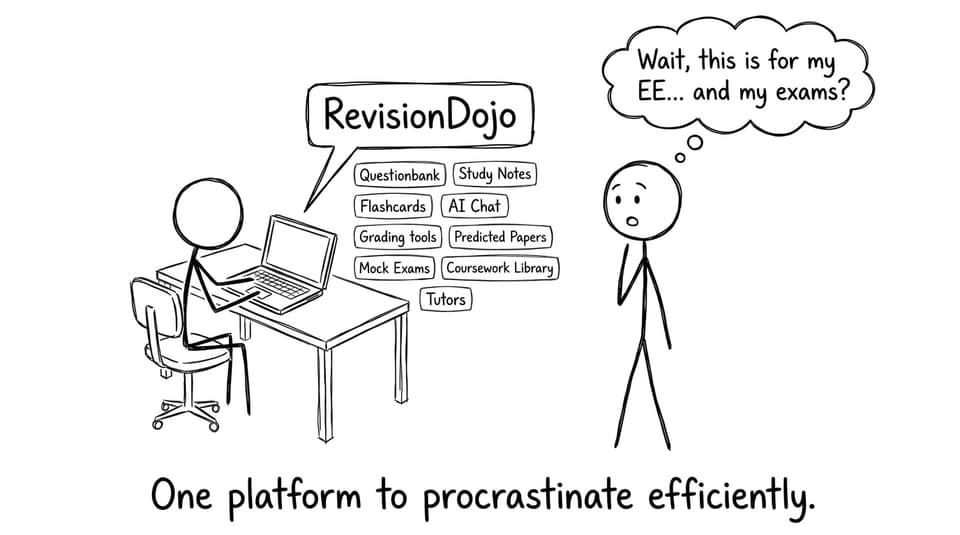
That’s why RevisionDojo is built like an exam-first ecosystem. When your coursework gets heavy, the fastest way to protect your final score is to keep revision tight:
- Questionbank to target weak topics fast.
- Study Notes for clean, syllabus-aligned refreshers.
- Flashcards for daily recall.
- AI Chat when you need an explanation without losing an hour.
- Grading tools to sanity-check drafts against criteria.
- Predicted Papers and Mock Exams to maintain timing under pressure.
- Coursework Library to compare your EE against real exemplars.
- Tutors when a single conversation saves you a week.
You can explore those tools through the Coursework feature hub and then jump back into drafting.
A simple workflow for adapting to the new EE guidance structure
If you want something practical, use this workflow:
Map your EE to the group logic (30 minutes)
Write a short paragraph answering:
- What does this subject group treat as evidence?
- What counts as strong evaluation?
- What would a weak, descriptive version of my essay look like?
- What would a strong, analytical version look like?
Validate your structure against known EE expectations (1 hour)
Compare your outline to RevisionDojo’s how to structure an Extended Essay. You’re looking for coherence: RQ, method, evidence, analysis, conclusion.
Use grading and exemplars to remove guesswork (ongoing)
If you’re in an interdisciplinary route like World Studies, using a rubric tool can reduce uncertainty. RevisionDojo’s World Studies EE grader is a practical way to pressure-test your alignment.
If you’re in Maths, the Mathematics EE grader helps you translate criteria into concrete edits.
The takeaway: learn the new map, then write the same kind of great EE
Yes, the EE subject-specific guidance has changed significantly: the IB consolidated it into subject groups, like one unified set for Individuals and Societies rather than separate subject documents. That’s a major structural shift, and it affects how you find guidance, justify method, and interpret examples.
But here’s the comforting part: the best EE has always been the same creature. A focused question. Evidence that matters. Analysis that proves you can think. Reflection that shows you grew.
If you want to adapt fast without losing exam momentum, use RevisionDojo as your basecamp: start at the Extended Essay guides hub, calibrate using IA/EE/TOK exemplars, and keep your revision sharp with Questionbank, Study Notes, Flashcards, AI Chat, Grading tools, Predicted Papers, Mock Exams, the Coursework Library, and Tutors. Your EE will be better for it, and your final exams will be safer, too.