
The part of your EE you can’t “fake”
There’s a moment in almost every EE where you realize the project isn’t just about the topic anymore.
Maybe it’s when your sources disagree and you have to decide who to trust. Maybe it’s when your data refuses to cooperate. Maybe it’s when you reread your draft and notice you’ve been trying to prove a conclusion you liked, instead of answering the question you asked.
That moment is the real subject of the EE reflective statement.
Q17 asks: What should the reflective statement include? The best answer is simple but uncomfortable: it should include what changed in you, including your thinking, your skills, your judgement, because of the choices you made while researching and writing your EE.
EE reflective statement checklist (what to include)
If you want a fast, IB-aligned checklist for what your EE reflective statement should include, aim to cover these five buckets (evaluatively, not as a diary):
- Learning skills developed that you can use elsewhere (transfer)
- Insights gained from researching and writing (what you now understand that you didn’t)
- Changes in perspective on your topic or question (how your view evolved)
- Impact of choices made during the process (methods, sources, scope, structure)
- Experiences shaping future thinking (what you would do differently next time and why)
A strong EE reflection does not read like “First I did X, then I did Y.” It reads like “I chose Y instead of X, here’s what happened, here’s what that taught me, and here’s how I’d apply it again.”
For broader context on why reflection matters and what examiners reward, see How Reflection Strengthens Your IB Extended Essay.
What the IB is really asking for in an EE reflective statement
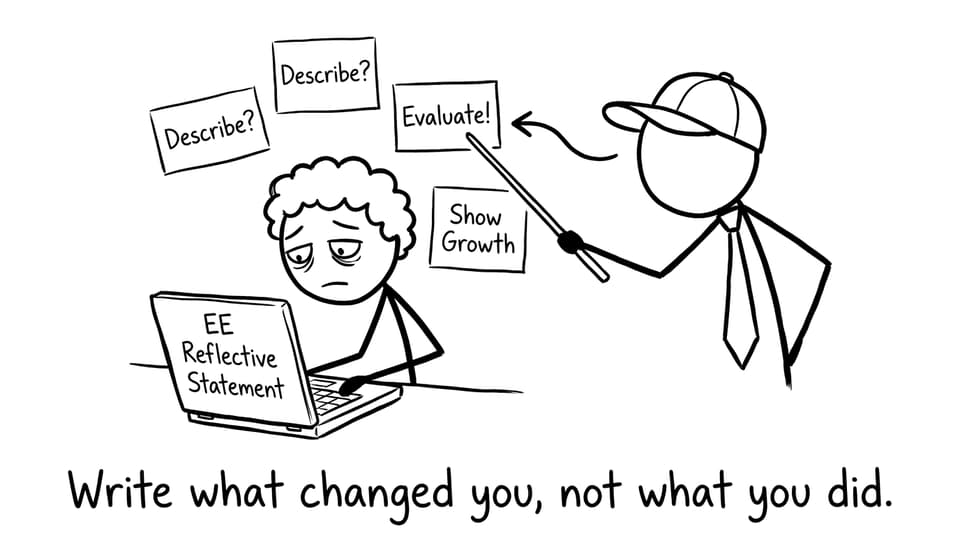
The reflective statement exists to prove engagement: that you owned the project, steered it, and learned from steering it. In other words, the EE isn’t just a product; it’s a thinking process.
A useful mental model:
- Description is the event: what happened.
- Evaluation is the meaning: why it mattered, what you learned, what changed.
- Transfer is the payoff: how you’ll use that learning again.
When you’re unsure what to write, start with one decision you made in your EE that had consequences. Then build outward.
If you want examples of turning challenges into high-mark reflection, use How to Reflect on Challenges in Your IB IA or EE.
What to include: learning skills you can use elsewhere (transfer)
This is one of the most overlooked parts of the EE reflective statement. Examiners love it because it signals maturity: you’re not just surviving an assignment; you’re building a toolkit.
Good transferable learning skills to write about:
- Framing better questions (narrowing scope without losing meaning)
- Source evaluation (credibility, bias, triangulation)
- Method selection (why your approach fits your RQ)
- Planning under constraints (time, word count, data access)
- Revision judgement (what to cut, what to keep, what to rework)
Make it specific. Instead of “I improved my research skills,” try:
- “I learned to rank sources by usefulness rather than prestige, which changed how I build literature reviews in other subjects.”
- “I practiced turning broad curiosity into a testable question, which is now how I start my Biology investigations and my History essays.”
RevisionDojo can help you capture these skills while you work: building a habit of mini-reflections in your notes, then pulling the best ones into the EE reflective statement later. The IB Extended Essay Guide hub is a good starting point if you want subject-specific expectations.
What to include: insights gained from researching and writing
Insights are not just “facts I found.” In a high-scoring EE, insights are shifts in understanding.
Examples of insight types that work well in an EE reflective statement:
- Conceptual insight: “I realized the key concept isn’t X, it’s the relationship between X and Y.”
- Methodological insight: “My early method produced tidy results, but it hid the variable I actually needed to see.”
- Interpretive insight: “Two sources used the same data but argued opposite conclusions; I learned to track assumptions, not just evidence.”
If your insight came from rewriting, mention that. Writing is thinking with friction; the EE reflective statement should show you noticed that.
For help organizing the whole essay so the learning feels coherent, see How to Create an Effective EE Outline for a Logical Flow.
What to include: changes in perspective on the topic
This is where the EE reflective statement becomes more than a compliance exercise.
A strong “change in perspective” usually has three parts:
- Before: the assumption you started with
- Disruption: what challenged it (a source, a dataset, a counterexample, a supervisor question)
- After: the more nuanced view you ended with
Try sentence frames like:
- “I started by assuming ___. After encountering ___, I realized ___.”
- “My initial argument depended on ___. As I reviewed ___, I had to accept ___.”
If you used TOK thinking to spot bias or perspective limits, say so. It’s one of the cleanest ways to show intellectual growth in an EE without sounding dramatic. Helpful guide: How to Use TOK to Enhance Your Extended Essay.
What to include: the impact of choices you made during the process
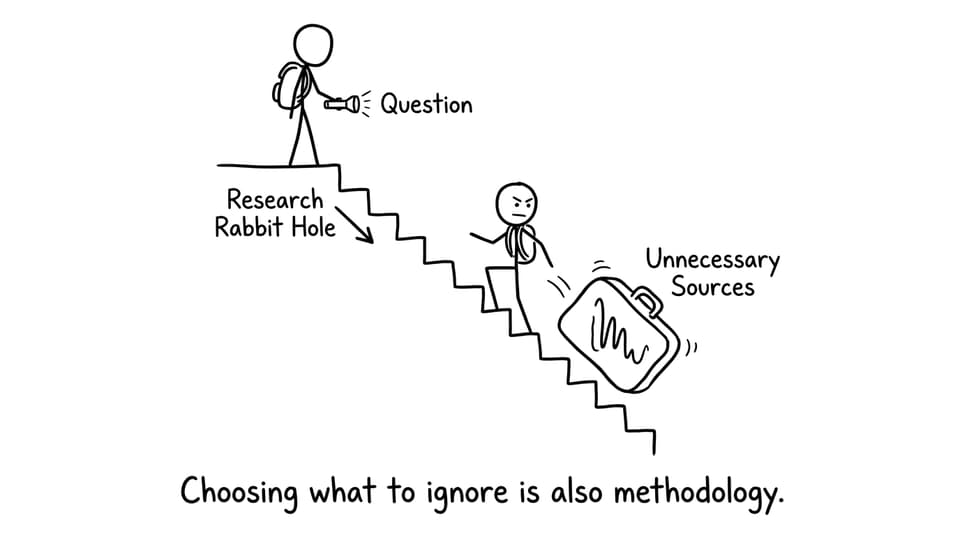
Every EE has trade-offs. Reflection is where you show you can see them.
Write about decisions like:
- narrowing or reframing the research question
- choosing certain case studies (and excluding others)
- switching methods (qualitative/quantitative, different texts, different time periods)
- deciding how to structure the argument
- accepting limitations you couldn’t fix and adjusting claims accordingly
The key is to show consequences. Example:
- “When I narrowed my scope to one region, my argument became deeper, but I lost generalizability. I handled this by tightening my claims and adding a limitations paragraph that matched the evidence.”
If you want to understand what parts of your process typically matter most for the final script, Mastering IB Extended Essays: How to Research, Write, and Revise is a useful roadmap.
What to include: experiences that shape future thinking
This is where you prove “growth and transfer” directly, which is exactly what Q17 is pointing you toward.
Strong future-thinking lines sound like:
- “Next time, I would pilot my method earlier, because I learned late-stage changes cost clarity.”
- “In future research, I will keep a running ‘assumptions list’ and test each one against counterevidence.”
- “I will use supervisor feedback as questions to investigate, not edits to apply.”
If you’re preparing for your final conversation with your supervisor, you can also connect this to how you’ll talk about your learning. Guide: How to Prepare for the IB Extended Essay Viva Voce.
A simple structure you can copy (without sounding templated)
Your EE reflective statement is short, so structure matters. A clean approach is:
Start with one turning point
Name the moment your EE stopped being straightforward.
- A method failed.
- An assumption collapsed.
- Your question changed.
Evaluate the decision you made
Explain why you chose your next step.
Explain what you learned (and how it transfers)
State the skill or insight, then connect it to another context (another subject, university-level research habits, or future projects).
End with what you’d do differently
Not as regret, but as improved judgement.
If you want to keep your reflection tight and focused (and avoid writing 900 words then cutting), it helps to be clear on constraints early. See Mastering the IB Extended Essay Word Count.
Common mistakes that weaken an EE reflective statement
Making it a timeline
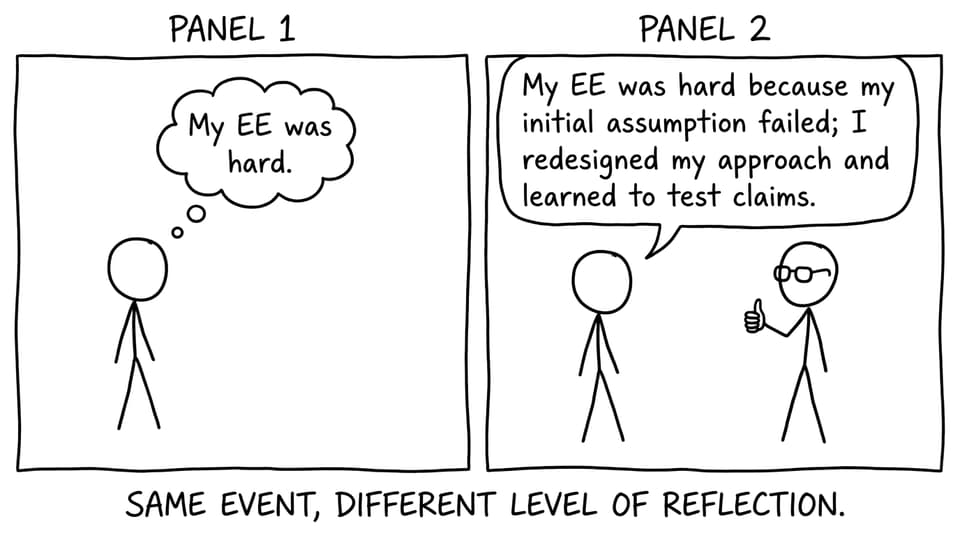
A timeline proves you were busy. It doesn’t prove you were engaged. Your EE reflection must explain reasoning and change.
Only describing emotions
It’s fine to mention stress or confidence, but always connect it to a learning insight: what did the feeling signal, and what did you do because of it?
Hiding the messy parts
The best EE reflections are honest about what didn’t work. You’re not punished for limitations; you’re rewarded for noticing them and responding intelligently.
Listing skills without evidence
Don’t write “I improved critical thinking.” Write the moment you practiced it: the claim you abandoned, the source you rejected, the method you redesigned.
If you’re unsure what “evidence-based reflection” looks like, How to Write IA Reflections That Show Real Growth translates well to the EE.
How RevisionDojo helps you write a stronger EE reflective statement
Most students don’t struggle because they lack growth. They struggle because they didn’t capture it when it happened.
RevisionDojo is built for that moment-to-moment learning:
- Study Notes help you build conceptual clarity so your EE insights aren’t surface-level.
- Flashcards turn key definitions, theorists, and case-specific vocabulary into recall, so reflection time isn’t wasted re-learning basics.
- Questionbank supports exam prep while you write, so the EE doesn’t hijack your entire DP.
- AI Chat can help you generate reflection prompts (not answers) like: “What assumption did I start with?” or “What evidence forced me to revise?”
- Grading tools help you self-check reflection quality and alignment before submission (for example, the RPPF Only Grader).
- Coursework Library lets you compare structures and see what strong academic writing sounds like.
- Mock Exams and Predicted Papers keep your exam readiness moving while your EE is in progress.
- Tutors can guide your revision strategy when you’re stuck between “I wrote something” and “this is actually reflective.”
If you want criterion-aligned feedback workflows at a bigger scale, this is also worth reading: IB EE Feedback Tool: Improve Your Extended Essay Score.
The final test: does your EE reflection show a changed thinker?
If Q17 feels vague, make it concrete: your EE reflective statement should show evidence that the same student who began the project is not exactly the student who finished it.
Not because you became a different person overnight, but because you practiced the rare skill of changing your mind in response to evidence.
If you want to turn that into marks, use your Researcher’s Reflection Space consistently, draft your reflection with the checklist above, and then run a final alignment check with RevisionDojo’s tools. Start with the EE guides, build your confidence with Study Notes and Flashcards, pressure-test your understanding with the Questionbank, and polish the reflection with the Grading tools and AI Chat prompts.
Your EE is already a story. The reflective statement is where you prove it had a point.