
You’ve hit the word limit. Again.
Your cursor blinks at the end of a sentence you’re weirdly proud of, and your brain starts bargaining: What if I just move this into the bibliography? What if I hide it in a footnote? Does any of this actually count in IB?
If you’re an IB student juggling the Extended Essay, TOK essay, and IAs while also preparing for exams, word count rules can feel like a trap door. But this one is straightforward once you know the boundary lines.
Does the bibliography count in IB word count?
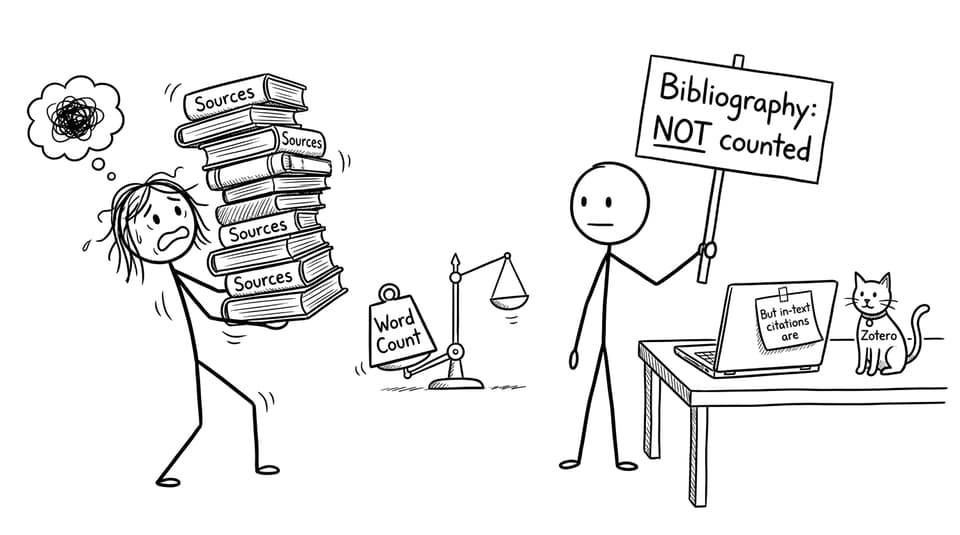
No. In IB assessments, the bibliography (also called references or works cited) is not counted in the official word count for essays like the EE and TOK essay. That’s consistent across official guidance and is reinforced in RevisionDojo’s breakdown of word count expectations.
Still, students get caught because “bibliography doesn’t count” is only half the story. The other half is: plenty of things around the bibliography do count, and some things you might try to use as hiding places are risky.
Quick checklist: what counts (and what doesn’t) in IB
Keep this mental model for any IB written task:
Usually counts toward the IB word count
-
Your introduction, analysis, discussion, and conclusion
-
In-text citations embedded in sentences (because they’re inside your running text)
-
Direct quotations
-
Headings and subheadings (if they’re words on the page)
-
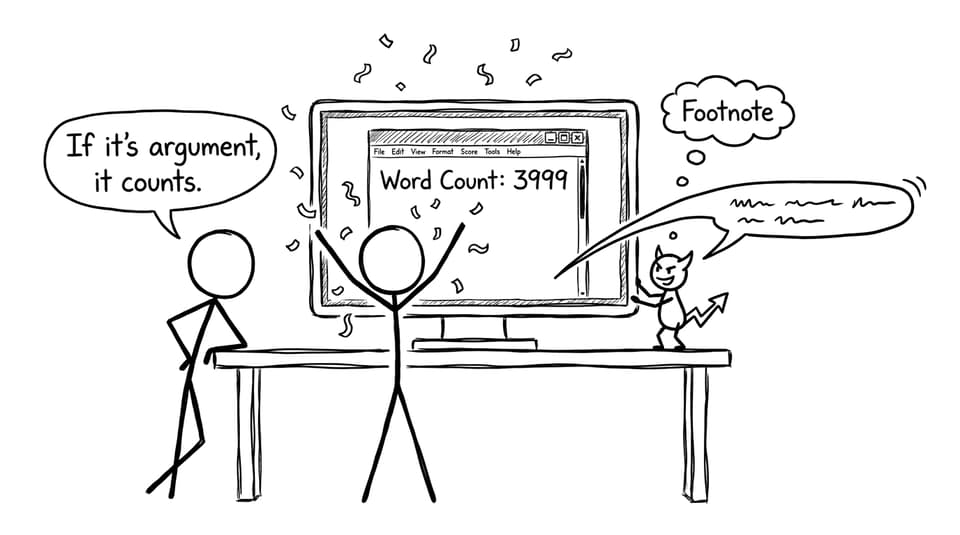
Footnotes/endnotes if they contain real argument
Usually does not count toward the IB word count
-
Bibliography / references list
-
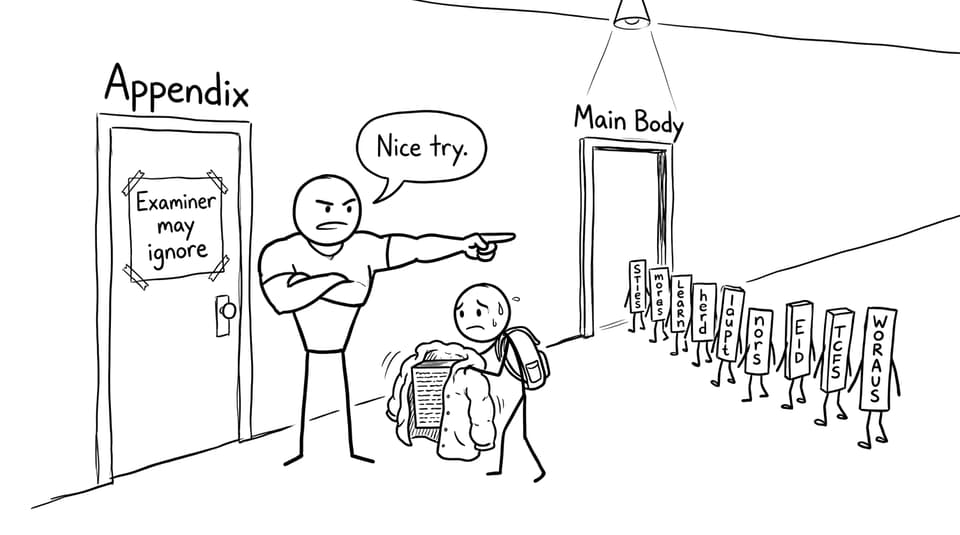
Appendices (but examiners may not read them)
-
Title page, table of contents, page numbers
-
Tables/figures themselves (though captions can be tricky if they include analysis)
For deeper word-limit strategy across coursework, see IB word count rules explained: IAs and Extended Essay.
Why IB excludes the bibliography from word count
The bibliography is where your IB work signals academic honesty: Here’s where my evidence came from, and here’s how you can find it too.
If the bibliography counted, students would be pressured to shrink citations, skip publication details, or “forget” sources to save words. Excluding it pushes you toward better scholarship instead of clever trimming.
But this doesn’t mean the bibliography is “free.” It still matters for credibility, and inconsistent referencing can weaken how trustworthy your work feels to an examiner.
If you want a sharp distinction between the two, read EE Reference List vs Bibliography: Key Differences.
The common trap: confusing bibliography with in-text citations
Here’s the painful twist: the bibliography doesn’t count, but in-text citations often do because they live inside your paragraphs.
So a sentence like:
The results suggest a clear correlation (Nguyen, 2022).
…is part of your running text, and therefore part of your IB word count.
This is why “I’ll just cite less to save words” is one of the worst trades you can make. You might save a tiny number of words, but you increase academic honesty risk and weaken your argument.
RevisionDojo has a practical guide for doing citations correctly without stress: IA Citations: 10 Best Practices for IB EE and IA.
Footnotes and appendices: the places IB students try to hide words
Every IB cohort has a moment where someone tries to stuff analysis into the margins.
Footnotes
If your footnote is purely a citation or a brief clarification, it’s typically treated as outside the word count. But if the footnote is basically a bonus paragraph of evaluation, you’re drifting into “this is part of the argument” territory.
Appendices
Appendices are often excluded from IB word counts, but there’s a bigger issue: examiners are not required to read them. If your crucial reasoning lives there, you’ve made it optional.
For a clear warning on what belongs where, see EE Appendices: What Examiners Will and Won't Read.
How to build a strong IB bibliography (without wasting time)
A calm bibliography is usually built early, not rushed at the end.
-
Choose a citation style (APA/MLA/Chicago/Harvard) and stay consistent.
-
Keep a running “master list” while researching, then trim to what you actually used.
-
Double-check author names, dates, titles, and links.
-
Use a reference manager (Zotero, Mendeley, etc.) if you’re citing lots of sources.
If you’re working on the EE specifically, these RevisionDojo resources help you stay compliant:
Bring it home: treat the bibliography as free space, not free marks
Here’s the clean answer you came for: in IB, the bibliography is not part of the word count.
And here’s the calmer mindset that keeps you safe: don’t hunt for loopholes. Put your best thinking where it will be read, inside the main body, and let the bibliography do its real job: proving your work is honest, precise, and academically grounded.
If you want a system for staying inside IB limits while still writing with depth, RevisionDojo is built for exactly that. Use the Study Notes to tighten subject accuracy, Flashcards to keep definitions sharp, and AI Chat to spot what’s bloated or unclear. When you’re ready to pressure-test your skills, use the Questionbank, Mock Exams, and Predicted Papers to keep exam prep moving alongside coursework. And if you want feedback that mirrors criteria language, RevisionDojo’s Grading tools, Coursework Library, and Tutors help you refine both structure and compliance, without the last-minute word count panic.