
Sometimes the most tempting help shows up right when you’re stuck.
You’re six sources deep, your argument has started to wobble, and someone says, “I know a PhD student in that field. They could mentor you.” In that moment, an external mentor feels like a shortcut out of uncertainty.
But your EE isn’t built to reward shortcuts. It rewards ownership. That’s the quiet truth the IB keeps circling back to: the EE is not just what you write, it’s what you learn by steering the work yourself.
So can an EE student have an external mentor?
Yes, under specific conditions. Your school must agree to the arrangement, you must still have an allocated in-school supervisor, the external mentor must sign a form (included in the appendix), and the mentor must be given clear instructions about the limits of their role. Only the internal supervisor may conduct the reflection sessions and sign the RPF.
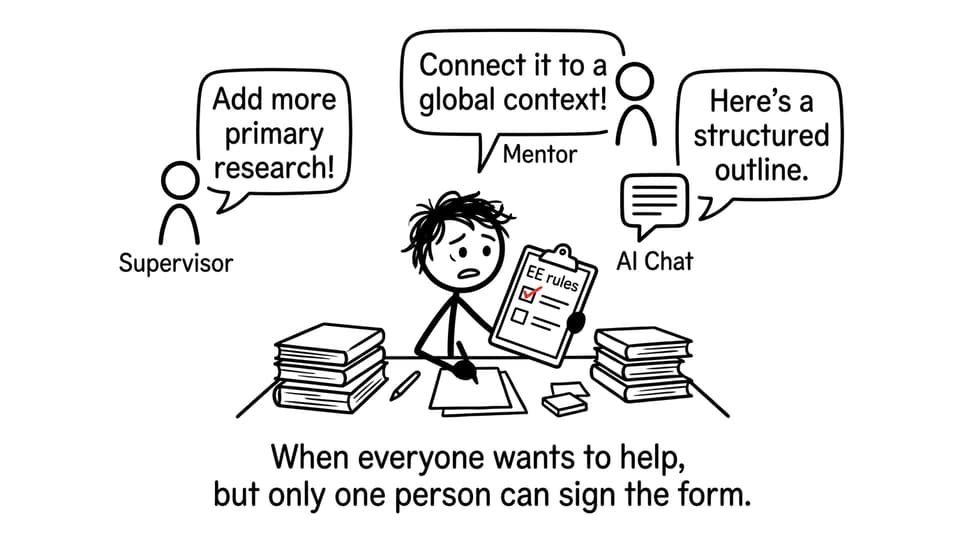
EE external mentor overview (fast checklist)
Use this as your sanity-check before you accept anyone’s help on your EE:
- Your school explicitly approves the external mentor arrangement.
- You still have an in-school EE supervisor assigned.
- The external mentor signs a mentor form that you include in the EE appendix.
- The mentor receives written instructions about what they can and cannot do.
- Your mentor does not run your reflection sessions.
- Your internal supervisor is the only person who conducts reflections and signs the RPF.
- Your work remains authentic: the thinking, structure, wording, and decisions are yours.
If you want to understand what supervisors are responsible for (and why the line matters), see 10 Key Responsibilities of the Extended Essay Supervisor.
What “external mentor” actually means in an EE
An external mentor is someone who isn’t employed by your school but supports your subject understanding or research process for the EE. Think: a researcher, engineer, lawyer, curator, or a university student working in a relevant area.
In the best cases, an external mentor helps in a way that feels like switching on a lamp, not grabbing the steering wheel. They might:
- Explain jargon so you can read higher-level sources.
- Suggest where researchers disagree (helpful for analysis).
- Warn you when a method is unrealistic for 40 hours.
- Help you avoid naive claims by pointing to standard debates.
But the EE is still your school’s responsibility, which is why the school has to approve it and why the in-school supervisor remains central.
If you’re still shaping the core of your topic, start with the IB Extended Essay guides hub and pair it with How to Survive the IB Extended Essay Research Process. Those two resources tend to prevent the most common early-stage spiral: choosing a topic that requires an expert to make it workable.
The non-negotiables: school approval, supervisor, form, and boundaries
The IB’s underlying concern is simple: authenticity. If too much of your EE is shaped by someone else, your reflections stop matching your work, and your voice stops matching your argument.
That’s why your arrangement needs four non-negotiables.
School approval (not “I think it’s fine”)
Your coordinator or school leadership needs to agree to the external mentor. This protects you. If questions ever arise about academic integrity, your school can show that the arrangement was transparent and structured.
You still need an internal supervisor
Even with a mentor, your EE must have an allocated supervisor within the school. That supervisor is the person who ensures your process fits IB expectations, and they are the person your reflections are built around.
If you want to use supervision well (instead of treating it as a once-a-month panic meeting), read How to Improve Your IB Extended Essay Draft.
The mentor signs a form (and it goes in the appendix)
The external mentor must sign a form that is included in your EE appendix. This is the paper trail that clarifies involvement.
The goal isn’t bureaucracy for its own sake. It’s clarity: who helped, how, and under what constraints.
The mentor gets clear instructions about limits
A good mentor wants to be useful. A great arrangement makes it easy for them to be useful without crossing lines.
Your written instructions should make it obvious that the mentor:
- cannot edit or rewrite your draft
- cannot “fix” your structure or argument in a way that replaces your decisions
- cannot tell you exactly what to conclude
- cannot conduct reflection sessions or complete official forms
A mentor who understands boundaries is a gift. A mentor who ignores boundaries is a risk.
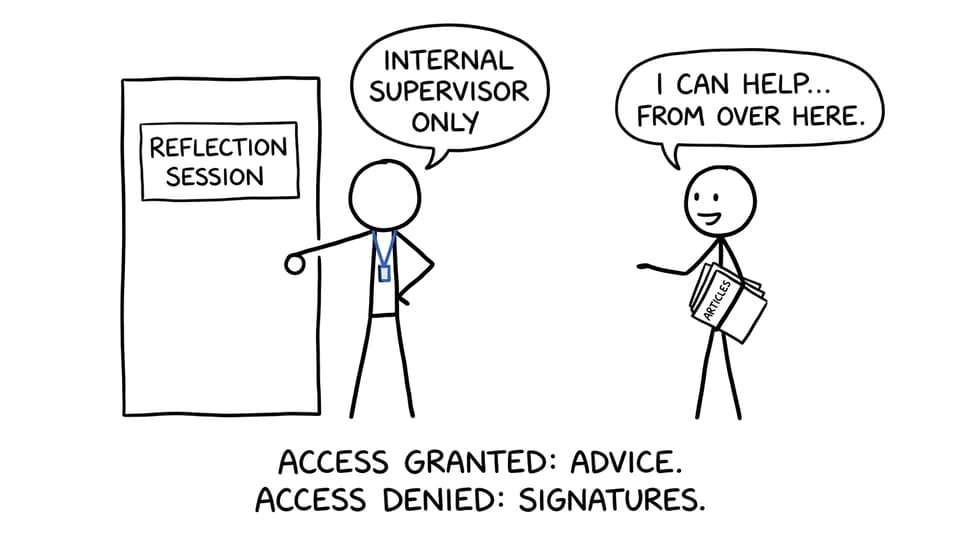
Reflection sessions and the RPF: only your internal supervisor
This point is worth repeating because it’s where students get unintentionally sloppy.
Only the internal supervisor may conduct the reflection sessions and sign the RPF.
Why does the IB care so much?
Because the reflections are meant to capture your planning and progress, guided by the person officially supervising you. If an external mentor runs reflections, it muddies the record. If an external mentor influences what you write in reflections, it becomes hard to tell whether your engagement is authentic.
If you’re anxious about the viva voce or reflection quality, use this as preparation:
- How Reflection Strengthens Your IB Extended Essay
- How to Prepare for the IB Extended Essay Viva Voce
Those resources help you treat reflection as evidence of thinking, not just “something to fill in.”
What an external mentor can do (and what they can’t) in an EE
Students usually ask this question because they want reassurance: “Where is the line?” The line is less about the mentor’s job title and more about whether the work remains yours.
Appropriate external mentor support for an EE
In most schools, these are reasonable ways a mentor might support your EE:
- Concept clarification: helping you understand difficult theories so you can apply them yourself.
- Feasibility feedback: warning you if your proposed method needs equipment you can’t access.
- Direction to broad resources: “Look at journals in X area” (not “Use these 12 sources and quote page 14”).
- General critique questions: “What alternative explanation might a skeptic give?”
- Industry context: explaining how something works in practice, which you then analyze critically.
Not appropriate external mentor support for an EE
These are the common boundary-crossers:
- Editing or rewriting your draft (even “light edits” can become voice replacement).
- Designing your research question for you rather than helping you refine your own.
- Choosing your sources for you in a way that bypasses your own research process.
- Telling you what to argue or handing you an outline that you follow blindly.
- Running official reflection sessions or being involved in signing the RPF.
If you want a clearer sense of what strong sources look like without outsourcing your research, read What Are the Best Sources for IB Extended Essay Research?.
How to set boundaries with your external mentor (scripts you can actually use)
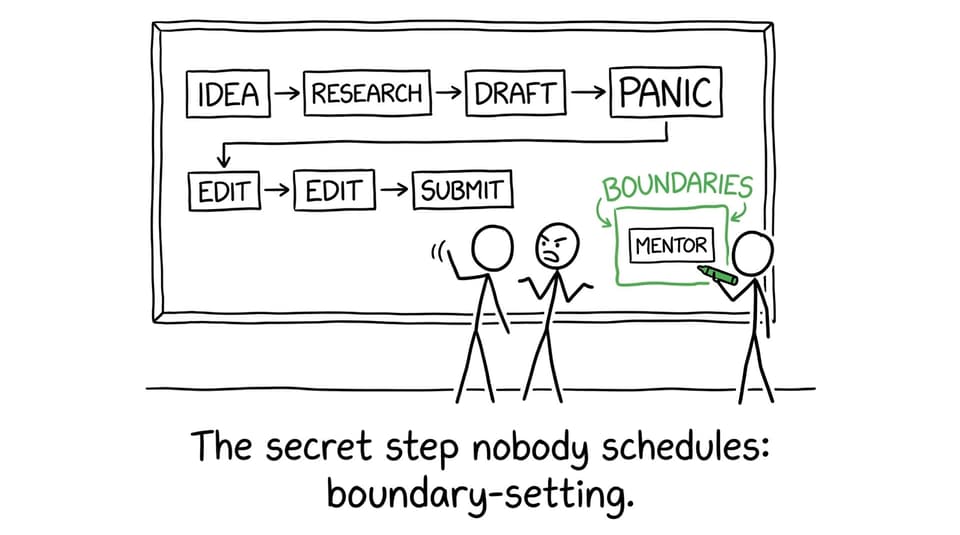
Most boundary problems come from politeness. Students don’t want to say no. Mentors don’t want to be unhelpful. So both drift into a grey zone.
Try these scripts instead.
Boundary script for draft feedback
“Could you read this section and tell me which parts are unclear or unsupported? Please don’t rewrite anything; I I need to keep the language in my own voice for the EE.”
Boundary script for research direction
“If you can, point me toward types of sources or debates I should search for. I’m trying to do the selection and evaluation myself so the EE stays authentic.”
Boundary script for reflection protection
“I can’t involve anyone outside school in reflection sessions or the RPF. If you have advice, I’ll bring it to my supervisor and decide how to act on it.”
Those sentences feel small, but they protect your work.
The exam-prep angle: protecting your time while doing the EE well
You’re an IB student preparing for exams, which means time is not a feeling; it it’s a budget.
The hidden risk of an external mentor is not just academic integrity. It’s time expansion. Meetings multiply. Advice creates new rabbit holes. Your EE begins to behave like a university dissertation, while your timetable insists it’s one component among many.
This is where RevisionDojo can quietly keep your EE contained:
- Use the Study Notes to learn background content quickly without getting lost.
- Use Flashcards to retain key definitions and theorists you need for the EE (so you stop re-learning the same ideas).
- Use AI Chat to clarify concepts at the moment you’re stuck, instead of scheduling another call.
- Use the Grading tools to check your draft against criteria and improve efficiently.
- Use the Coursework Library to compare your structure and academic tone to strong models via IB Coursework Examples: IA, EE and TOK Exemplars.
- Use Tutors when you need human guidance that stays inside clear academic boundaries.
- Keep exam performance moving with Questionbank, Predicted Papers, and Mock Exams so the EE doesn’t steal your final-month momentum.
If you’re also worried about technical compliance, pair your drafting with How to Format Your EE According to IB Guidelines and, for word-count strategy, Mastering the IB Extended Essay Word Count.
A simple “green-yellow-red” test for mentor involvement
When you’re unsure whether something is allowed, use this test.
Green: safe help
- Explaining concepts
- Suggesting broad reading areas
- Asking probing questions
- Offering general feasibility warnings
Yellow: proceed carefully
- Commenting on clarity of an argument (without rewriting)
- Discussing whether your research question is too broad
- Explaining how professionals in the field would interpret data
Red: don’t do it
- Line-editing your writing
- Writing paragraphs for you
- Building your outline and telling you to follow it
- Being involved in reflections or signing the RPF
If you want structured, criterion-aligned feedback without crossing integrity lines, use IB EE Feedback Tool: Improve Your Extended Essay Score.
Closing: the EE is still yours
An external mentor can be a powerful addition to your EE journey, but only when the arrangement is transparent, approved, and tightly bounded.
If you remember nothing else, remember this: the mentor can help you see further, but they can’t walk the path for you. Your school must agree, you must still have an internal supervisor, the mentor must sign the appendix form, and only the internal supervisor may conduct reflection sessions and sign the RPF.
When you’re ready to keep your EE high-quality without letting it consume your exam season, use RevisionDojo as your backbone: the Coursework Library for models, Grading tools for criterion clarity, AI Chat for quick unblocking, and Tutors when you need careful human guidance; plus plus Questionbank, Study Notes, Flashcards, Predicted Papers, and Mock Exams to protect what matters most: your final performance.
Your EE can be supported. It just has to remain unmistakably yours.