


Choosing your IB science can feel like picking a door in a hallway you haven’t walked down yet. You hear opinions at lunch. You read a few forums. Someone says, “Physics is impossible,” and suddenly your future seems to hinge on a single timetable choice.
But the truth about IB Biology, Chemistry, and Physics is quieter: each is difficult in a different way, and the “right” choice is usually the one that matches how your brain likes to work under exam pressure.
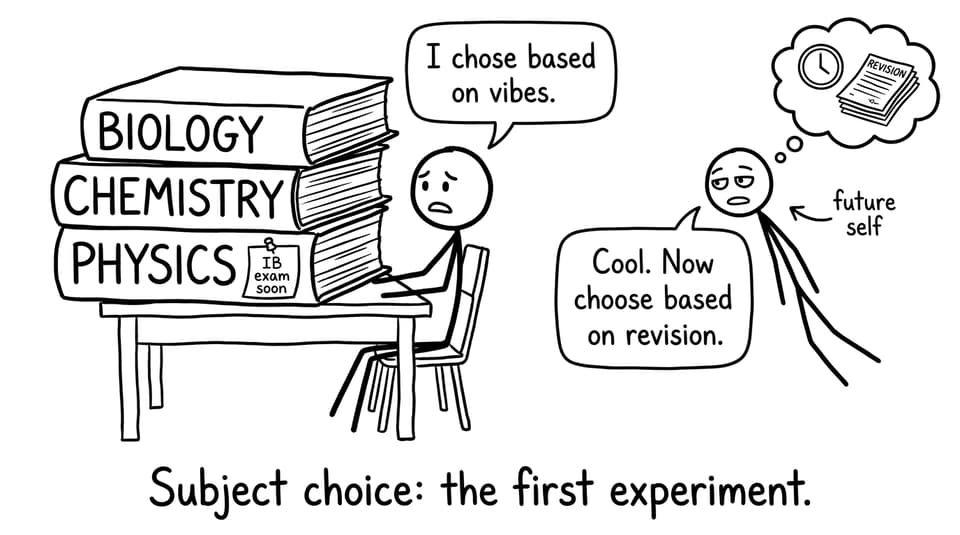
IB Science Choice Checklist (quick, honest, useful)
Before you decide, run this IB checklist:
-
Do you prefer memorising and explaining (Biology), multi-step problem solving (Chemistry), or models + maths (Physics)?
-
Are your university goals likely to require a specific IB science?
-
Do you enjoy lab work, or do you just tolerate it?
-
Can you commit to a weekly routine of Study Notes -> Flashcards -> Questionbank -> timed practice?
If you want broader context on what makes exams feel hard, read How Hard Are IB Exams? A Realistic Guide.
Biology vs Chemistry vs Physics in IB: the clearest comparison
IB Biology
IB Biology is the subject of living systems: cells, genetics, evolution, ecology, and human physiology. It often rewards students who can build clear explanations from detailed content.
Best fit if you like:
-
learning processes and writing them clearly
-
linking diagrams to explanations
-
steady, spaced revision (because forgetting is fast)
Start here: IB Biology Resources and IB Biology Revision Notes (SL/HL).
IB Chemistry
IB Chemistry sits in the middle: conceptual ideas, calculations, and lab precision. Many students find it fair but unforgiving: small method errors can cost marks.
Best fit if you like:
-
structured problem solving
-
practising until steps become automatic
-
learning patterns (stoichiometry, energetics, equilibrium)
Build your base with IB Chemistry - RevisionDojo and sharpen exam technique with Breakdown of IB Chemistry Marking Schemes.
IB Physics
IB Physics is a logic-and-models course. You’re often turning a real scenario into an idealised model, choosing an equation, and executing clean maths under time pressure.
Best fit if you like:
-
algebra and rearranging formulas confidently
-
drawing diagrams and extracting relationships
-
puzzles where understanding beats memorising
Use Physics - IB Resources and the practical advice in IBO Physics: How to Succeed in the IB Physics Course.
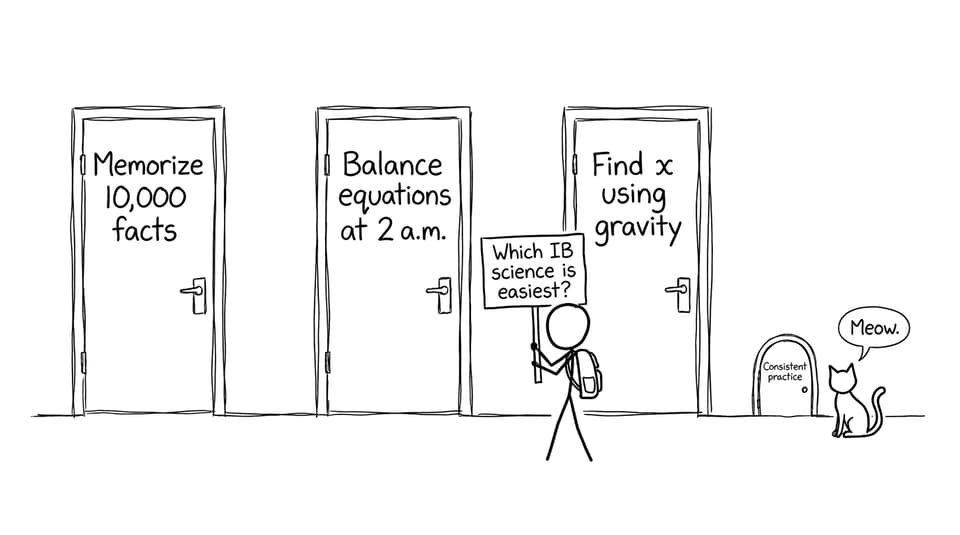
Which IB science is easiest (and why that question backfires)
In IB, “easy” usually means “easy for my learning style.”
-
Biology can feel easiest if you revise little-and-often with Flashcards.
-
Chemistry can feel easiest if you enjoy method marks and repeatable steps.
-
Physics can feel easiest if maths is your comfort zone and you like clean models.
If you’re tempted to choose purely on difficulty, read Which IB Science Is the Easiest? A Detailed Guide and The Hardest Science Subjects in IB: A Comprehensive Guide.
Choose your IB science by university goals (simple guide)
Some degrees treat IB science choices like prerequisites, not preferences.
-
Medicine / biomed: often Chemistry HL, sometimes Biology HL too
-
Engineering / physics: often Physics HL
-
Environmental pathways: often Biology (and sometimes ESS, depending on school)
For a bigger picture, use Which IB Science Subject Has the Best University Recognition.
How to study whichever IB science you pick
The highest-performing IB students look boring in one specific way: they keep the same loop.
-
Study Notes to get clarity fast
-
Flashcards for daily recall (definitions, processes, equations)
-
Questionbank to turn knowledge into marks
-
AI Chat + Grading tools to find what the markscheme wanted
-
Mock Exams + Predicted Papers to train timing and stamina
RevisionDojo is built for this system across sciences: Questionbank, Study Notes, Flashcards, AI Chat, Grading tools, Predicted Papers, Mock Exams, Coursework Library, and Tutors.
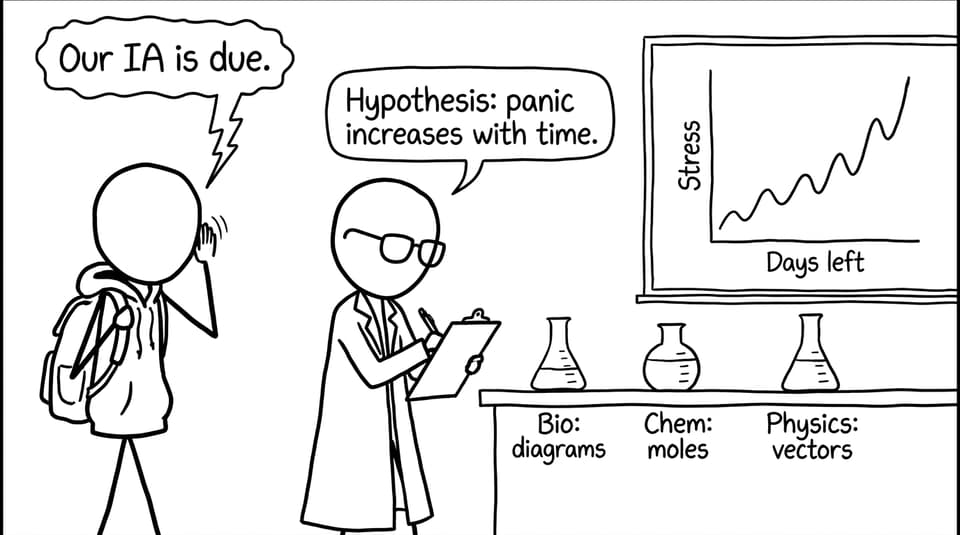
Conclusion: pick the IB science you can practise consistently
The best IB science isn’t the one your friend called “easy.” It’s the one you can revise steadily, practise under time, and improve in week by week.
If you want a calmer way to choose (and then score higher once you’ve chosen), make RevisionDojo your home base: start with Study Notes, lock knowledge with Flashcards, prove it in the Questionbank, then pressure-test with Mock Exams and Predicted Papers. Your IB choice matters, but your IB system matters more.