
Most “easy subject” stories start the same way: someone hears a rumor in a hallway.
A friend of a friend says IB ESS is basically common sense. Another student says it’s “just watching documentaries.” And suddenly you’re picturing a calm two years where you stroll into exams with a reusable water bottle and good vibes.
Then the first timed response hits. The question asks you to evaluate a policy using systems thinking, include a case study, and weigh two environmental value systems. You realize the label “easy” is doing a lot of work.
So, is IB ESS really the easiest IB subject? It can be one of the most manageable choices for the right student. But “manageable” is not the same as “automatic 7.” This guide breaks down what makes IB ESS feel easier, what still makes it challenging, and how to revise for exams with less stress and more strategy.
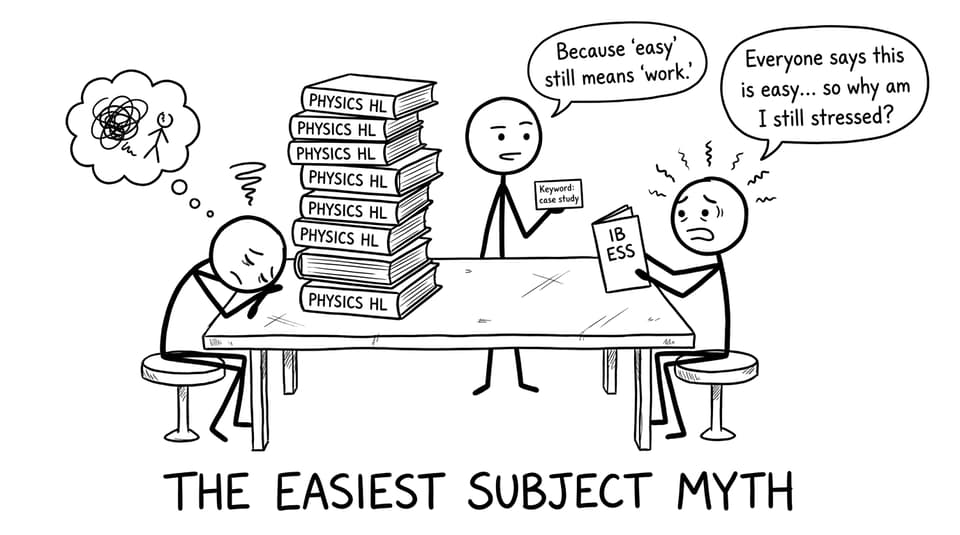
The quick reality check (use this before you choose IB ESS)
If you’re deciding whether IB ESS is your “easiest” option, run this checklist:
-
Do you like switching between science and humanities in the same answer?
-
Can you write clear explanations under time pressure?
-
Are you willing to build a small set of case studies and use them flexibly?
-
Do you enjoy debates about ethics, policy, and trade-offs?
-
Will you start your Internal Assessment early enough to avoid a last-minute spiral?
If you answered “yes” to most, IB ESS often feels lighter than the most technical Group 4 courses. If you answered “no,” the course can feel surprisingly heavy because it rewards synthesis, not memorization alone.
To see the full course structure and where each topic sits, browse the RevisionDojo IB Environmental Systems and Societies resources.
What IB ESS actually is (and why that matters for difficulty)
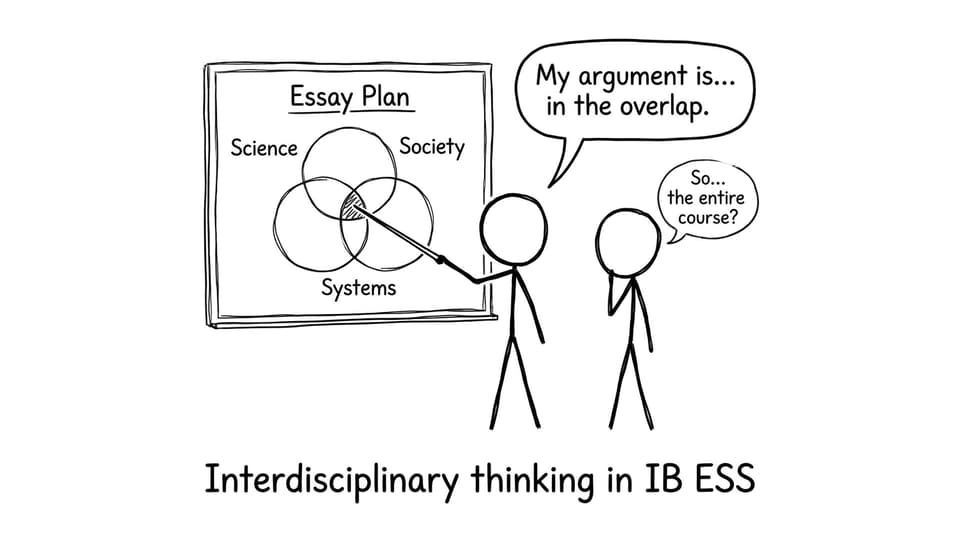
IB ESS is interdisciplinary by design. It asks you to explain environmental systems (flows, storages, feedback loops, energy transfers) and connect them to societies (economics, politics, ethics, cultural values). That blend is the source of its reputation.
For many students, this feels “easier” than a course where every mistake is a wrong calculation or a missed mechanism. In IB ESS, you can often earn marks by:
-
Defining terms accurately
-
Applying a relevant case study
-
Explaining a process in stages
-
Evaluating pros and cons with balance
-
Using systems language clearly
But the same flexibility can be a trap. Because answers are more open-ended, students sometimes write a lot and still miss the command term.
A practical way to keep content clean is to revise topic-by-topic with structured notes and active recall. RevisionDojo’s Study Notes and built-in Flashcards are designed for that exact purpose: short definitions, quick diagrams, and repeatable practice.
Why IB ESS gets called “easy” (the fair reasons)
Less technical math than many sciences
Compared with Physics or Chemistry, IB ESS usually demands less algebra-heavy work. You will still interpret data (graphs, tables, trends), but fewer students get stuck because of a single equation step.
The content is familiar from real life
Pollution, climate change, biodiversity loss, sustainable food systems-these aren’t abstract. Your brain already has opinions and mental images. That familiarity reduces the initial learning curve, especially for Paper 2 essays.
You can reuse a small set of case studies
One strong case study can “travel” across multiple syllabus areas. For example, a water management case can support answers about ecosystems, human systems, and sustainability.
If you want a concrete benchmark for how many examples you truly need, RevisionDojo’s guide IB ESS Case Studies: How Many to Memorize for 2026 is a good compass.
It rewards clear writing, not perfect recall alone
In IB ESS, a calm, structured paragraph often beats a messy brain-dump. Students who are strong in English A skills (planning, evaluation, clarity) frequently find they can climb quickly.
The part nobody says out loud: where IB ESS is still hard
Breadth is real
Because IB ESS touches ecology, resource management, atmospheric systems, and human geography, the content map is wide. The difficulty isn’t one hard concept-it’s the constant switching.
A good fix is to revise by “systems,” not by chapter. Treat each topic as inputs, outputs, storages, and feedback. When you do that, the course stops being random and starts feeling patterned.
You can practice this directly inside RevisionDojo’s Questionbank (so you’re applying ideas, not just rereading). Start with Topic 1 and build outward: Topic 1: Foundation and the linked Topic 1 Questionbank.
Systems thinking is a skill, not a buzzword
Students lose marks when they describe events without showing relationships. Examiners like when you connect human actions to environmental consequences via mechanisms.
That’s why IB ESS can feel “easy to understand” but “hard to score a 7.” Understanding is passive. Scoring is active.
If you’re aiming high, use this as your roadmap: How to Get a 7 in IB ESS (2026 First Assessment).
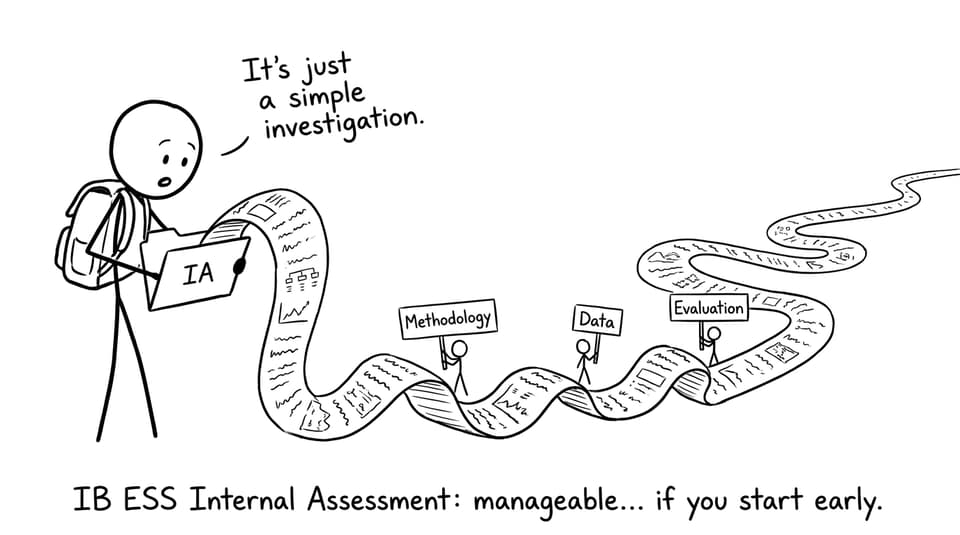
The Internal Assessment can be “easy” only if you respect time
The IB ESS IA is often more flexible than lab-heavy sciences, but that flexibility creates another problem: students delay decisions.
The winning approach is boring but reliable:
-
Choose a measurable question early
-
Collect clean data
-
Explain method limitations honestly
-
Tie everything back to the research question
If you want a rubric-aligned reality check, RevisionDojo’s IB ESS IA Grader turns the criteria into plain English feedback. It’s one of those tools that prevents “I thought it was fine” heartbreak.
Comparing IB ESS to other IB sciences (without the hype)
If your question is really “Should I take IB ESS or Biology/Chemistry/Physics?” the cleanest comparison is assessment style.
-
Physics/Chemistry: high precision, heavy problem-solving, small mistakes cascade.
-
Biology: big content load, strong memorization, clear processes.
-
IB ESS: medium content load, high integration, evaluation + case studies.
That’s why two students can take the same IB ESS class and have opposite experiences. One feels relieved by the writing and real-world relevance. Another misses the certainty of right-or-wrong answers.
If you’re still deciding what “easy” means in Group 4, these RevisionDojo reads help you choose with less guesswork:
How to revise IB ESS for exams (the simplest high-return method)
Build a “12 case study” bank
Don’t chase endless examples. Build a set you can bend to different questions. Use the RevisionDojo case study guide above, then store each case in Flashcards: location, issue, stakeholders, outcomes, evaluation.
Practice command terms like they’re content
In IB ESS, “outline,” “explain,” and “evaluate” are different jobs. Use the Questionbank to train that reflex, then ask AI Chat to critique your response structure and missing evaluation.
Use short timed writing to remove fear
Ten minutes. One question. One plan. One paragraph. Do it repeatedly.
If you want a built-in stream of ESS-focused support, browse All IB ESS posts to revise by weak spots.
So…is IB ESS the easiest IB subject?
IB ESS is often the easiest IB subject for students who enjoy interdisciplinary thinking, can write clearly, and are willing to build a case study toolkit. It’s rarely the easiest for students who want neat certainty, dislike evaluation, or hope to “wing it.”
If you want the version of IB ESS that actually feels manageable, build your revision around RevisionDojo: the Questionbank for exam rhythm, Study Notes for clarity, Flashcards for active recall, AI Chat for feedback, Grading tools for your IA, plus Predicted Papers, Mock Exams, the Coursework Library, and Tutors when you need a human to tighten your strategy.
“Easy” is mostly a story people tell to feel safe. IB ESS rewards students who replace that story with a plan.