



The day you realize the IB markscheme isn't judging you
The first time most IB students meet a markscheme, it feels personal. You wrote a whole paragraph, you knew the topic, you even used some fancy words, and the marks still come back lower than expected. It's tempting to conclude the system is picky, inconsistent, or secretly designed to humble you.
But behind the scenes, IB markschemes are less like a teacher's vibe-check and more like a safety railing on a mountain path. Examiners are trained to look for visible evidence that you did the thinking the question asked for. Your job isn't to sound smart. Your job is to make the marks easy to award.
That's the quiet shift that changes everything: once you understand how an IB markscheme is built and used, you stop "answering" and start scoring.
Quick checklist: what the IB markscheme is really doing
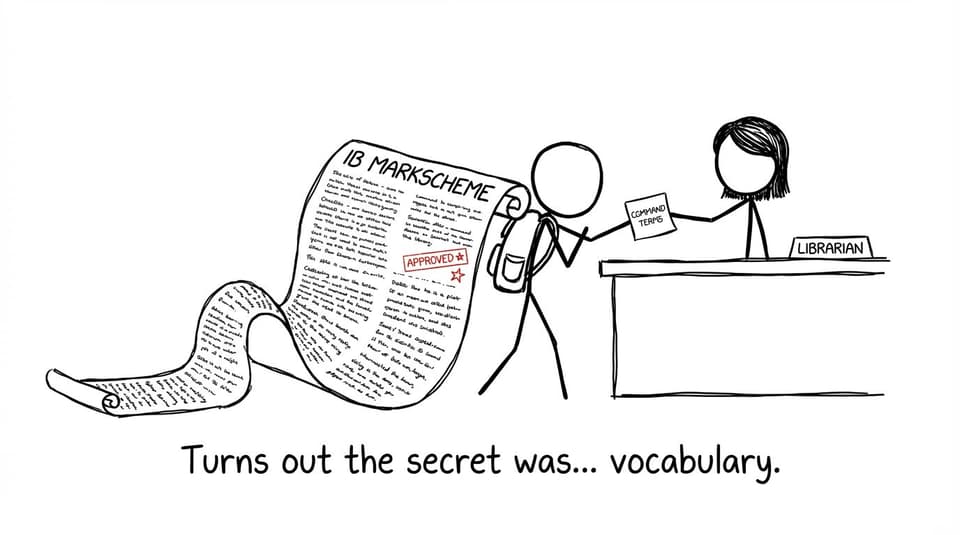
Before we go behind the curtain, here's a practical checklist you can keep in your head during IB exam practice:
- Identify the command term (define, explain, evaluate, compare, justify).
- Decide what the markscheme likely needs: a list, a chain of reasoning, or a judgement with evidence.
- Write in "mark-ready" units: one point per sentence when possible.
- Use subject language precisely (especially in Sciences and Math).
- Show method/working when marks can be awarded for process.
- Make evaluation explicit: claim + evidence + implication/limitation.
If you want a place to practice this without guesswork, build answers in RevisionDojo's Questionbank and check your patterns using its Grading tools and AI Chat feedback loop.
What an IB markscheme is (and what it isn't)
An IB markscheme is a scoring guide that helps different examiners award marks consistently. It is not a model essay, and it is rarely a full list of every acceptable idea a student could write.
In most subjects, an IB markscheme includes some combination of:
- Marking points: specific bits of content that earn credit.
- Alternative answers: other acceptable phrasings or approaches.
- Notes to examiners: what to do if the student does X, or if the question can be interpreted in Y way.
- Level descriptors (for extended responses): what a 3 vs a 5 vs a 7-quality response looks like.
This is why two answers that "feel similar" can score differently in the IB: one answer shows the examiner clear, scorable evidence; the other implies it.
Behind the scenes: what examiners are trained to do
Most IB students imagine an examiner reading like a literature critic. In reality, examiner training prioritizes standardization. They are trained to:
- Apply the markscheme as written.
- Use "positive marking" (award what is clearly demonstrated).
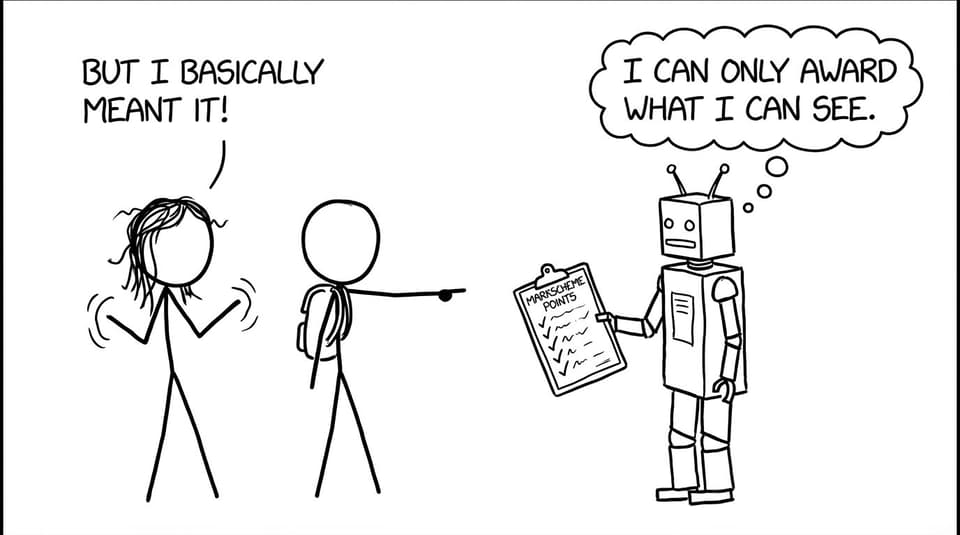
- Avoid guessing what you meant.
- Maintain consistency across thousands of scripts.
That last point is the hidden pressure. Consistency is the entire game in IB assessment. A markscheme is designed to make sure your grade depends more on what you wrote than on who happened to read it.
The practical implication: you should write answers that are hard to misunderstand.
"I basically meant it" doesn't score in IB (visibility matters)
A good mental model is this: an IB markscheme can only award what it can see.
If a question expects a cause-and-effect chain, you can't hint at it. If it expects a comparison, you can't describe two things separately and hope the examiner connects them. If it expects evaluation, you can't just say "this is significant" without showing why.
This is why command terms are the doorway to marks. If your answer doesn't match the command term, you can be factually correct and still undershoot the markscheme.
RevisionDojo students often improve fastest by drilling command-term style responses in the Flashcards feature, then immediately applying them in timed sets in the Questionbank.
Two kinds of markschemes you'll meet in the IB
Point-based markschemes (short answers, structured questions)
These are common in IB Sciences, Math, and many short-response items. They are built from discrete marking points.
How to write for them:
- Use short, clean sentences.
- Aim for one idea per line.
- Include units, definitions, and key terms.
- Show substitutions and intermediate steps when method marks exist.
Level-based markschemes (extended responses, essays, evaluations)
These appear in many IB humanities, language papers, and longer science responses. Instead of hunting for five isolated facts, the examiner matches your response to descriptors like:
- Focus and relevance
- Quality of explanation
- Use of evidence
- Balance and judgement
- Structure and clarity
How to write for them:
- Make your line of argument explicit.
- Use evidence in a predictable pattern.
- Signal evaluation (strengths, weaknesses, limitations).
- Write topic sentences that tell the examiner what the paragraph is doing.
The secret sauce: method marks, follow-through, and "ecf"
One of the most misunderstood parts of IB markschemes is how they reward process.
Method marks
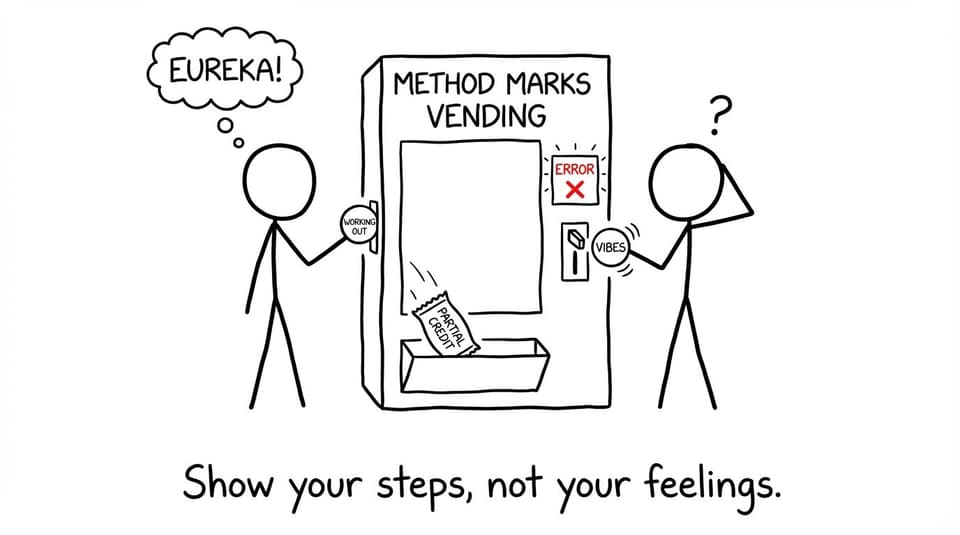
In many quantitative questions, marks are awarded for how you approach the problem, not just the final value. That's why neat working can be a scoring strategy, not just good manners.
Error carried forward (follow-through)
In some markschemes, if you make an early slip but then use your incorrect value consistently and correctly, you can still gain follow-through marks. This is the markscheme acknowledging that the underlying method may be sound.
How to use this in practice: don't abandon a question because you think you made a mistake. Keep going cleanly. The IB markscheme often has room for you.
Why "extra information" can sometimes lose you marks
Many IB students respond to uncertainty by writing more. More context, more facts, more side explanations. Sometimes that works. Often it doesn't.
A markscheme can include instructions like "do not award if…" or it can penalize contradictions indirectly. If you write something correct, then later write something that conflicts with it, you create doubt.
A better strategy is controlled completeness:
- Answer exactly what was asked.
- Add only the next most useful sentence.
- Stop when you've clearly hit the likely marking points.
RevisionDojo's Mock Exams and Predicted Papers are especially useful for practicing that discipline under time pressure, so your answer stays markscheme-shaped.
What "evaluation" really means to an IB markscheme
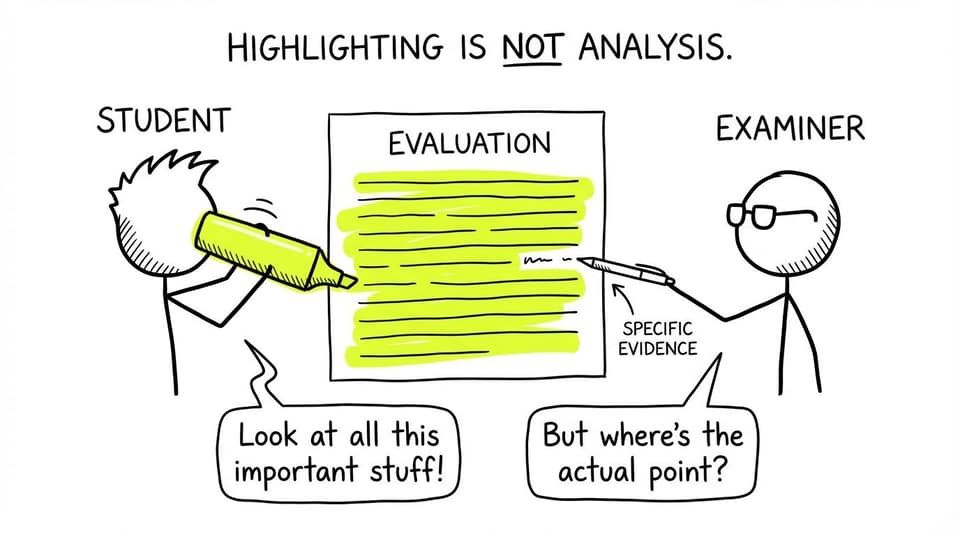
In the IB, "evaluate" rarely means "give an opinion." It means "make a judgement using criteria and evidence."
A markscheme-friendly evaluation tends to include:
- A clear claim (what's better, more valid, more significant).
- Evidence (data, examples, theory, or case study material).
- A limitation or counterpoint (what would change your judgement).
- A final decision (so the examiner knows you actually evaluated).
Students often think evaluation is about sounding nuanced. The markscheme treats it as a structure you can see.
How to reverse-engineer an IB markscheme when you don't have it
Even when you can't see the exact markscheme, you can infer what an IB markscheme likely rewards by asking three questions:
- How many marks are available (2, 4, 7, 10)? That suggests how many distinct points or how deep the response must be.
- What is the command term? That determines the response shape.
- What content is "core" to the syllabus expectation? That's usually what earns marks first.
Then write your answer in a way that makes marking points obvious. If you want a fast feedback loop, RevisionDojo's AI Chat can help you test whether your answer contains scorable points or just general description.
Using RevisionDojo to train markscheme instincts
Markscheme skill is pattern recognition. The IB rewards students who can repeatedly produce scorable units of thinking.
A simple training stack inside RevisionDojo looks like this:
- Use the Study Notes to build precise definitions and core explanations.
- Drill recall and command-term language with Flashcards.
- Apply under constraints with the Questionbank (topic-by-topic, then mixed).
- Use Grading tools to spot where your responses become vague.
- Simulate pressure with Mock Exams and Predicted Papers.
- If coursework is part of your load, use the Coursework Library to see what "criteria language" looks like in practice.
- When you're stuck, book targeted help with Tutors.
This is how you stop treating the IB markscheme as a mystery and start treating it as a map.
Closing: make the IB markscheme your ally
Once you see how an IB markscheme works behind the scenes, it stops feeling like an arbitrary gatekeeper. It becomes a predictable system: show the right thinking, in the right shape, with the right level of precision.
If you want that predictability to show up on exam day, build it into your practice. Use RevisionDojo to train the habits that markschemes reward: crisp marking points, clean method, explicit evaluation, and calm structure. The IB isn't asking you to be perfect. It's asking you to be clear.