

The uncomfortable truth about a 7 in IB
In IB, there's a specific kind of panic that shows up around March or April. It's not the panic of students who haven't studied. It's worse. It's the panic of students who have studied. The ones with color-coded folders, rewritten notes, and a calendar that looks like a losing game of Tetris.
They're doing the hard work. And yet their grades don't move.
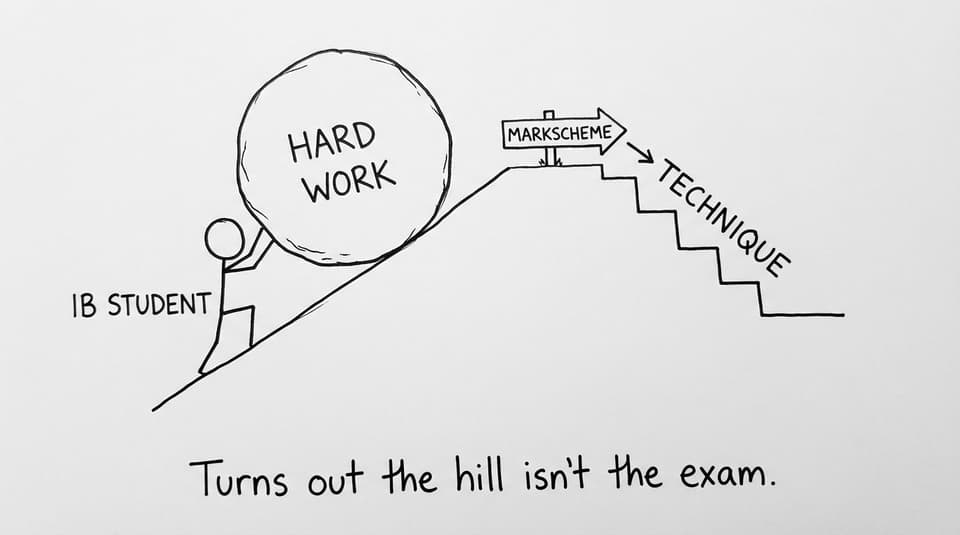
That's the moment when the real lesson of IB arrives: hard work is not the same thing as useful work. A 7 is rarely a reward for effort. It's a reward for alignment. Alignment with the assessment model, the markscheme logic, the command terms, and the quiet constraints of time.
If you've ever walked out of a timed IB paper thinking, "I knew that… why couldn't I show it?" this is for you.
The 7 checklist (what actually changes your grade)
Before we get reflective, get practical. If you're aiming for a 7 in IB, your weekly revision needs these elements:
- Syllabus-aligned understanding (so you stop revising the wrong things)
- Active recall (so knowledge becomes retrievable under stress)
- Exam-style questions (so you learn the IB patterns)
- Feedback loops (so you fix what the markscheme punishes)
- Timed practice (so your brain learns to think fast and clean)
- Coursework calibration (so IA/EE/TOK marks don't quietly cap your total)
RevisionDojo is built around this exact loop: Study Notes for clarity, Flashcards for recall, a Questionbank for exam-style practice, Jojo AI Chat and Grading tools for feedback, and Mock Exams plus Predicted Papers for timing and realism.
If you want the big-picture workflow in one place, keep this open as your "home base": RevisionDojo App: The Smarter Way to Prep for IB Exams.
Why hard work fails in IB (it's not moral, it's mechanical)
Hard work fails in IB for the same reason running laps doesn't automatically make you better at basketball. Fitness helps, sure. But the game is still about decisions, patterns, and execution.
IB grades are not a measurement of how much you tried. They're a measurement of how reliably you can do three things:
- Recognize what the question is asking (command term + context)
- Select relevant knowledge fast (not everything you know)
- Express it in the markscheme's shape (structure, key phrases, justification)
Most "hard-working" revision methods train the wrong muscles.
The trap: time spent feels like progress
Rewriting notes, making aesthetic summaries, and re-reading chapters all create the warm feeling of being busy. But IB papers don't reward "familiarity." They reward retrieval and application.
That's why students can spend 4 hours "revising" and still freeze on a 6-mark question.
If you're still building your foundation, use syllabus-aligned notes instead of endless rewrites. Start here: Digital IB Study Notes: Access Anywhere, Anytime and the notes hub: IB Notes -- Comprehensive Revision Guides.
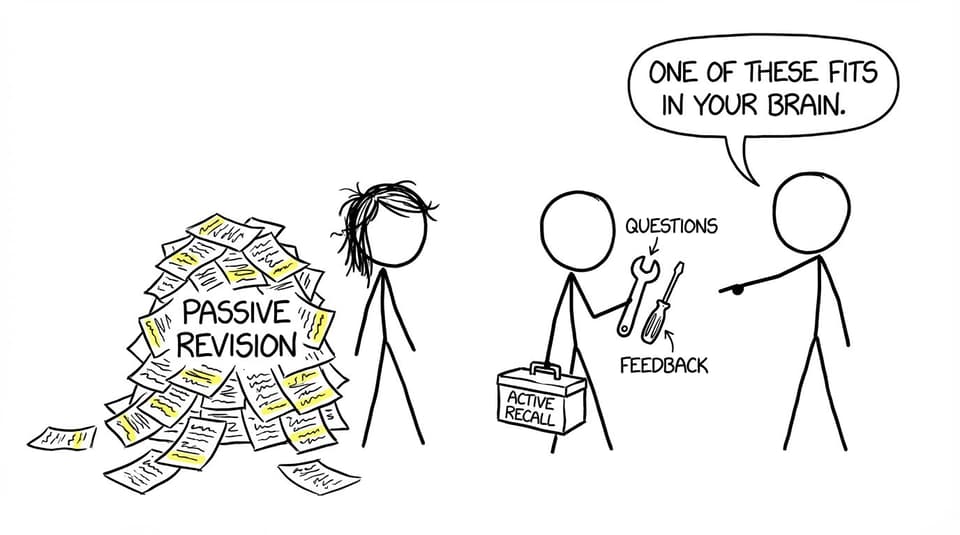
IB rewards feedback, not effort
A 7 is usually built from a string of small, slightly embarrassing moments:
- you answer something confidently
- you get it wrong
- you learn why it was wrong
- you don't repeat that mistake under timed conditions
That middle step is what most students skip.
They do work, but they don't do work with feedback.
The markscheme is the "boss" of IB
In IB, you can be correct in a general sense and still lose marks. Because correctness isn't the only target. The target is mark allocation. The markscheme is not judging your intelligence. It's judging whether you hit specific criteria in limited space and time.
This is why a Questionbank is not optional if you're chasing a 7. It's how you learn the "shape" of high-scoring answers.
Use: Questionbank | RevisionDojo and, if you want a deep dive into why this matters, read: Comprehensive IB Question Bank: Thousands of Practice Questions.
Hard work without exam technique is just rehearsal for stress
Exam technique sounds vague until you notice it everywhere:
- writing too much for low-mark questions
- misreading command terms like "evaluate" vs "describe"
- giving correct content with no justification
- getting stuck on one question and donating time to the rest of the paper
In IB, technique is the difference between "I know this" and "I scored this."
Build technique the way athletes build form
Athletes don't train form at full speed first. They train slowly, with feedback, then gradually add intensity.
Do the same:
- Start untimed: focus on structure and markscheme language
- Add constraints: short timed sets (15--25 minutes)
- Then simulate: full paper timing using Mock Exams and Predicted Papers
This is exactly the progression recommended in How to Study for IB Exams: Step-by-Step Guide.
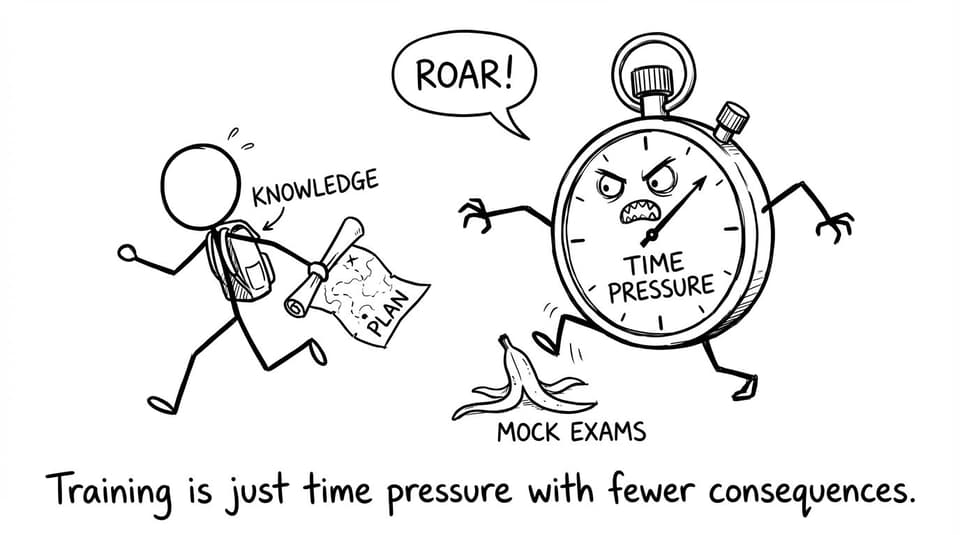
Timed practice is where a 7 is actually decided
The most honest moment in IB prep is a timer.
Under a timer, your "knowledge" turns into behavior:
- Can you start quickly?
- Can you decide what to leave out?
- Can you keep your handwriting and structure readable?
- Can you recover after a hard question?
Most students don't lose a 7 because they're missing content. They lose it because time pressure makes them messy.
Use timed simulations early, not as a last-minute "confidence check." In RevisionDojo, that's what Mock Exams and Predicted Papers are for: they turn anxiety into data.
If you're in a subject that offers predicted sets, explore an example like IB Biology Predicted Papers or IB Physics Predicted Papers.
The "quiet" way students cap their IB score: forgetting daily recall
There's a boring truth about IB: the winners aren't always the ones who do heroic study sessions. They're the ones who don't forget.
Forgetting creates re-learning. Re-learning steals time. Then you compensate with longer sessions. Then you burn out. Then you revise less effectively. The cycle looks like hard work, but it's mostly leakage.
Flashcards are not a personality trait, they're a system
Used well, flashcards are a small daily tax you pay to avoid a giant finals-season bill.
RevisionDojo's Flashcards (including Jojo AI-powered generation) are built for exactly this kind of daily maintenance: short sessions that compound. If you want to set it up properly, use: IB Flashcard System: Active Recall for Better Memory.
IB is also coursework -- and "hard work" can still miss the rubric
A lot of students treat coursework like a separate universe: do the IA, do the EE, survive TOK, move on.
But coursework isn't just a requirement. It's a scoring opportunity, and it has its own version of the "hard work trap." You can spend 40 hours and still lose marks for:
- unclear research question framing
- weak evaluation language
- missing criterion-specific elements
- structure that doesn't match the rubric
This is why Grading tools matter. Not because you want someone else to do your thinking, but because you want your effort to land on the rubric.
Use: IB Coursework Grader | RevisionDojo. Pair it with Jojo AI Chat to ask targeted questions like: "Which criterion am I under-serving?" or "What would make this evaluation more explicit without adding fluff?"
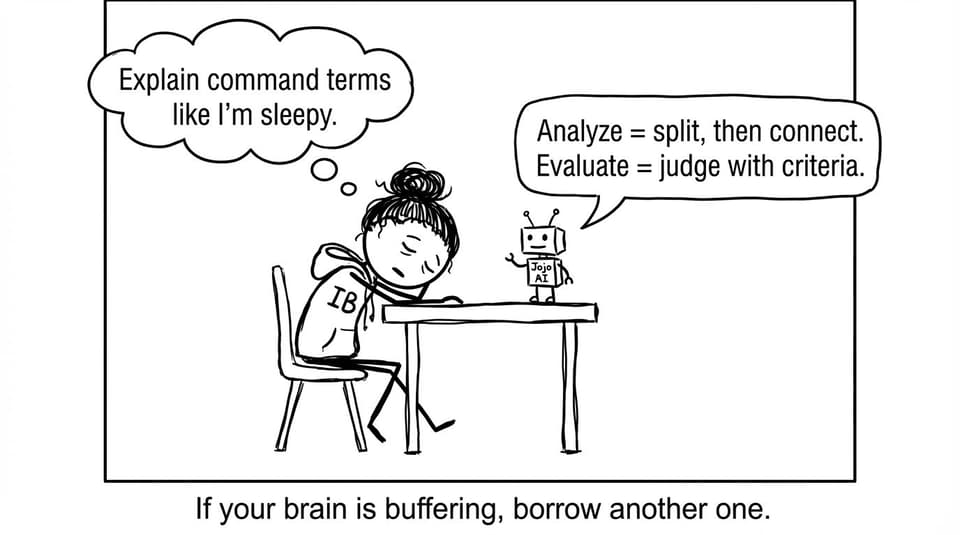
A simple weekly system that turns hard work into 7-level work (IB)
Hard work becomes powerful when it's pointed in the right direction. Here's a calm weekly structure you can run for any IB subject:
Two sessions for understanding (low stress, high clarity)
- Use Study Notes to learn one topic properly
- Ask Jojo AI Chat the questions you usually postpone
- Create or review Flashcards the same day
If you need a starting point for what resources exist and how they connect, keep this bookmarked: International Baccalaureate (IB).
Three sessions for application (where grades move)
- Do targeted sets in the Questionbank
- Tag mistakes for review
- Re-do similar questions 48 hours later (same concept, new prompt)
One session for timing (where 7s are separated)
- Run a timed section using Mock Exams or Predicted Papers
- Review with the markscheme mindset: "What did they want?"
- Write a short "mistake rule" (one sentence) for next time
Optional: one coursework calibration block
- Upload one chunk to the Coursework Grader
- Fix the top 3 rubric issues
- If you're still stuck, use Tutors for one focused session instead of weeks of guessing
This system is not glamorous. That's the point. IB rewards the students who build a feedback loop, not a mood.
Closing: in IB, effort needs a direction
Hard work is noble. It's also common.
What's rare in IB is hard work that is calibrated: work that talks to the markscheme, rehearses command terms, and gets faster because it's measured.
So keep your work ethic. Just stop spending it on tasks that don't pay marks.
Build the loop: Study Notes for clarity, Flashcards for recall, Questionbank for exam patterns, Jojo AI Chat and Grading tools for feedback, Mock Exams and Predicted Papers for timing, and the Coursework Library and Tutors when you need examples or a human guide. That's how RevisionDojo helps IB students turn genuine effort into a 7-level result.
If you want to start today, open the RevisionDojo for IB hub, pick one topic, and do one tight cycle: notes -- flashcards -- questions -- feedback. In IB, that's what progress looks like.